
9 Habits of People Who Never Complain About Getting Older

Waiting for the crosswalk light, you glimpse yourself in a dark storefront window — and for one heartbeat, the creases fanning out from your eyes belong to a stranger.
Most aging advice frames the calendar as an opponent to outsmart with pricey serums or relentless cheerfulness. Yet a small slice of people seem completely untouched by that low-grade dread.
You will never hear them talk about rewinding time, and a birthday gets about as much ceremony as an ordinary Tuesday. Their secret is not superior genetics or dogged denial — it is a particular set of psychological habits that changes the way time registers in the body.
Two Approaches to Time
⚠️ What drains you
- Measuring today against your twenties
- Joking about your “failing” memory
- Working out purely from fear
- Only befriending your own generation
🌱 What steadies you
- Treating today’s capacity as simple fact
- Answering age questions with calm neutrality
- Keeping friendships across generations
- Accepting each day without theatrics
When the Calendar Stops Feeling Like an Enemy
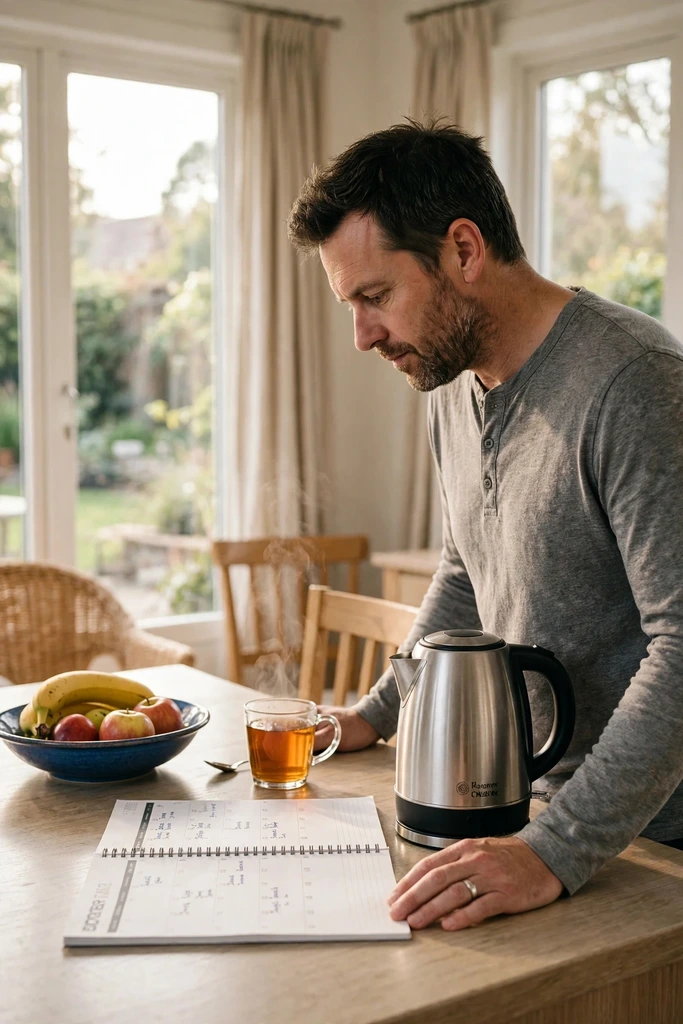
Someone leans on the kitchen counter waiting for the kettle, laughing a little as their knees crack — as though an ordinary joint sound were a personal insult from the universe. Our culture insists every decade deserves a formal grieving period for the body you used to have, as if time were a fund manager quietly liquidating your assets.
Once you accept that story, each stiff joint or blanked-on name starts looking like proof of a one-way slide into irrelevance — ordinary biology recast as a character flaw. The people who stay serene about aging have simply thrown out that whole baseline comparison; they refuse to keep score against a self that no longer exists.
Instead they measure themselves against what they want to get done next Tuesday, not what they could do at twenty-five — and that one change of reference point breaks the loop of endless self-auditing. The shift is not just philosophical: it steadies stress hormones, deepens sleep, and changes how the nervous system meets small physical friction during the day.
Next time you catch yourself filing a new ache under “decline,” try saying aloud that your body is just carrying the mileage of a full life. Feel what happens to your breath when the calendar stops being an eviction notice and becomes what it actually is — a logbook of everything you have lived.
At a Glance: The Aging Resilience Framework
⏱️
Rhythm
Daily practice
🧠
Focus
Present usefulness
🛡️
Shield
Clear boundaries
🌱
Result
Quiet clarity
1. They Quit Measuring Today Against Yesterday

After a long weekend hike leaves your knees grumbling for two days, it is tempting to announce that you are losing your edge.
Stacking your current body against an earlier model is the main engine of aging fatigue — it turns every natural shift into a personal charge sheet.
People who never grumble about age simply treat today’s capacity as a neutral fact, not a bereavement. If the body asks for an extra hour of rest, they give it — no inner courtroom drama about what it portends.
One honest exception: sometimes pain or sudden exhaustion is a genuine signal of injury that deserves a doctor, not stoicism. The test is simple — does it ease with ordinary rest, or does it persist as a sharp, localised alarm?
The replacement habit is blunt: register the friction, adjust the plan, and skip the commentary track entirely.
💡 Tip: State the adjustment aloud like a weather report — neutral, brief, with no apology and no grievance attached.
💡 Pro Tip
End the Comparison Game for Good
Grading today against ten years ago is a rigged test — you can only lose. The only baseline that exists is the one you woke up with this morning.
2. They Won’t Perform Aging for an Audience

A few seconds of self-mocking humor can buy a whole table of relatives a comfortable laugh.
You are at a family dinner, someone teases about “senior moments” after a misplaced set of keys, and you feel the pull to play along so nobody feels awkward.
That unspoken deal — we all agree to act old together — is a quiet trap. Every round of it rehearses decline as your identity, and the mental tiredness compounds.
People who stay sharp simply do not join the chorus about fading memories and creaking joints. When the table starts swapping aches, they steer toward something happening next month instead.
Next time the room reaches for an age joke, let the pause hang for one beat — then ask a forward-looking question about an upcoming trip or project.
Social Friction — At a Glance
🗣️ The trap
Jokes about your own decline
🛡️ The move
A calm change of subject
🎯 The payoff
Attention stays protected
Key rule: Never laugh at your own body’s expense.
3. They Treat Exercise as a Trade, Not a Punishment

The usual advice says stretch every day and hit the gym so you can “stay young” — which quietly frames each workout as a frantic attempt to turn back time. That framing curdles over the months, because you are moving out of dread rather than desire.
Calm agers treat movement as a straightforward exchange. You lift or walk this morning so you can haul your own groceries next year — not because a number on a chart has you frightened.
Seen as a clean transaction instead of an emotional war, exercise stops stockpiling burnout. An hour of motion today purchases independence tomorrow, and you can finally drop the fantasy that sweat alone can freeze the calendar.
⚠️ Common Mistake
Don’t Train From Panic
Working out to outrun time is a guaranteed path to quitting. Move because you want to feel strong today — that is a reason that renews itself.
4. They Waste No Energy Missing Past Decades

Why do we keep spending emotional money on decades that already closed their accounts?
You find a photo from a trip twenty years back and wish you had appreciated your skin at the time — conveniently forgetting you spent that whole week fretting about things that do not matter now.
That backward glance quietly taxes the attention you need for today.
People who never moan about age regard their younger selves with fond detachment, like characters from a novel they finished long ago. They understand that wishing to be thirty again means wishing away everything they have learned since.
When the thought surfaces, simply notice it — then bring your attention back to the coffee cup in front of you.
Mental Focus Checklist
👁️
This moment
📝
What’s true today
🚪
The past, released
5. They Keep Learning Difficult New Things

The hidden cost of decades spent in comfortable mastery is a world that keeps shrinking — until every small bodily change feels like a catastrophe.
Most adults abandon genuinely hard learning long before midlife, settling into routines where success is guaranteed and surprise has been fully retired.
When your whole day is made of tasks you could do blindfolded, your attention has nowhere to go except your body’s decline.
Ask yourself honestly: was the last truly clumsy, humbling thing you tried to learn this year — or over a decade ago? If you cannot recall the last time you stared at a beginner’s manual feeling utterly lost, you have built yourself an ivory tower out of old wins.
People unbothered by time are usually in the middle of something awkward and new — a stubborn musical instrument, woodworking from zero. Being gloriously bad at a fresh skill reminds the brain that growth was never youth’s private property, and it aims your attention at the horizon instead of the mirror.
🌱 Growing Tip
Stay a Beginner on Purpose
Choose one skill this month that you will be clumsy at. The awkwardness pulls your focus off physical decline and onto something far more interesting.
6. They Answer the Age Question With Total Boredom

I once believed that dodging an age question with a witty line or a self-effacing sigh was simply polite — a way to keep everyone comfortable.
Then someone asks your age at dinner with that slightly hungry curiosity people save for milestones, and the pressure to act surprised or crack wise feels enormous.
We handle the number like a confession that needs instant emotional cushioning, as if saying it flatly would stop the evening cold.
People who never fuss about age deliver the number the way they would give their street address — flat, unadorned, with no chaser of “can you believe it” or “where does the time go,” because to them it is not an event.
They set the number down and let the conversation walk on to something worth discussing. Reframe the calendar as data, not a performance review, and the room stops treating it like a spectacle.
The goal: delete the background narration that turns time into an adversary.
7. They Dress for Themselves, Not the Crowd

You stand before the wardrobe wondering whether a certain jacket is “appropriate” at your age.
That voice is rarely yours — it is usually an echo of some invisible critic with strong opinions about conformity.
People at peace with aging wear whatever suits their real life and their comfort, unbothered by unwritten department-store dress codes.
Bright sneakers? Long hair? If that is your thing, you simply wear it — no press release, no justification.
The clothes work for the life you are living today, not for a demographic bracket.
8. They Keep Friends of Every Age

Confining your social life to one narrow age band builds a sealed room where the same anxieties bounce around as the only currency.
When every chat orbits identical milestones and identical maintenance routines, your view of the world contracts to fit a very small space.
Researchers who study networks and longevity keep finding the same pattern: the most deeply satisfied people tend to hold friendships that stretch across decades.
When your inner circle includes someone twenty years younger in a chaotic career launch and someone twenty years older navigating a whole different chapter, your own troubles lose their monopoly on your attention.
You absorb different thought rhythms, different priorities, different ways of weathering change — things a generational echo chamber could never hand you.
That mix quietly dissolves the myth that any single decade owns capability or relevance.
Do not wait for a milestone birthday to diversify: this week, invite one person outside your age bracket for a deliberate twenty-minute coffee, and ask what they are trying to figure out right now.
9. They Accept Reality Without Making a Show of It

Tuesday morning, the mirror shows a new fold of skin, a deeper crease.
Most assume that staying unbothered takes heroic Zen discipline or a total retreat from vanity. That is a misreading of what is actually happening.
What looks like deep serenity from the outside is, up close, just a dull refusal to argue with reflective glass.
The moment you notice yourself opening negotiations with your reflection, state the plain facts and go make coffee instead.
FAQs
It is not denial — they simply file birthdays under ordinary days instead of staging them as milestones for anxiety or performance. When the date carries no emotional voltage, the calendar cannot set your mood.
Treat today’s capacity as the starting line, not a shortfall. Once the comparison drops, physical adjustments become plain logistics — what to change, how to adapt — instead of emotional emergencies.
Yes. They run on present-moment attention and small habit edits, both of which are available at any age. The nervous system does not check your birth certificate before it calms down.
Pivot cleanly: offer a neutral fact or ask about something else entirely. Every joke you decline to validate is one less rehearsal of decline.
The Quiet Strength of Staying Present
Strip out the cultural commentary and the self-mocking punchlines, and aging is revealed as something plain: a sequence of bodily adjustments, met with either friction or ease.
Your next move is almost embarrassingly simple — drop the comparison with your younger self today, and let the capacity you have right now be the only one that counts.
Start Your Own Audit Today
Pick one mental habit from this list to retire today — then notice how much lighter the afternoon feels.