
Rich Color, Real Life: Jewel Tones That Flatter Women Over 50
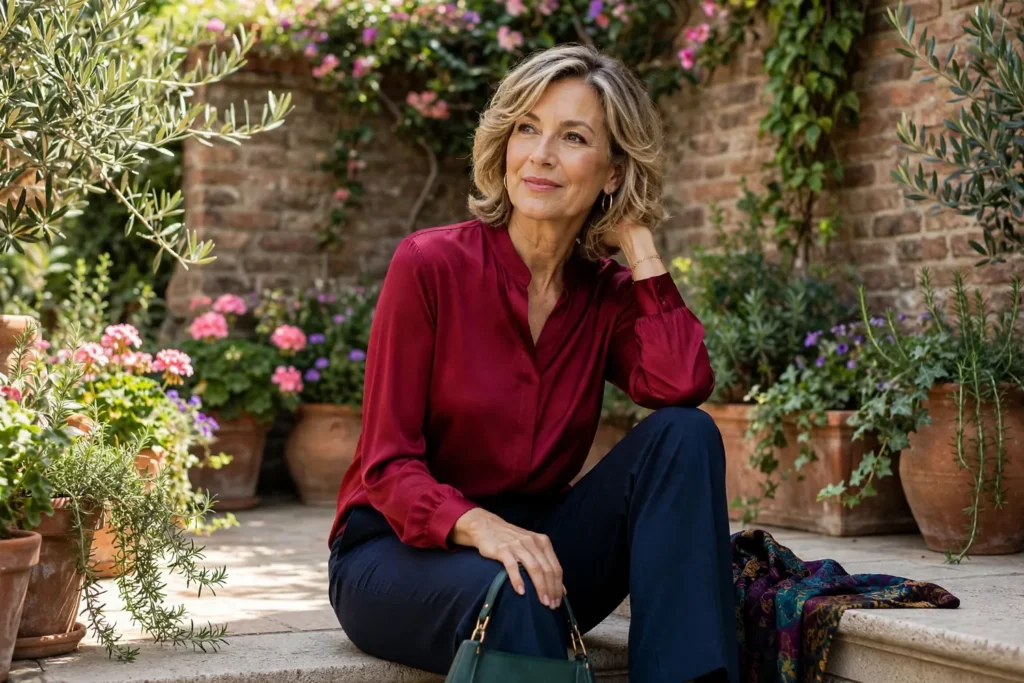
A single rich color can pull an entire outfit together in seconds — yet jewel tones have a way of feeling tricky once you’re standing in front of your own closet. Certain shades light up your face instantly, while others can fall flat or feel like too much.
After fifty, the solution is never to hide inside beige, navy and black. As hair color shifts, skin contrast softens and fabric preferences evolve, strong colors simply start behaving differently around the face — and that’s information, not a limitation.
Chosen well, jewel tones produce some of the most elegant outfits for women over 50, delivering depth without demanding complicated styling. Everything comes down to getting the depth, softness, placement and supporting pieces right.
If rich color has felt off-limits for years, you don’t need a wardrobe overhaul to begin. One jewel-tone scarf or blouse, worn with the neutrals you already own, is enough to show you what the right depth can do for your face.
Table of Contents
- What Makes Jewel Tones So Flattering Close to the Face
- Four Foolproof Jewel Tones to Try First
- Match the Color’s Intensity to Your Natural Contrast
- Pair Bold Color With Clean, Simple Shapes
- How Fabric Decides Whether a Jewel Tone Feels Casual or Dressy
- Tame Bright Color With the Right Neutrals
- When Rich Color Starts Feeling Too Heavy
- One Repeatable Jewel-Tone Formula for Every Season
- FAQs
- Which jewel tones suit women over 50 best?
- Do jewel tones work with grey or silver hair?
- Which neutrals pair best with jewel tones?
- Can you wear jewel tones casually?
- Should your accessories match your jewel tones?
- Make Rich Color an Everyday Habit
What Makes Jewel Tones So Flattering Close to the Face
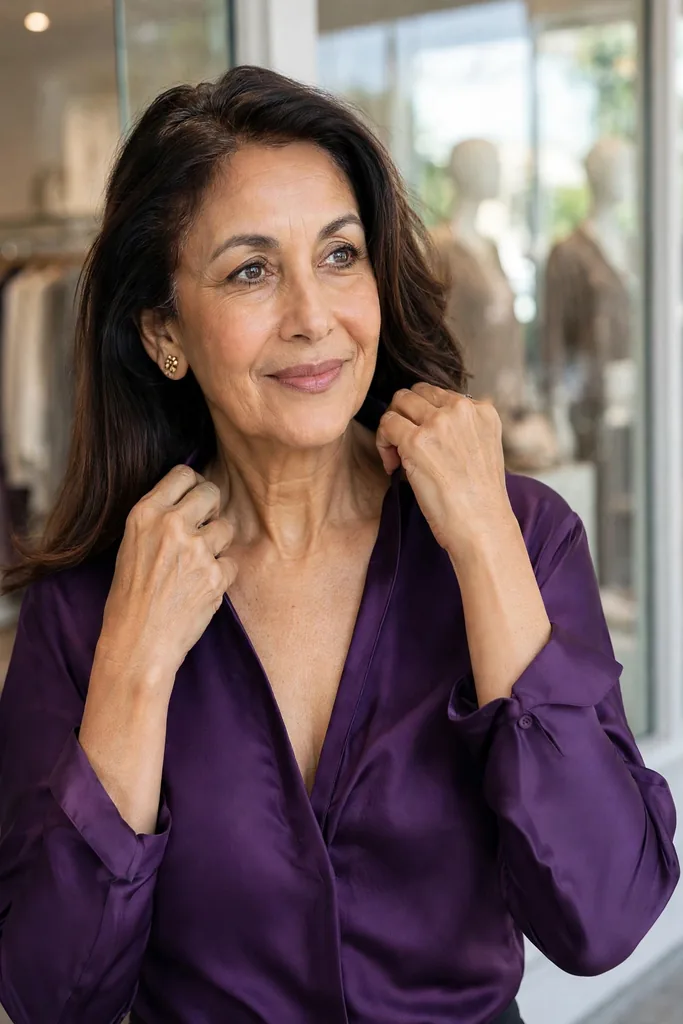
Jewel tones live in the sweet spot between loud primaries and quiet everyday neutrals. Emerald, sapphire, ruby, deep teal, amethyst and plum each carry enough richness to sculpt definition around your features without leaning on heavy makeup or fussy details.
That built-in depth becomes especially valuable as natural coloring shifts. With grey or silver hair, softer brows, or gentler contrast between hair and skin, pale shades can start to wash you out — and a richer tone steps in to restore balance.
Something as simple as a deeper blouse, knit, scarf or jacket can return that missing definition to the area around your face.
Maximum brightness was never the goal. What you actually want is just enough color to make your complexion read clearer — the shade should flatter your skin, not walk into the room ahead of you.
When you’re comparing familiar jewel shades side by side, this quick reference gives you a practical place to begin.
| Jewel Tone | Look For | Easy Neutral Pairing |
|---|---|---|
| Emerald | A clear green or one leaning slightly blue-green | Navy, camel, cream |
| Sapphire | A deep medium blue, not near-black navy | Charcoal, white, taupe |
| Ruby | A red with enough depth to avoid neon | Black, chocolate, ivory |
| Amethyst | Purple with blue or berry undertones | Grey, navy, soft beige |
| Deep teal | A balanced blue-green of medium depth | Cream, denim, brown |
| Plum | A muted wine-purple, not bright violet | Camel, charcoal, blush |
Nobody needs the entire spectrum. Two or three jewel tones that reliably make you look rested are plenty — together they become your personal color formula.
Daylight is the most honest mirror for this work. A shade that looks perfect under store fluorescents can turn muddy or harsh at home, so always give any new color a second look near a window before you commit to it.
Four Foolproof Jewel Tones to Try First
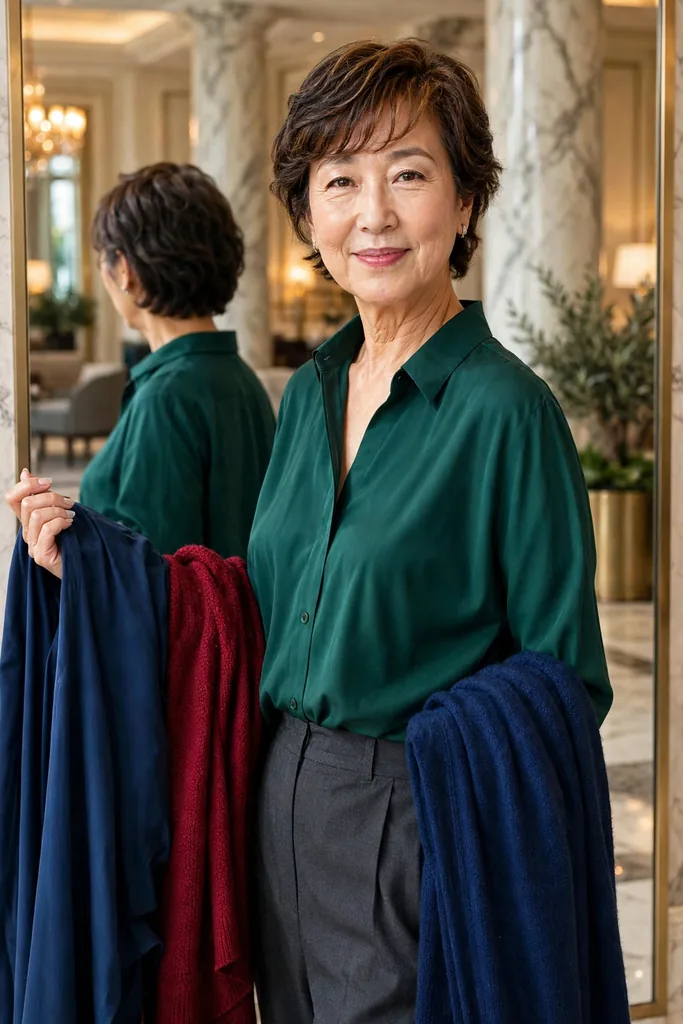
When strong color feels intimidating, start with the blue-green and blue-violet families — they slip into a wardrobe far more easily than vivid reds or hot pinks.
Sapphire shines in uncomplicated pieces: a V-neck sweater, a button-front blouse, an easy blazer, a knit dress. It carries real presence, yet that familiar blue undertone keeps it completely wearable for errands, lunches and workdays alike.
Emerald delivers a slightly more luxurious effect, and it looks best when the garment itself stays clean and simple — think straight-leg trousers, a fine knit, a satin blouse or a softly structured jacket.
Deep teal fills the gap between blue and green beautifully. Because it pairs so naturally with denim and brown leather, it earns its place in everyday rotation instead of being saved for special occasions.
Plum and amethyst offer warmth and depth with none of bright purple’s intensity.
If even these feel like a leap, start smaller than a garment. A jewel-tone scarf, handbag or pair of earrings lets you test-drive the color near your face with almost no commitment — and you’ll know within a day whether it deserves a bigger role.
Treat the fitting room as your laboratory. Carry three versions of one jewel tone — bright, deep and softened — and photograph each near your face. The camera is brutally honest, and the whole comparison takes less than five minutes.
Shade check:
Hold the garment up near your face in natural daylight. When your skin looks clearer before you even register the color, you’ve likely found your depth.
Match the Color’s Intensity to Your Natural Contrast
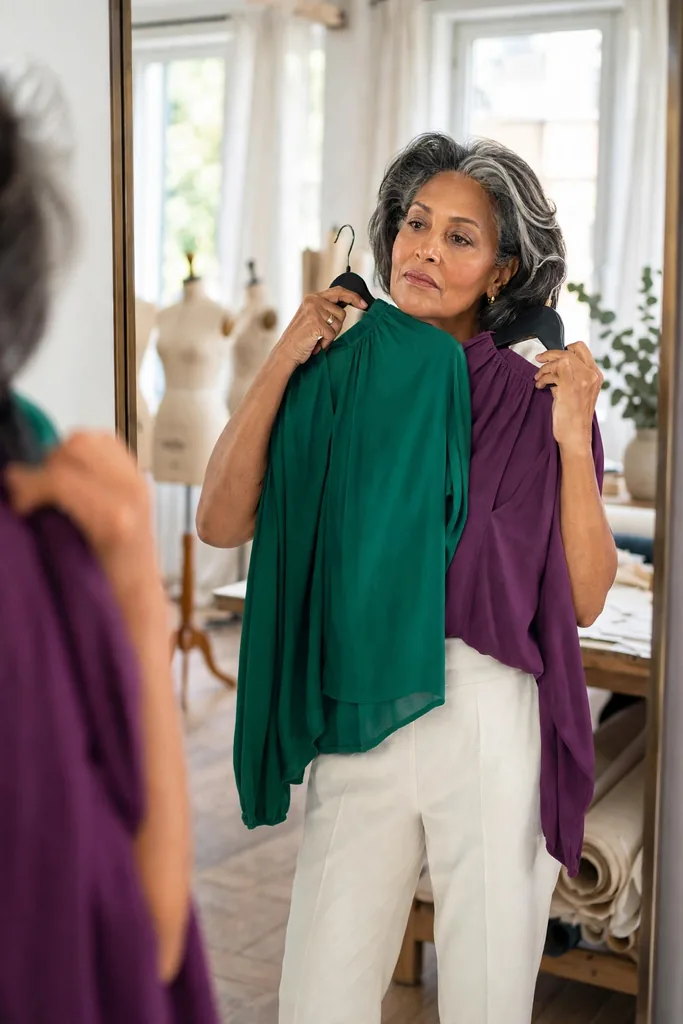
Forget whatever the label calls it — what matters is how intense that shade looks sitting next to your skin.
Two sweaters both sold as emerald can behave like entirely different colors. One might read bright, clear and saturated; the other could lean darker, smokier, softer.
When punchy colors feel like they’re wearing you, reach for softened jewel tones instead — smoky teal, berry, aubergine, petrol blue or a muted emerald.
If deeper shades sharpen your complexion, you’ll likely carry sapphire, ruby, forest emerald and rich violet with almost no effort at all.
Judge shades against each other, not in isolation:
- Hold a vivid emerald beside a softened teal and see which one lets your skin breathe.
- Set true ruby against a deeper burgundy-red and notice which flatters more.
- Try sapphire next to muted petrol blue before deciding.
- Compare violet with plum or aubergine in daylight, not store lighting.
This isn’t about pinning yourself to a strict seasonal category. You’re simply discovering how much saturation your own coloring comfortably supports.
This side-by-side of tired rules and better approaches makes the whole process simpler.
| Old Rule | A More Useful Approach |
|---|---|
| Grey hair means softer colors only | Test rich and softened shades against your face |
| Black suits every jewel tone | Also try navy, chocolate, charcoal or cream |
| Bright color works only as an accent | A well-cut jewel-tone knit or dress can carry the outfit |
| Warm skin needs warm colors only | Depth and saturation can matter as much as undertone |
| Strong color always looks dressy | Add denim, flat shoes and simple layers for daytime |
Good dressing over 50 gets dramatically easier once you treat color as adjustable — a dial you turn — rather than something dictated by age.
Undertone matters less than most guides claim. Whether your skin leans warm, cool or somewhere neutral, the depth and clarity of the shade usually settle the question long before undertone enters the picture.
Pair Bold Color With Clean, Simple Shapes
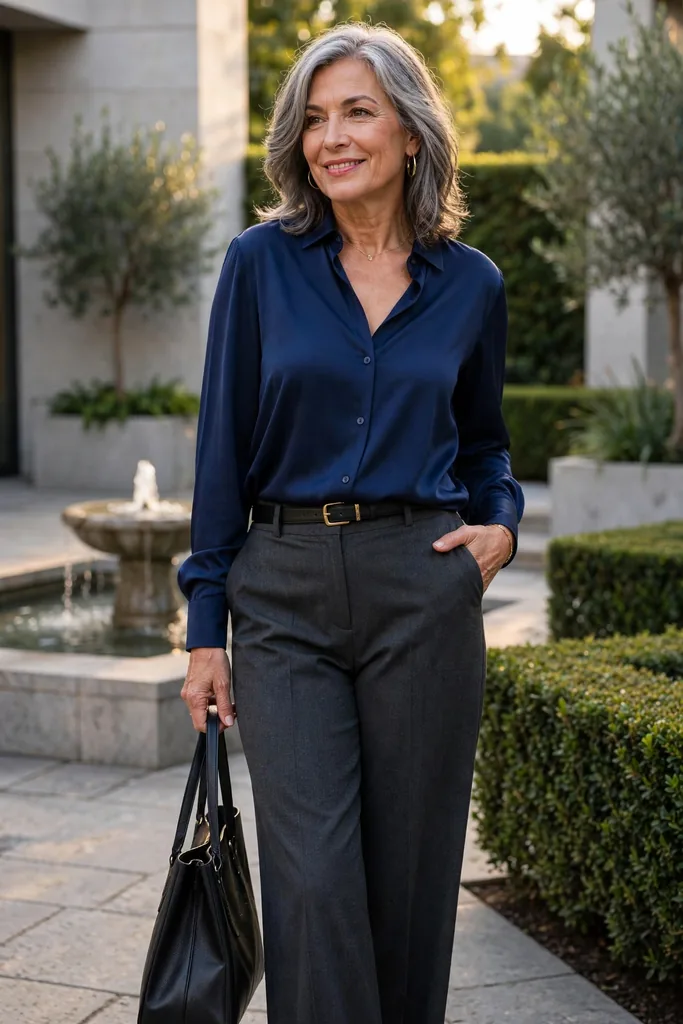
Rich color already supplies the visual interest, so the rest of the outfit can relax — it rarely needs extra decoration.
An emerald satin blouse with straight dark trousers looks sophisticated because the contrast comes purely from color and texture. Pile on ruffles, statement jewelry, patterned shoes and an embellished bag, and the whole effect starts competing with itself.
The principle holds for casual days too. A sapphire crew-neck with medium-wash straight jeans and loafers reads pulled-together because every piece has one clear job.
Proportion deserves the same attention. A loose jewel-tone blouse asks for a cleaner lower half — straight trousers or slim (never tight) jeans restore the balance.
When the jewel tone lives in a wide-leg trouser or full skirt, a simpler, more fitted knit rebalances everything above the waist.
Shoes and bags deserve the same restraint. While the color does the talking, a simple leather loafer or an unlined tote keeps the outfit grounded — save the embellished evening bag for after dark.
A good tailor is a jewel tone’s best friend. Taking up a sleeve or nipping a waist costs little, yet it makes strong color look deliberate instead of approximate — and deliberate is exactly what reads expensive.
Fit check:
Bold color pulls the eye straight to it, so confirm the shoulder line, sleeve length, waistband and trouser break all sit exactly where you want them before you even think about accessories.
How Fabric Decides Whether a Jewel Tone Feels Casual or Dressy
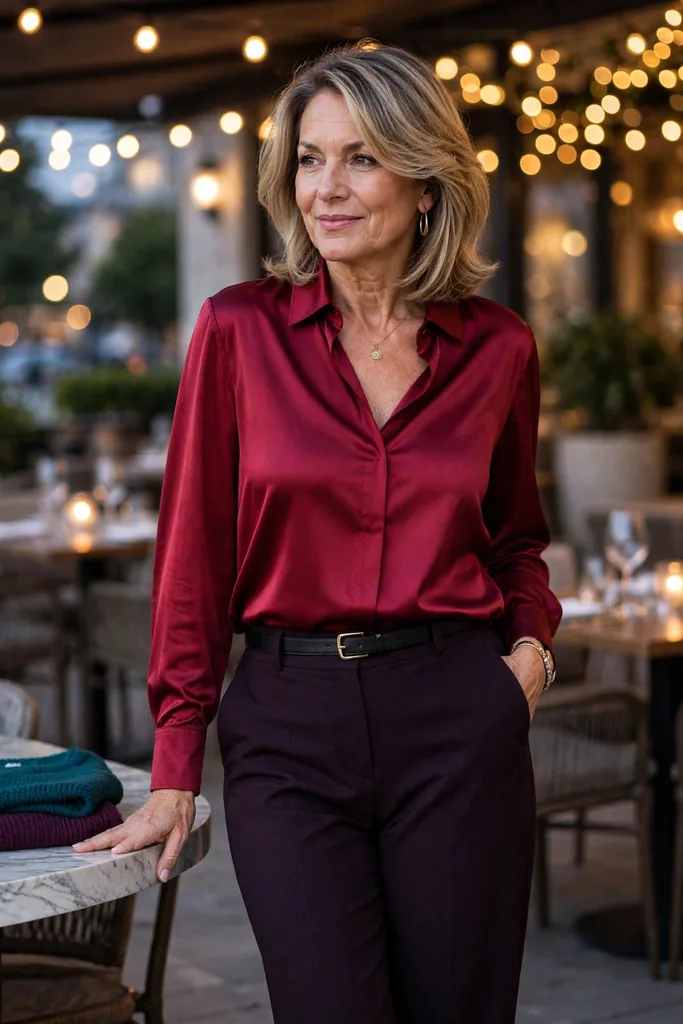
Texture changes everything about how a jewel tone reads.
Ruby satin catches the light and instantly feels dressy; that identical ruby in a cotton knit or brushed wool becomes an easy daytime piece.
Velvet, satin, silk-like weaves and fine-gauge knits deepen every color they touch — beautiful for dinners, holidays, weddings and evenings out.
For daily life, matte textures keep things relaxed: cotton, soft denim, wool blends, jersey and textured knits stop jewel tones from reading overly formal.
That versatility lets a single color work overtime across your wardrobe.
Think of fabric as a seasonal dial. The same emerald that feels crisp in a summer linen-blend turns plush and wintry in velvet — which means one favorite color can anchor outfits in every month of the year.
A deep teal sweater with jeans handles Tuesday; a teal satin shell under a blazer handles Saturday dinner.
Here’s how fabric alone shifts the mood within one color family.
| Fabric | Best Use | Why It Works |
|---|---|---|
| Fine knit | Everyday, office, travel | Polished enough without feeling dressy |
| Cotton or jersey | Errands and relaxed outfits | Keeps strong color feeling casual |
| Satin | Dinner and special occasions | Catches light and deepens jewel tones |
| Velvet | Evening and winter events | Builds richness through texture |
| Wool blend | Jackets, trousers, sweaters | Gives saturated color real structure |
Comfort fix:
When satin clings, choose a blouse with gentle movement through the body instead of sizing up dramatically — better drape almost always looks more polished than extra volume.
Tame Bright Color With the Right Neutrals
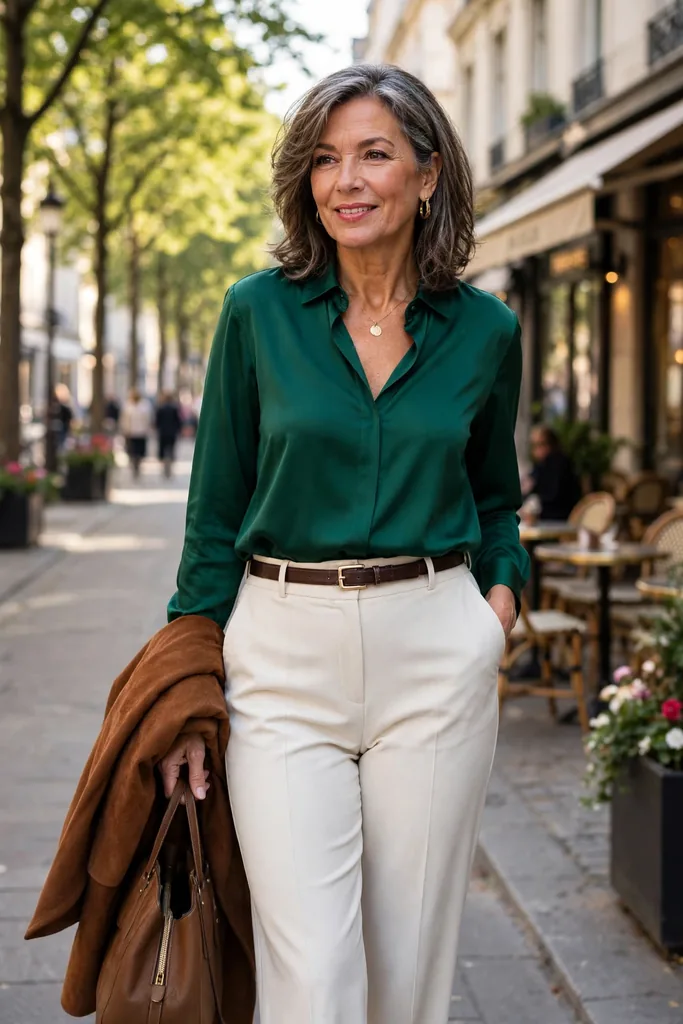
Head-to-toe jewel tone is never required.
The simplest route is usually one strong color held up by two quieter pieces — a combination that keeps stylish outfits for women over 50 feeling current without complicating everyday dressing.
For softness, surround jewel tones with cream, camel, taupe, mushroom, soft grey or medium-wash denim.
For contrast, reach for charcoal, dark navy, chocolate, crisp white or black.
Your neutral choice also rewrites the color’s personality: emerald with black turns sharp and evening-ready, while emerald with camel turns warm and relaxed.
Sapphire beside white feels crisp; beside grey, quieter. Deep teal with chocolate brown settles into a soft autumn mood.
Try doubling the neutral: a plum sweater with charcoal trousers and charcoal loafers looks far more intentional than introducing a third, unrelated color through the shoes.
Your handbag counts as one of the quiet pieces. A tan leather tote or black structured bag next to a jewel-tone top keeps the whole equation balanced without adding another color to manage.
Metals count as neutrals too. Gold warms up emerald and ruby, while silver cools down sapphire and teal — so let your everyday jewelry quietly nudge the color in the direction you want.
When Rich Color Starts Feeling Too Heavy
A strong color alone is rarely the culprit. Problems typically start when several bold elements all compete at once.
When an outfit feels busier than intended, change one element instead of giving up on the color entirely.
- When the color overwhelms: shift it away from your face — try it in trousers, a skirt, shoes or a handbag instead.
- When it reads too formal: swap satin or velvet for knitwear, cotton, denim or suede.
- When everything feels dark: add cream, soft white, lighter denim, or a hint of skin at the neckline.
- When it feels dated: simplify the jewelry and pick a cleaner shoe shape rather than ditching the jewel tone.
Jewel tones look most modern when treated as ordinary wardrobe colors, not saved for holiday dressing.
A teal sweater is allowed at the grocery store. An emerald shirt doesn’t require a dinner reservation.
When in doubt, remove the smallest strong element first — usually the jewelry or a printed scarf — before touching the main color. Nine times out of ten, the outfit was a single edit away from working.
One Repeatable Jewel-Tone Formula for Every Season
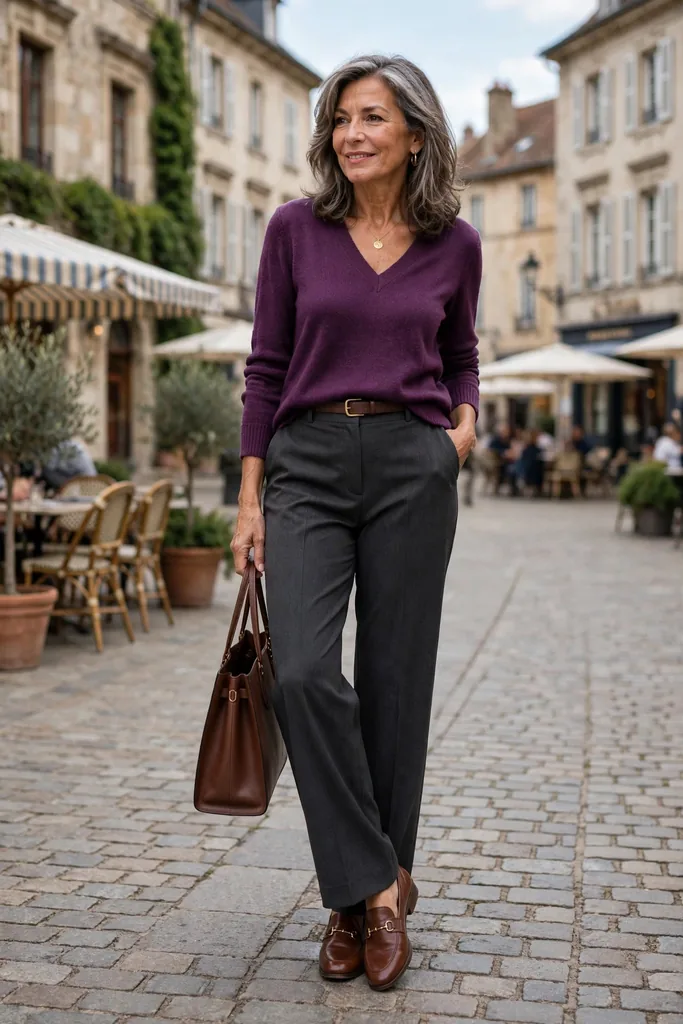
The most useful color strategy is the one you can repeat without a twenty-minute closet standoff.
The formula:
Jewel-tone top + quiet neutral bottom + streamlined shoe.
Try it as an emerald knit with straight navy trousers and loafers, or a sapphire blouse with dark jeans and ankle boots.
In warm weather, trade the knit for a sleeveless teal shell and the trousers for cream linen-blend pants; in winter, layer a camel coat or charcoal blazer over the same foundation.
For everyday outfits for women over 50, this works because a single piece supplies the personality while everything around it stays familiar and comfortable.
The formula also works in reverse:
The reverse:
Neutral top + jewel-tone bottom + neutral shoe.
A cream knit with plum trousers and brown loafers delivers strong color without parking it right beside your face.
This formula also packs beautifully. Three jewel-tone tops, two neutral bottoms and one streamlined shoe can carry a full week of travel with endless combinations — and a suitcase that still closes.
Build the collection slowly. One jewel-tone piece per season is plenty; within a year you’ll own a small rotation where everything works together, because each addition was chosen against the same formula.
FAQs
Make Rich Color an Everyday Habit
Jewel tones don’t belong to any particular age, season or occasion. The best shade is simply the one that works with your coloring, your existing clothes, and the way your days actually unfold.
Putting together elegant outfits for women over 50 has less to do with obeying color rules than with balancing depth, fabric, fit and proportion. Start this week with one emerald, sapphire, teal or plum piece you already own — and let it earn a regular spot. Once rich color feels ordinary, getting dressed gets easier every single morning.