
Style That Fits Your Life Now: A Confident Wardrobe Guide for Women Over 50

Your style instincts don’t disappear when your shape shifts — but your clothes can start feeling like strangers. The jeans that used to glide on now tug in odd places, a once-loved blazer suddenly fights your shoulders, and getting dressed turns into a round of second-guessing.
That daily friction can make getting dressed after 50 feel like a puzzle with missing pieces. Here’s the reframe worth keeping: your body isn’t the problem. More often, the cuts, cloth weights, and proportions hanging in your closet were chosen for the body you had years ago — not the one getting dressed this morning.
Nothing here asks you to hide or to start your wardrobe from zero. A handful of deliberate tweaks can restore real style confidence over 50 — clothes that feel comfortable through a full day, look current without chasing trends, and feel unmistakably like you.
Table of Contents
- Quit Styling for the Shape Your Closet Remembers
- Begin With Pieces That Fit Without a Fight
- Choose Fabrics That Skim Instead of Clinging
- Play With Proportion to Shape Without Hiding
- Create a Go-To Formula From What You Really Wear
- Alter Strategically Where It Shows the Most
- Start With Just One Small Switch Today
- FAQs
Quit Styling for the Shape Your Closet Remembers
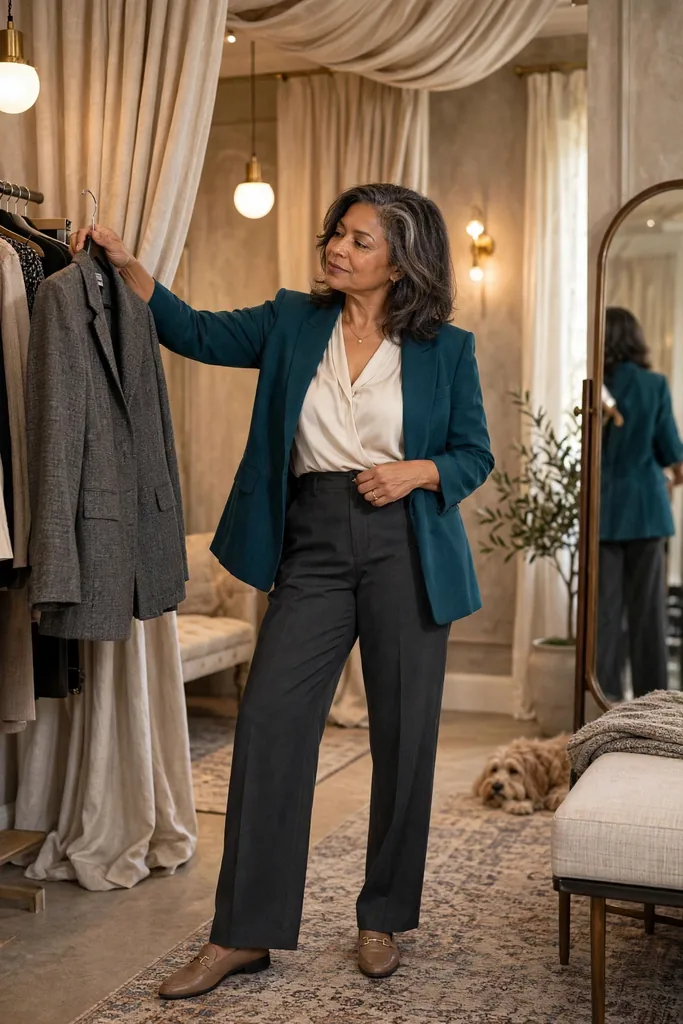
The toughest mental shift is grading today’s outfits against how yesterday’s clothes used to fit. Without thinking, you grab the same jean rise, the same jacket length, the same neckline — because a decade ago, that combination was flawless.
Those favorites aren’t banned for life. It only means the proportions that flatter you most may have moved — and your closet deserves permission to move with them.
From now on, let the mirror of today do the judging. Does the fabric drop in a clean line? Can you sit down without negotiating? Do you see a shape you actually like — rather than spending the day tugging, yanking, and smoothing?
That one habit — assessing the outfit in front of you instead of the memory behind you — does more than any attempt to wedge yourself back into an old formula.
A few tired rules deserve a rewrite. Here’s the healthier version:
| Tired Rule | The Smarter Move |
|---|---|
| Stick to your longtime size | Choose whatever size fits today’s body best |
| Baggy clothes camouflage everything | Pick easy shapes that keep some definition |
| Tight always looks sharper | Let fabric float, never grip |
| Dark shades are universally slimming | Bring in color anywhere it brightens your face |
| Certain looks are ‘too young’ | Assess the silhouette and fabric, ignore the age tag |
Treat the number on the tag as trivia, not truth. What matters is the evidence in the mirror — how the garment hangs, moves, and settles on the body you have right now.
Begin With Pieces That Fit Without a Fight

A wardrobe you can trust begins with garments that never interrupt your day. No digging waistbands when seated, no pulling across the bust, no sleeves fighting your movement — unglamorous details, but they’re everything.
Comfortable fit changes how you carry yourself, often before you notice. The fidgeting stops — no more hoisting the top, no more checking the trousers — and suddenly the outfit looks natural because you feel natural in it.
Before spending anything, pull out the trousers, jeans, jackets, knits, and dresses you reach for most and try them on with fresh eyes. Keep what genuinely feels good — and get specific about what nags you in the rest.
Often the culprit is oddly precise:
- Your jackets keep stopping right where your hips are fullest.
- Tops hang loose all over, yet pull tight at the bust.
- Dresses glide past the torso but grip the upper arms.
- The waistband behaves standing but rebels the moment you sit.
- Rises sit inches below where you want your waistband to live.
Those specifics are gold — they become your shopping list for what to look for next.
Fit tip
Between sizes? Pick the one that fits best where alterations are hardest. Taking in a waist or shortening a sleeve is routine for a tailor; rebuilding shoulders or hips is surgery.
Choose Fabrics That Skim Instead of Clinging
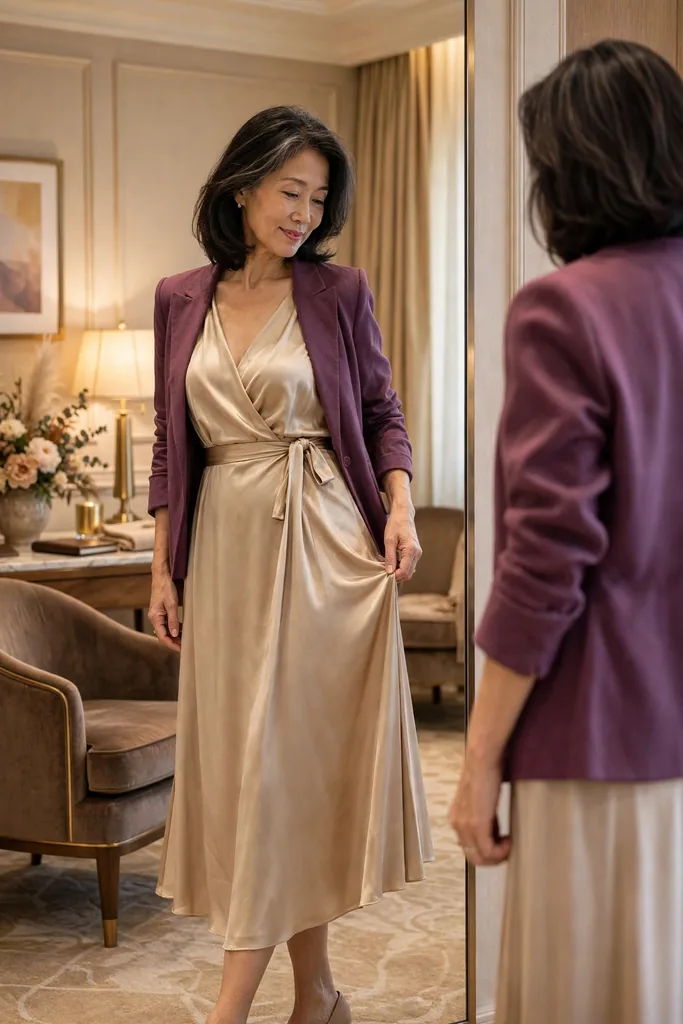
Cloth choice matters more with every passing year — it’s what separates polished from stiff. Featherweight fabrics cling to everything beneath them; armor-heavy ones pile on visual bulk exactly where you don’t want it.
Hunt for cloth in the sweet spot — substantial enough for a crisp line, supple enough to travel with your body. Soft denim, ponte, weighty jersey, fine-gauge knits, linen blends, fluid wovens — the right pick depends on the piece, but the principle never changes.
Stretch should assist the fit, not substitute for it. When comfort depends on fabric pulled to its breaking point, size up or switch the cut. Your silhouette will look cleaner for it.
Keep this cheat sheet in mind next time you’re in a fitting room:
| Piece or Fabric | What to Seek and Why |
|---|---|
| Denim | A hint of stretch that flexes without going saggy |
| Pants | Weighty enough cloth to fall straight from the hip |
| Sweaters | Fine-to-mid gauge knits that hover, not hug |
| Dresses | Fluid weaves with swing and seaming that holds |
| Blazers & jackets | Soft construction that defines shoulders minus rigidity |
Fitting-room test
Sit down. Walk. Bend your elbows, lift your arms overhead. An outfit has to survive your actual day — not just the thirty seconds you stand motionless before the mirror.
Play With Proportion to Shape Without Hiding
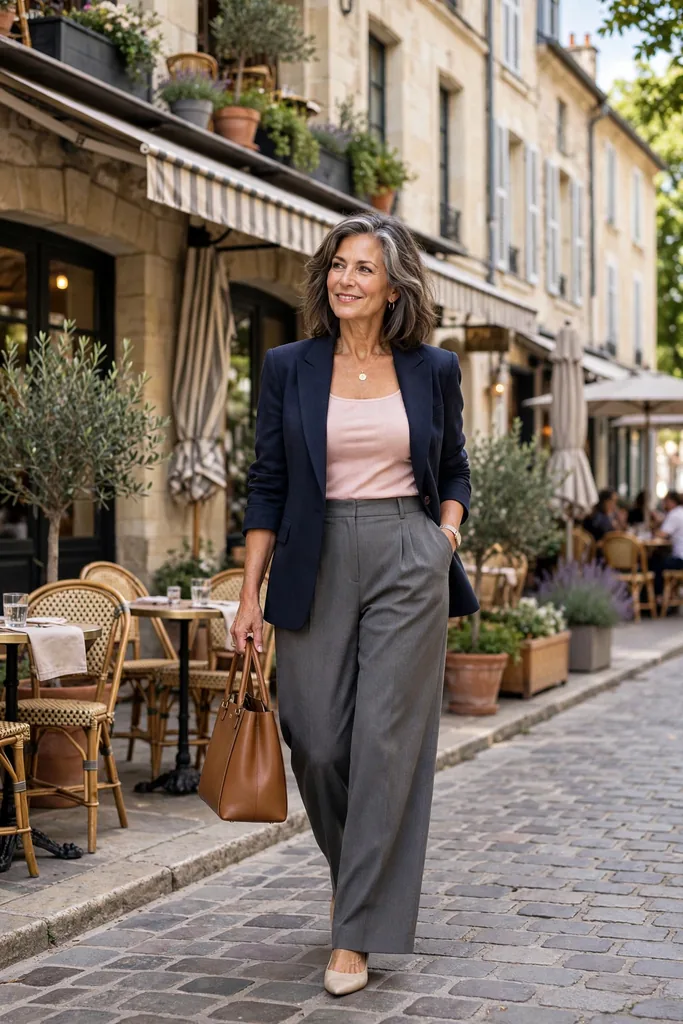
If an outfit feels frumpy, interrogate the proportions first — not your age, weight, or shape. Stack too many long, loose pieces and all definition quietly disappears.
The reverse trap is just as real: head-to-toe fitted pieces can leave you feeling exposed and constrained when all you wanted was polish.
The fix is contrast — pair volume with structure, ease with definition.
Pair wide legs with something tidier up top — a trim knit, a tucked-in shirt, a jacket with a higher hem. For billowy shirts, ground the look with straight-leg denim or trousers cut with a sharper lower half.
Where a hem falls matters just as much as how wide the piece runs. A jacket that stops a touch higher, or a shirt with a casual half-tuck, can transform the whole outfit — nothing tight required.
Definition doesn’t have to mean a cinched waist. Leave a jacket open, button a shirt to show its placket, add a long pendant, layer a contrasting piece, press a crease into your trousers — any of these leads the eye on a path through the look.
Forget the idea of one ‘correct’ silhouette for women over 50 — it doesn’t exist. Ask just this: is there enough tension between the relaxed pieces and the structured ones to read as intentional?
Create a Go-To Formula From What You Really Wear
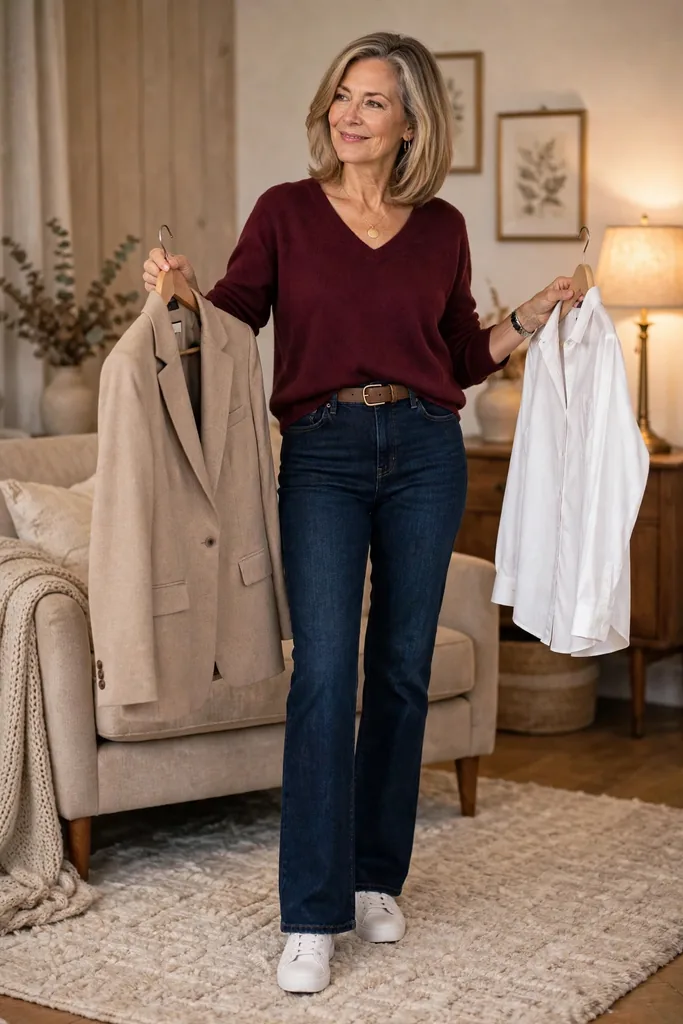
Getting your style confidence over 50 back takes one reliable combination, not an arsenal of new outfits. Identify the one that already feels like you — then ring small changes on it.
Your uniform might be straight-leg denim plus a soft knit. Or maybe flowing trousers with a sharp button-down is where another woman feels like herself. Both are perfect.
No formula outranks another. What counts: the proportions flatter, the pieces stay comfortable past noon, and you can rebuild it half-asleep on a busy morning.
A few field-tested formulas for real life:
| Situation | Wear This | The Payoff |
|---|---|---|
| Running errands | Straight-leg denim, easy knit, white sneakers | Laid-back but pulled together |
| Lunch out | Flowing trousers, tucked-in blouse, loafers | Soft drape with a nipped-in waist |
| Casual office day | Dark denim, simple knit, relaxed blazer | Basic pieces, instant polish from the jacket |
| Travel days | Pull-on pants, featherweight knit, packable jacket, cushioned shoes | Moves with you, never sloppy |
| Evening dinner | Midi dress, short jacket, low heels or pointed flats | One sleek column, sharpened by the outer layer |
Treat these as frameworks to riff on, not uniforms to obey.
Play with necklines, colors, footwear, accessories, and outer layers — just don’t touch the proportions that flatter you. That’s the difference between a capsule wardrobe over 50 that feels like freedom and one that feels like a rulebook.
Alter Strategically Where It Shows the Most
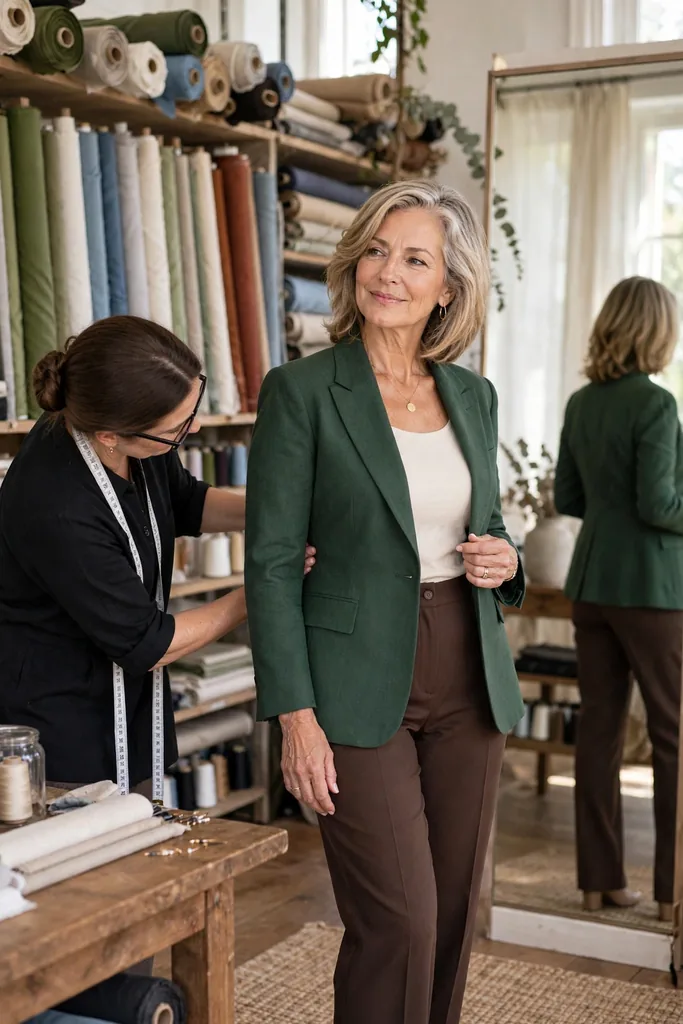
Not everything needs the tailor’s touch. But one small alteration can rescue a piece that’s ninety percent perfect.
Hems, sleeves, waists, and shirt lengths are all adjustable without rewriting a garment’s personality. Sometimes shifting a single button transforms how the whole thing sits.
Alterations earn their keep when your proportions don’t match the pattern block — needing room in one zone and less fabric in another is completely normal.
Off-the-rack clothing follows generic size charts — it was never patterned for your particular frame.
About to donate a costly jacket or trousers? Pause and judge: does the whole piece fail, or could one alteration rescue it? Fixing what you own often beats the cost-per-wear of buying new.
Start With Just One Small Switch Today
Dressing differently doesn’t require a shopping trip.
Grab a repeat-worn outfit and plant yourself before the full-length mirror. Skip the ‘do I look thinner or younger’ audit — instead ask three better questions: does it look balanced? comfortable? intentional?
Alter a single element — just one.
Try a short boxy jacket instead of that endless cardigan. Retire the painted-on jeans in favor of a straighter leg. Do a front tuck, push up your sleeves, switch footwear, or choose a stronger neckline — one move only.
These micro-experiments teach you more, faster, than any shopping spree.
The aim was never camouflage. It’s fluency — learning how your clothes can work with the body you have today.