
How to Dress an Hourglass Figure Over 50 Without Losing Your Silhouette
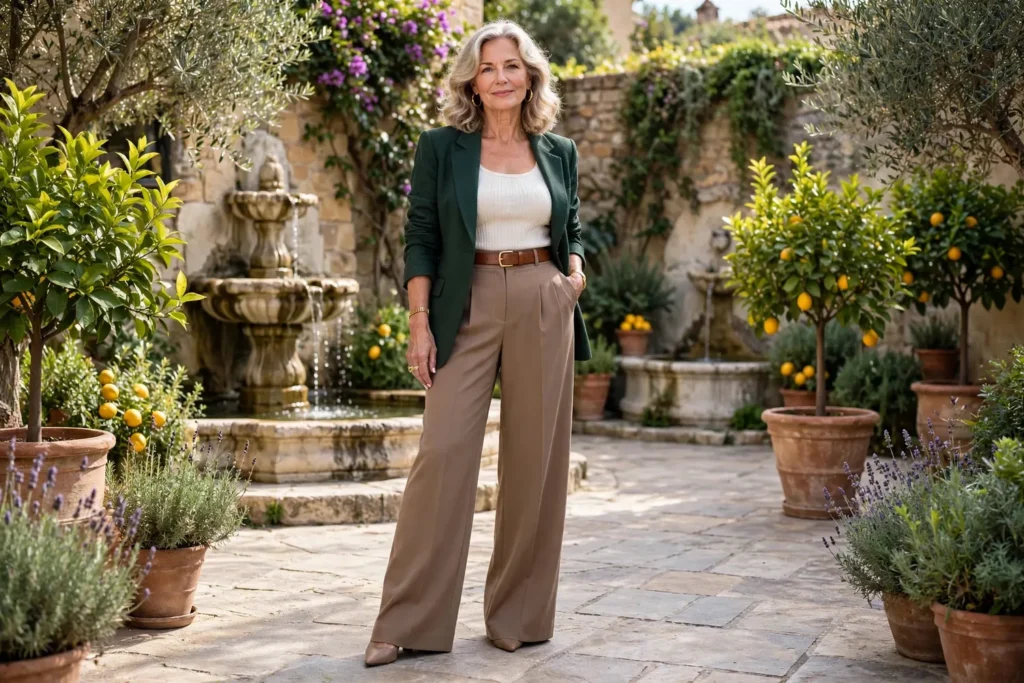
An hourglass figure can vanish under modern styling faster than most women expect. When your bust and hips sit fairly level and your waist dips in between, roomy cuts have a way of ironing out that lovely curve — a tunic here, a dropped shoulder there, and the mirror shows a straighter line than the one you actually have.
That stings a little extra now, because dressing over 50 already brings its own set of questions — about ease, coverage, and staying current without trying too hard. Let me be clear from the start: the fix is never a tighter wardrobe or more skin on show.
What works for women over 50 is tracing the body’s own line without clamping down on it. Shift where the waist lands, pay attention to fabric and jacket length, choose trouser shapes with intention — and the same closet starts producing outfits that look polished, contemporary, and entirely you.
What follows is a practical walk-through of exactly those levers: why the shape disappears under certain cuts, how to hint at the waist without tight cinching, where tops and jackets should end, which bottoms earn their place, how fabric can skim instead of cling, where to park visual volume, a repeatable outfit formula for busy mornings, and a quick frumpy-check you can run in the mirror. Nothing here demands a new wardrobe — most of it works with pieces you already own.
When Your Hourglass Shape Gets Lost Beneath the Wrong Clothes
This shape was never really about the number on the tag. It is about proportion: shoulders and hips reading as roughly equal, with the waist stepping in between to create that visible change of direction.
Trouble begins the moment your clothing flattens that change of direction out of existence.
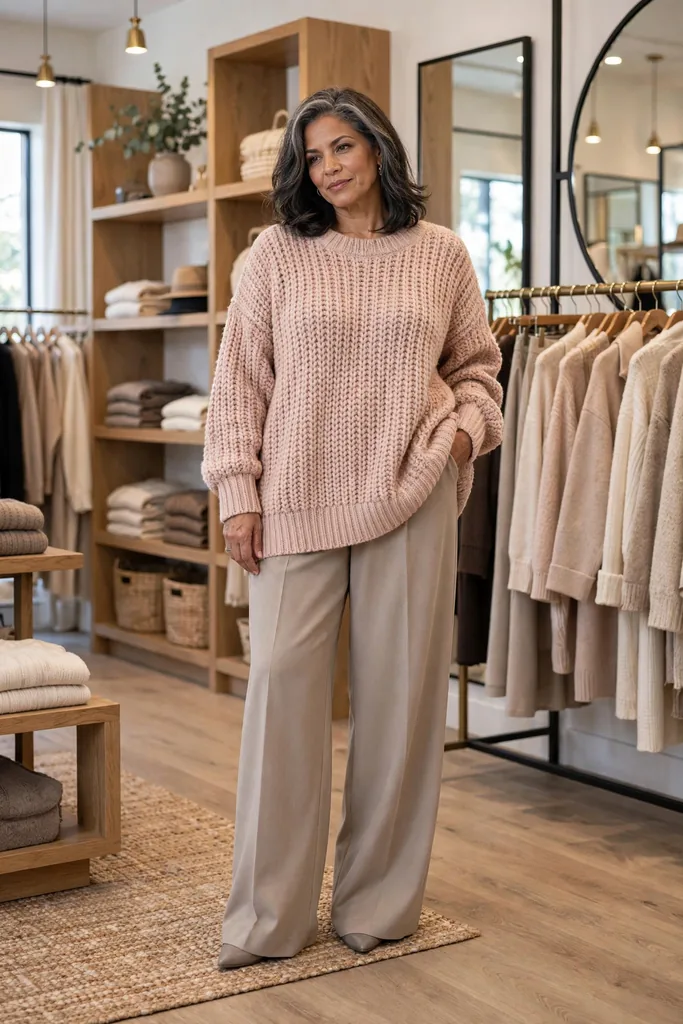
Picture a soft blush-rose chunky knit hanging in one straight panel — it can carry you from shoulder to hip with no pause at the middle. Layer warm greige wide-leg trousers underneath, and the whole look collapses into a single generous rectangle, even though both pieces are lovely on their own.
Neither garment is the villain here. The real culprit is volume piling up everywhere at once.
Relaxed dressing is still very much on the table. What the eye wants is one clear anchor point.
Give it one: a waistband it can see, a tucked hem, a jacket with some waist shaping, a wrap tie, or trousers that meet your natural waist without fuss.
A useful fitting-room test: button or zip the piece, then look at yourself from the side, not just the front. If the silhouette runs flat from underarm to hip with no inward curve at the middle, that garment will flatten your hourglass no matter how pretty it looks on the hanger. Put it back, or pair it with something that restores the curve — an open cardigan over a tucked knit, say, or a blazer with a nipped-in middle.
This balance is exactly what makes stylish outfits for women over 50 so wearable — you keep all the comfort, yet nothing reads as shapeless or half-finished.
Hint at Your Waist Without Squeezing It Too Tightly
No tight belt or bodycon dress is required to make an hourglass silhouette readable.
More often than not, a whisper of waist definition looks far more current.
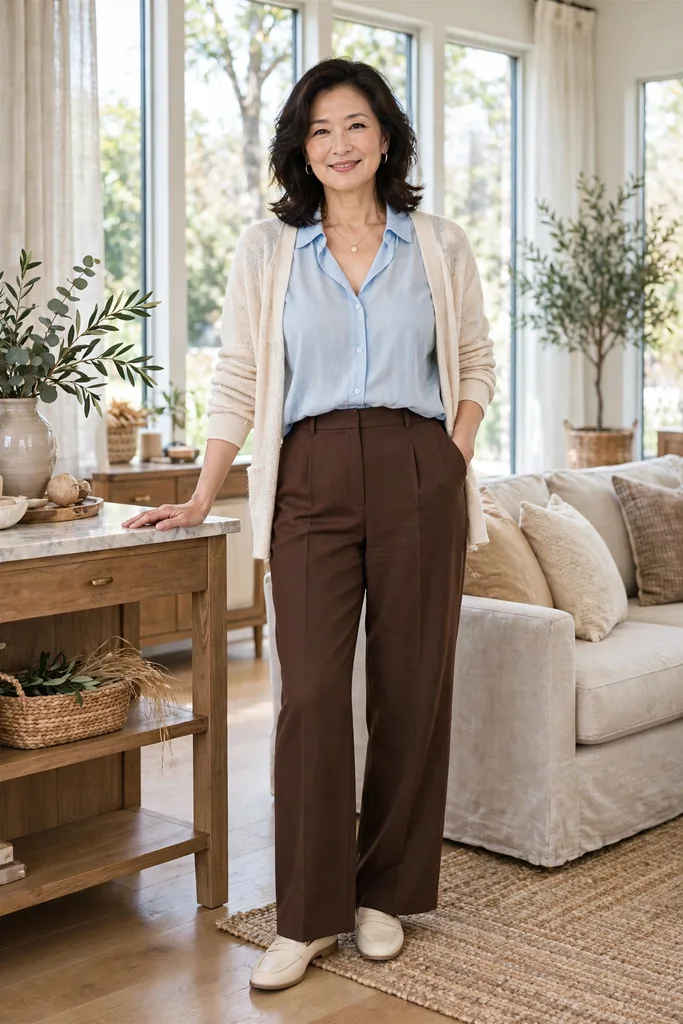
Start simple: choose a knit that finishes right at the trouser waistband, tuck a soft blouse fully into higher-rise jeans, or leave a cream cardigan open over a fitted base layer so the line underneath still shows. A pale sky-blue button blouse with chocolate-brown high-waist trousers and a cream cardigan worn open is exactly the sort of pairing that pulls this off — nothing cinched, everything clear.
Wrap-front tops have earned their reputation here. Their diagonal seam travels inward toward the waist without chopping the body into hard horizontal bands.
Seams do quiet work too. Princess seams, gentle darts, and jackets that curve lightly through the middle trace your shape without ever pressing in.
Notice what the goal is not: the smallest possible waist. The goal is simply keeping your clothes from erasing the natural step down between waist and hip.
Tucks deserve a small vocabulary of their own. A full tuck reads crisp and intentional with higher-rise trousers; a French tuck — just the front hem, letting the sides fall — gives softer definition with jeans; and a side tuck adds asymmetry that can be kinder on days when you want less attention at the middle. Whichever you choose, check that the tucked fabric lies flat rather than ballooning above the waistband, because puff above the tuck can add the very width you were trying to avoid.
Before you buy anything new, run your eye over the pieces you already own — this quick reference makes the check fast.
| Detail | What to Look For | Why It Works |
|---|---|---|
| Waistbands | A mid or higher rise that lies flat and smooth | It hands the outfit a natural focal point |
| Tops | Hemlines that graze the hip or tuck without a fight | They stop fabric from bunching at the middle |
| Jackets | A little curve through the midsection | Your line is followed, never squeezed |
| Knits | Fine to medium weight with a soft fall | The fabric travels with your curves instead of hovering off them |
| Dresses | Wrap styles, tie waists, or seamed and gently fitted cuts | They keep shoulders, waist, and hips visually joined |
Fit note: When a piece grips across the bust or hips yet floats at the waist, reaching for the next size up is not always the fix. A small waist-only alteration can tidy the whole garment without turning the rest of it into a tent.
Choose Top and Jacket Lengths That Actually Serve You
Where a top ends can re-balance your entire hourglass at a glance.
A hem sitting squarely at the fullest point of the hip draws a bold horizontal stripe across exactly the widest area — which is why that placement sometimes reads as broadening, even when the top fits perfectly.
Longer tops are not banned. What matters is the landing zone.
A shirt ending just under the waistband lets more of your real shape come through, while a longer blouse earns its place with side slits, a curved hem, a soft tuck, or enough drape to swing rather than box.
Jackets deserve the same scrutiny.
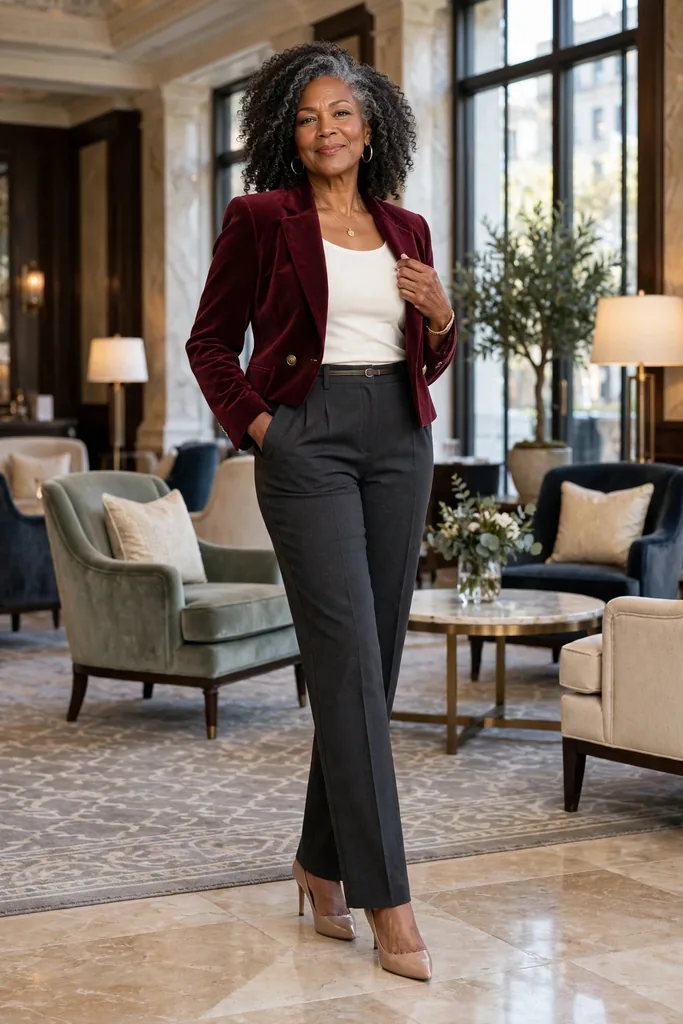
Imagine a burgundy cropped blazer over an ivory top with charcoal straight-leg trousers: worn with higher-rise bottoms, a cropped jacket turns the waist into a deliberate, clean statement. A longer blazer can play the same game, provided it carries some shaping and stays open enough to reveal what is underneath.
Rigid, oversized blazers are the trickiest players, since they pad out the shoulders and middle in one go.
Love that silhouette anyway? Anchor it with a neat foundation — a fitted knit and straight-leg trousers, perhaps finished with nude heels to keep the leg line long — so the roomy layer never gets to swallow the look.
Shoes quietly finish the proportion work that hems begin. A heel that roughly matches your skin tone — nude pumps, a low tan sandal — extends the leg line so a cropped jacket reads as deliberate rather than shrunken. With flat shoes, aim the top’s hem slightly lower or choose a longer jacket, so the eye still gets a clear top-and-bottom rhythm instead of a chopped one.
Comfort upgrade: You do not owe structured tailoring a daily appearance. A knit blazer with some softness, a fine cardigan, or a lightweight jacket cut with waist shaping delivers the same visual lift with far less stiffness.
Give Jeans, Trousers, and Skirts a Waistline to Work With
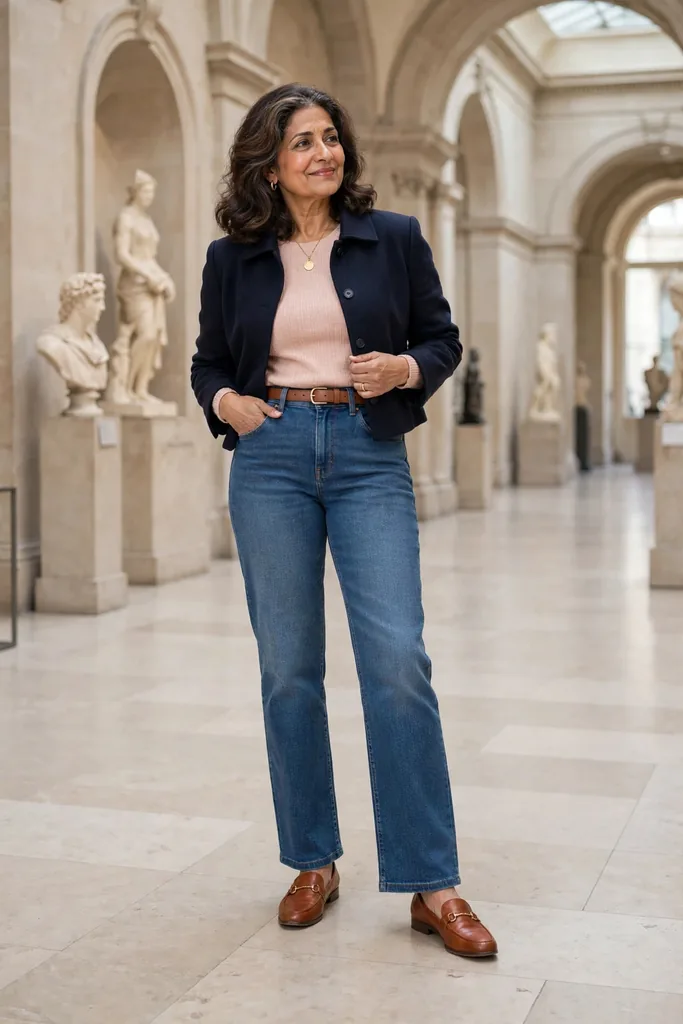
Bottoms do their best work when they back up your proportions instead of wrestling them.
For most hourglass figures, a tidy waistband outranks an ultra-low rise. A mid or higher rise marks the spot where tops should end and quietly separates the torso from the hips.
Straight-leg jeans are the easy win: they honor the hips and then run clean all the way down. Try a navy cropped jacket over a blush-pink knit top, tucked into medium-wash straight-leg jeans with a cognac belt and matching loafers — every line in that outfit points back to the waist.
Bootcuts deserve attention too — that whisper of width at the ankle echoes the hip line, while wide-leg trousers shine when the waist and upper hip stay neat before the leg opens out.
When trousers hug your hips but yawn at the back of the waist, do not conclude the style is wrong for you. The waistband probably just wants a tailor’s touch.
Denim wash matters more than most people realize. A medium, even wash with minimal whiskering keeps the eye moving smoothly over the hips, while heavy fading across the thigh can spotlight exactly the area you would rather soften. And if tailoring sounds extravagant, remember that taking in a waistband is one of the cheapest alterations there is — far less than replacing jeans that otherwise fit beautifully.
Skirts answer to the same logic.
An A-line lets the hips breathe while the waist stays on display; a bias cut skims with almost no structure; and a pencil skirt — in a fabric with enough give for sitting and walking — works when you enjoy a closer fit.
So stop asking, “Can an hourglass body wear this?”
Ask instead, “Where does this piece build shape, and where does it add volume?”
Let Your Fabric Skim Over Curves Instead of Fighting Them
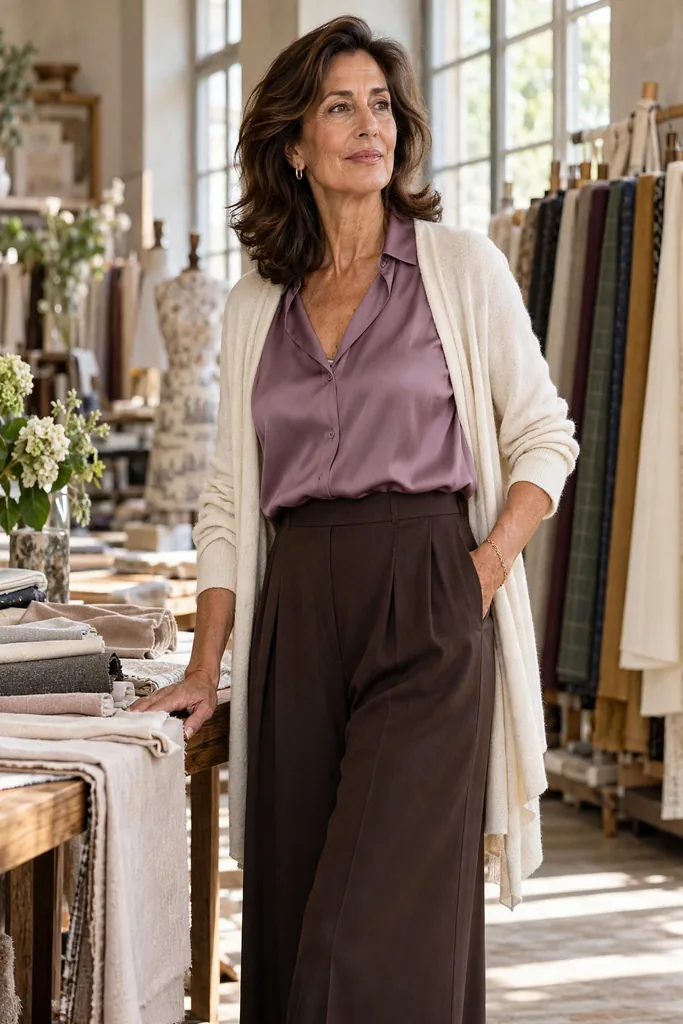
Fabric pulls just as much weight as cut.
Paper-thin, clingy material maps every line of the body — more disclosure than most of us want — while thick, board-stiff cloth can hover inches off the frame and wipe the shape away entirely.
The happiest middle ground usually sits between those two extremes.
Medium-weight jersey, soft denim, ponte, fluid crepe, fine knits, and weaves with a touch of stretch all trace curves without clamping them.
Soft cotton shirts, viscose blends, and light woven fabrics tuck cleanly too, as long as they move with you rather than against you.
Texture adds another lever.
A smooth fitted knit under a nubby cardigan has far more dimension than two bulky layers stacked together — think a dusty mauve silk blouse with deep espresso fluid wide-leg trousers and an ivory cardigan over the top. A fluid blouse against structured trousers creates the same kind of contrast without extra noise.
Think seasonally, too. In warm months, linen blends and lightweight viscose give you that skimming drape without trapping heat; in cold months, ponte and double-faced knits bring structure that thin jersey cannot. The principle never changes — fabric that follows the body — but the right weight for the weather keeps the principle comfortable.
This is where dressing over 50 gets easy: comfort and polish stop competing, because a fabric can feel gentle on the body and still keep enough body of its own to look finished.
Fabric note: When you are deciding on a top or dress, gather a pinch of fabric in your fingers and release it. If it drops back into a soft fold, it will usually travel with your body; fabric that holds a stiff, flat crease will fight your shape all day.
Let One Spot Carry the Volume at a Time
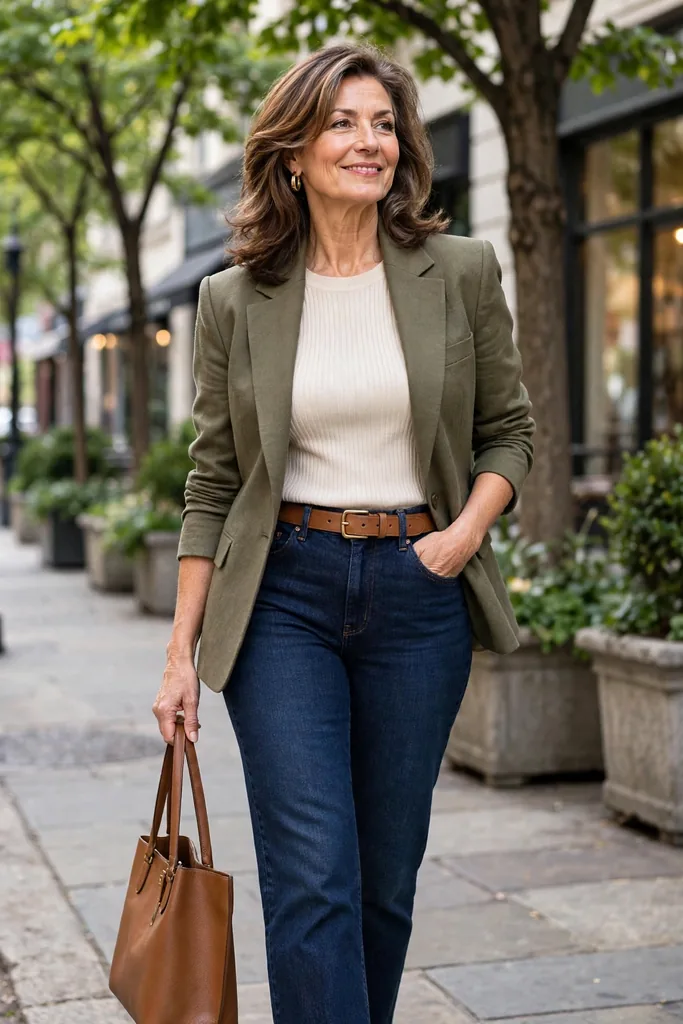
Hourglass styling gets dramatically simpler the moment you stop asking every garment to be the star.
Wide trousers? Then keep the topline cleaner. Full sleeves? Calm the bottom half. An oversized coat? Let the outfit underneath read at a glance.
That is not a demand for head-to-toe fitted.
It is a demand for contrast.
A fitted crew-neck knit with wide-leg trousers succeeds because the top shows the torso while the legs bring the motion. A relaxed blouse with straight-leg jeans works in reverse — the jeans hand the softer top a sturdier base. An olive-green blazer over a cream ribbed knit with dark indigo straight-leg jeans, a tan belt, and a tan tote nails the same principle: one structured layer up top, clean lines below, and nothing competing for attention.
Try a Tuesday-morning test drive: pull on your widest trousers, then deliberately choose the simplest top you own and tuck it in. Notice how the outfit suddenly looks styled rather than sloppy — that contrast is doing all the work. The next day, reverse it: a fuller blouse with your straightest jeans. Two easy outfits, same single rule, and your hourglass stays legible in both.
When an outfit starts feeling heavy, these small changes usually fix it:
- If top and trousers both feel oversized, tuck the top or trade one piece for a straighter cut.
- If a long cardigan swallows your waist, wear it open over a shorter top with the waistband on show.
- If a belt pinches or feels fussy, try a half-tuck, a wrap line, or a shaped seam instead.
- If the layers feel bulky, put one light fitted base underneath and build everything from there.
These small moves usually out-perform replacing the outfit outright.
Build a Personal Outfit Formula for Your Hourglass Shape
build-a-personal-outfit-formula-for-your-hourglass-shape.webp
A dependable formula saves you from re-solving the proportion puzzle every single morning.
For an hourglass shape, this one keeps proving itself:
Formula: defined top + visible waist + balanced bottom + clean shoe
The pieces themselves can rotate freely with your day.
Here is how the same formula flexes in real life.
| Occasion | Pieces | Why It Works |
|---|---|---|
| Everyday errands | Tucked knit, straight jeans, loafers | The waist shows while the mood stays easygoing |
| Lunch with friends | Flowing blouse, wide-leg trousers, low heel | Fluid shapes feel dressed-up without piling on bulk |
| Smart casual | Fine knit, A-line midi skirt, ankle boots | The waist stays clear and the lower half gains soft motion |
| Travel day | Fitted tee, open cardigan, straight trousers, sneakers | Easy layers that still let your proportions speak |
| Dinner | Wrap top, dark trousers, pointed flat | The diagonal line pulls the eye inward toward the waist |
Once one version clicks for you, keep repeating it.
Swap the color, the sleeve, the shoe, the jacket, the fabric — but stop rebuilding your whole style each morning.
That is when a personal uniform turns helpful instead of dull: decision fatigue drops, and you hold a trustworthy base for chic outfits for women over 50.
Your favorite take might be a tucked knit with straight jeans and a short jacket — a rust-orange blazer over an ivory top with charcoal cropped trousers, a brown belt, and brown loafers, say — while someone else leans toward a wrap blouse with wide trousers.
Both obey the same proportion logic.
The formula also travels well across seasons without any real changes. Swap the loafers for ankle boots, trade the blazer for a longer open coat, or replace the trousers with a midi skirt — the defined top, visible waist, balanced bottom, and clean shoe are still all there. That is the mark of a formula worth keeping: it bends around your calendar instead of breaking.
If Your Outfit Feels Frumpy, Inspect These Details First
if-your-outfit-feels-frumpy-inspect-these-details-first.webp
Good pieces can still combine into a slightly-off outfit.
Almost always, one proportion is working too hard.
Treat what follows as experiments, not hard-and-fast mistakes.
| If This Feels Off | Try This Instead |
|---|---|
| Long boxy top swallows the waist | Add a partial tuck or choose a slightly shorter hem |
| Oversized blazer feels heavy | Keep it open over a close-fitting knit |
| Wide trousers take over the outfit | Team them with a simpler, more defined top |
| A tight belt feels uncomfortable | Lean on a wrap shape, a seam, or a visible waistband |
| A dress reads as shapeless | Bring gentle definition with a tie, a cropped layer, or tailoring |
Color can shape you too.
When your top, trousers, and outer layer sit in nearly the same tone, the eye travels one unbroken line — elegant, yes, but the waist can soften right into it.
You can stay tonal and still keep definition. Try a fine knit tucked into fluid trousers under an open, longer jacket, or a plum wrap top with dark straight-leg trousers and low nude heels — the waist shows, yet the palette never raises its voice.
The look stays calm, yet the waist never disappears.
One last habit: check the outfit from the side and back before you leave. Most of us dress the mirror’s front view and forget that a tucked hem can ride up at the back or a waistband can gap when you sit. Thirty seconds and a three-way mirror — or your phone’s camera on a timer — catch the issues no front view ever shows.
FAQs
Which styles flatter an hourglass body over 50 the most?
Pieces that hint at the waist while giving the bust and hips room tend to shine — wrap tops, jackets with a shaped middle, trousers in a mid or higher rise, straight jeans, A-line skirts, and dresses with a waist seam all earn their place.
The winner is always the piece that traces your proportions without feeling snug or restrictive.
Can women over 50 with an hourglass shape still wear relaxed clothes?
Yes — relaxed clothing simply asks that not every piece carry the same volume.
Style wide trousers with a neater top, or leave an oversized jacket open over a more defined base. The easy feel stays; the shape stays visible.
Does an hourglass figure need a belt every time?
No — a belt is one route to waist definition, not the only one.
A tuck, a wrap-front top, a shaped jacket, a visible waistband, a cropped layer, or a dress seam can do the same job. If belts dig or feel fussy, skip them without a second thought.
Are high-waisted jeans a good match for an hourglass body?
They can be, particularly when the waistband lies smooth and the hips still get enough room.
You are not obliged to wear the highest rise on the shelf — pick the rise that sits comfortably when you sit down and gives a clean handoff between your top and jeans.
How do I look current without dressing younger than my age?
Think in modern proportions, not in every passing trend. A wider trouser, a refreshed straight jean, a relaxed blazer, a contemporary flat, or a clean sneaker can bring familiar basics up to date.
It keeps dressing over 50 in conversation with today’s fashion while feeling completely like you.
The Takeaway: Your Shape Is the Style
Here is the simplest truth in this whole guide: your hourglass was never the problem, and it was never something to dress “in spite of.” Every tip above — the visible waistband, the hem that lands in the right place, the fabric that skims, the single spot of volume — is just a different way of letting your natural line do the talking.
Start with one small shift this week. Tuck the knit you already love into a higher-rise jean, or wear the cardigan open instead of buttoned. Watch how quickly the mirror starts agreeing with you, and how much easier getting dressed becomes when the proportions are already working in your favor.
Comfort never had to mean disappearing, and polish never meant squeezing. Dress the shape you actually have, in the colors that make you feel like yourself, and the rest of the style conversation gets wonderfully simple.