
What Your Winter Wardrobe Really Needs After 50

There is a special kind of frustration that arrives with the cold: suddenly every outfit demands bulky layers, stiff fabrics, and heavy shoes, and nothing in the mirror feels like you anymore.
Past 50, plenty of women notice their longtime favorites have stopped cooperating in layers. A thick sweater that once slid neatly under a coat now bunches and rides up; trousers snag against boots instead of falling clean; and the practical pieces meant to solve winter end up weighing the whole outfit down.
Buying more is not the fix. The wardrobe essentials for women over 50 worth keeping are the rare pieces that layer without a fight, stay comfortable from morning to night, and mix with each other on autopilot.
Get three things right — fabrics that earn their keep, proportions that flatter, and a handful of combinations you can repeat — and winter dressing turns warm, polished, current, and genuinely easy.
Table of Contents
- Every Winter Piece Should Earn Its Place in Your Closet
- Begin With Base Layers That Warm Without the Bulk
- Choose Trousers and Jeans That Pair With Winter Footwear
- Pick Knitwear With Shape, Not Fabric That Swallows You
- Let a Great Coat and Sensible Shoes Do the Heavy Lifting
- Shape a Compact Winter Capsule Around Your Actual Week
- Spend Less by Repairing the Weakest Link in Your Winter Wardrobe
- FAQs
Every Winter Piece Should Earn Its Place in Your Closet
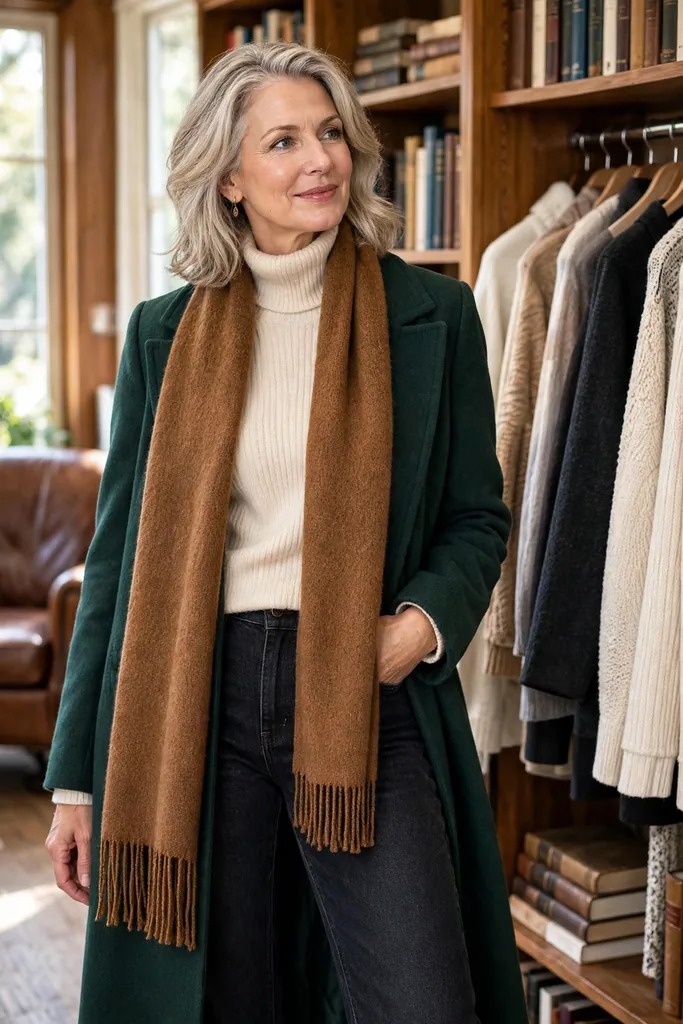
Calling something an essential takes more than a neutral color or a basic shape. To deserve the name, a piece should fix a genuine dressing headache — and team up with half the things you already own.
Here is the test I use: if one merino sweater can handle your coat days, your shirt days, and your jeans days, it has earned more closet space than any dramatic knit chained to a single pair of trousers.
Fit is half the battle, because winter clothing adds visual weight all by itself. Neat shoulders, restrained volume, and fabrics that drape rather than billow will do more for easy layering than any trend ever could.
The wardrobe essentials for women over 50 that matter most are the ones shaped around your real life. A work-from-home routine calls for softer knit layers; a commuting or travel-heavy life gets far more mileage from weather-ready boots and one structured coat.
Whether you end up warm or merely bulky usually comes down to fabric. The quick rundown below narrows it to the fabrics that truly pull their weight in everyday winter dressing.
| Fabric to Know | What It Does for a Winter Wardrobe |
|---|---|
| Merino wool | Delivers real warmth in a fine, smooth knit — no heavy layers required |
| Cashmere and cashmere blends | Feather-light softness that warms sweaters and scarves without weight |
| Cotton jersey | The easy-comfort pick for base layers worn indoors and relaxed outfits |
| Wool blends | Where coats and trousers need both structure and warmth |
| Ponte knit | Trousers that hold their line all day yet still move with you |
Do not feel you must own them all. Start with the one fabric that solves your most frequent winter complaint, then build outward from there.
Begin With Base Layers That Warm Without the Bulk
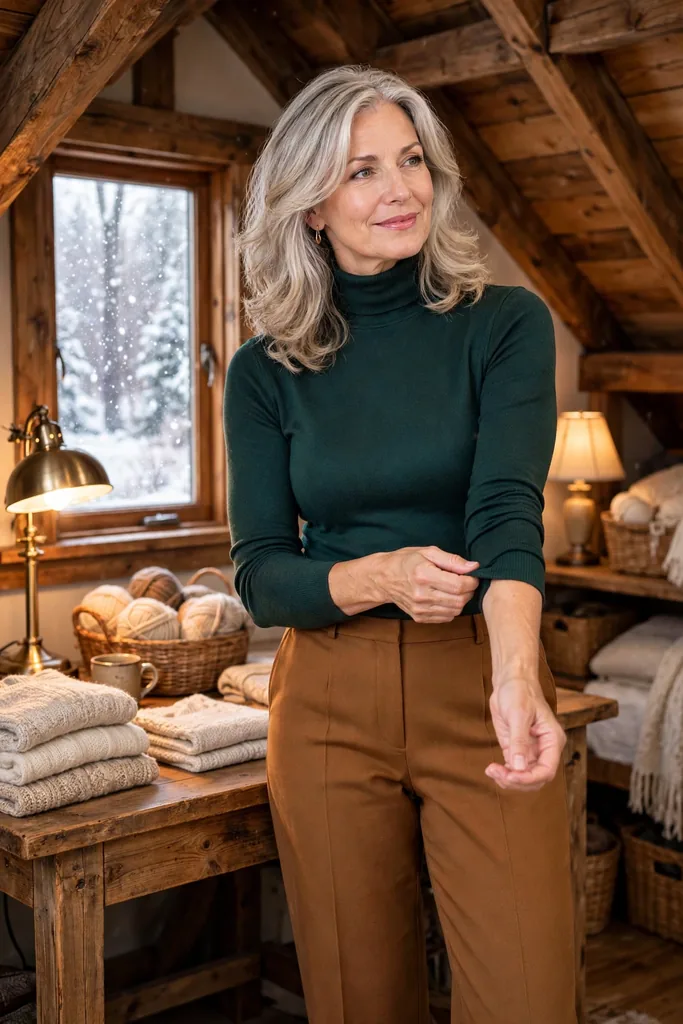
Counterintuitively, the simplest winter outfits rarely begin with the heavy sweater. They begin with the slim layer underneath it.
A neat long-sleeve tee, a fine merino top, a ribbed knit, or a soft mock neck will trap body heat — and still leave room above for the cardigan, blazer, or coat to come. A silk camisole or heat-tech layer tucked underneath adds surprising warmth for almost no bulk at all.
This is not about wearing things tight. You want a first layer that traces your shape without pulling anywhere — chest, shoulders, or waist.
Necklines change the math, too. A crew neck disappears cleanly under sweaters; a V-neck opens space around the face; a mock neck warms the throat without the extra roll of fabric a folded turtleneck demands.
Try this: if every sweater feels like too much under your coat, trade one thick inner layer for a slimmer wool or cotton knit. The warmth barely changes — but your freedom to move changes enormously.
Do not overlook color as a workhorse here. Black, navy, cream, charcoal, chocolate, olive, and soft gray make effortless foundations, yet nothing obliges you to stay neutral.
One base layer in berry, teal, rust, or deep green is often all it takes to shake the dullness out of a winter wardrobe.
Choose Trousers and Jeans That Pair With Winter Footwear
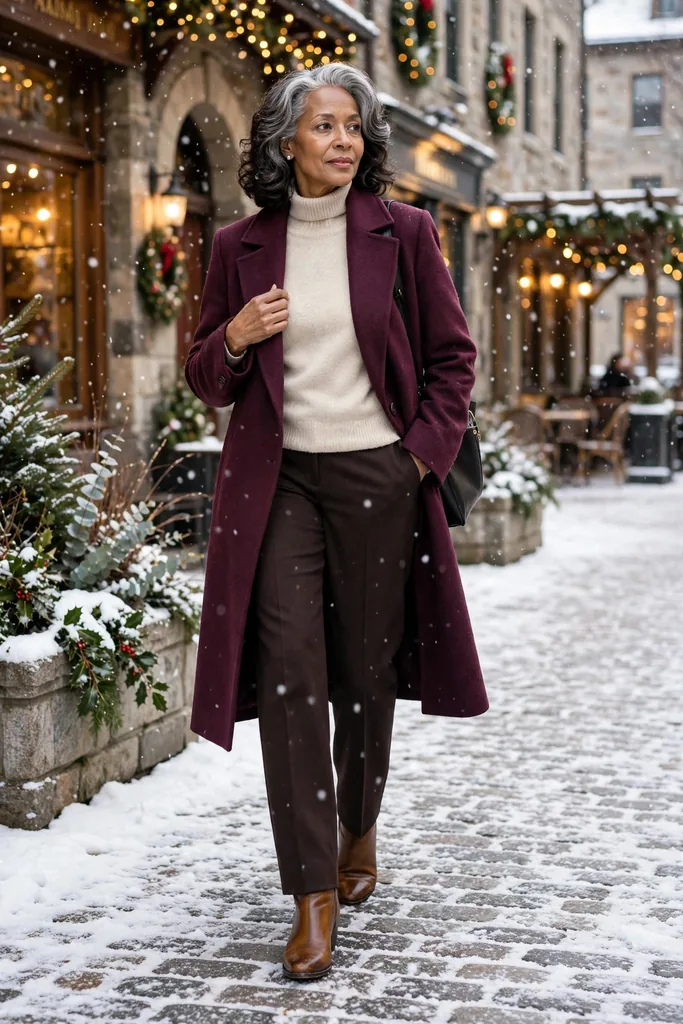
A winter bottom is judged twice: once against your top half, and again against your footwear. It has to fall properly over boots, sneakers, loafers, or weatherproof shoes — not just look right on the hanger.
This is where straight-leg jeans quietly win. They clear most ankle boots with room to spare, minus the pooling and excess of a very wide leg.
Wash matters, too — dark denim plus a sweater and loafers reads polished, while a medium wash keeps the everyday uniform relaxed.
Trousers live or die by fabric weight: choose cloth with enough body to hang clean. Ponte, brushed twill, and wool blends will serve you far better in the cold than thin fabrics that cling or crease by noon.
Then there is length — the detail everyone forgets. Trousers that look elegant with flats can collapse into awkward bunching the moment an ankle boot goes underneath.
Make it a rule: never buy winter trousers without trying them with your most-worn winter shoes. Five minutes of that test beats any amount of barefoot mirror-gazing.
One more lever: a slightly higher rise. It lets sweaters and jackets meet the waistband in a clean line — a small thing that matters most with cropped jackets or a half-tucked knit.
Pick Knitwear With Shape, Not Fabric That Swallows You
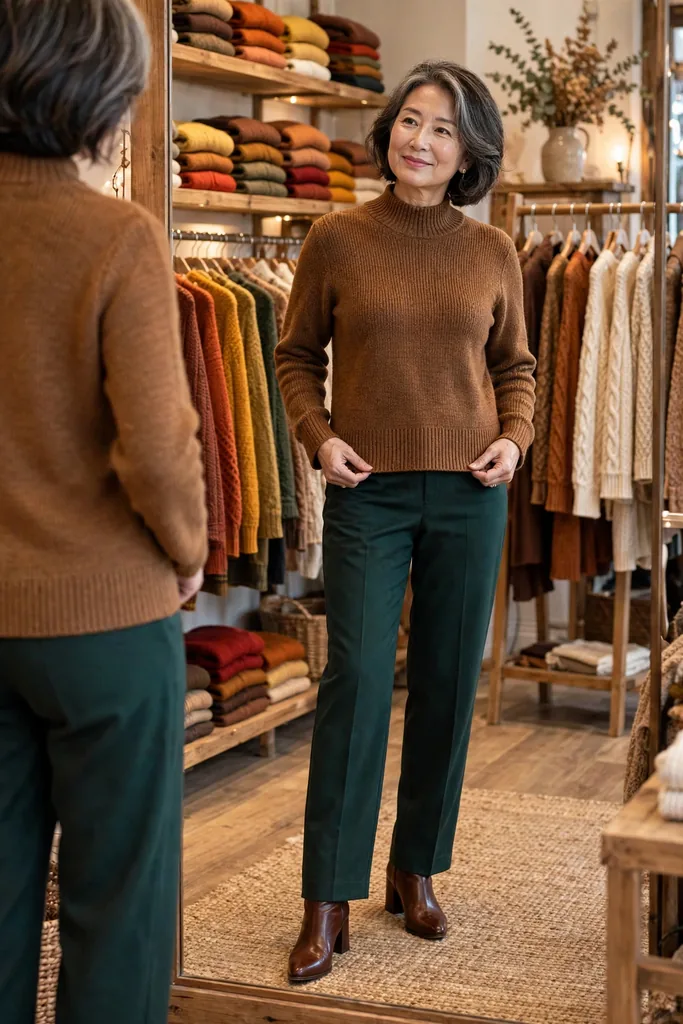
Knitwear is non-negotiable in winter, yet piling on thickness is no guarantee of either warmth or style.
The sweaters that style themselves are the ones with intention built in: a defined shoulder, a sleeve that behaves, a hem that stops where it should. An oversized knit with volume in every direction asks far more of you.
That is not a ban on relaxed sweaters — only a reminder to balance the volume.
Pairing logic helps: let a roomy knit sit over straighter trousers, and save the wider leg or fuller skirt for the closer-fitting sweater.
Use this five-point check in the fitting room:
- Shoulders: the seam belongs on the shoulder — not sliding down the arm into a shapeless droop.
- Sleeves: slightly relaxed reads comfortable; dramatically wide reads bunched the second a coat goes over it.
- Hem: a hip-length or slightly cropped hem plays nicest with trousers.
- Texture: choose fine ribs and smooth knits over heavy cables when layering is the plan.
- Neckline: it should feel easy at the throat and leave room for a scarf or a necklace to sit.
Before you retire a shapeless sweater, try rescuing it: a small front tuck, one rolled cuff, or a longer pendant can redraw the whole silhouette into something intentional.
Tweaks this small cost nothing and add nothing — yet they can make everyday outfits for women over 50 look entirely deliberate.
Let a Great Coat and Sensible Shoes Do the Heavy Lifting
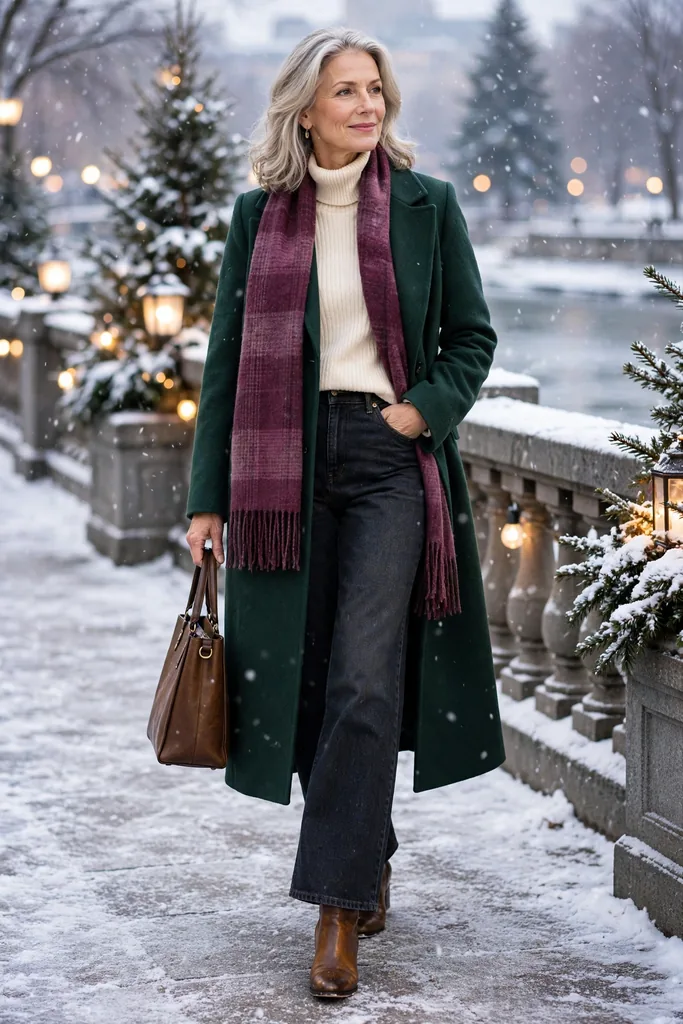
In winter, your coat speaks first. Whoever meets you reads the coat before anything else — which is why fit and proportion outrank any passing trend.
The hardest-working shape is the knee-length wool coat: trousers, denim, dresses, skirts — it covers them all. Beside it, a shorter structured jacket earns its keep on driving days, errand runs, and milder winter afternoons.
If your winter includes real rain, wind, or snow, let function lead. A warm puffer cut in a clean silhouette looks every bit as polished as wool — the fit does the talking, not the filling.
Apply the same realism to shoes. The right winter footwear carries you through a normal day on steady footing, without making you choose between comfort and looking pulled together.
Depending on your climate, the shortlist might include ankle boots, sleek weatherproof boots, supportive leather sneakers, or sturdy loafers — each one earning its place by suiting your actual weather.
Here is the quiet superpower of a winter wardrobe: keep the base identical and change only the coat and shoes, and the whole mood of the outfit shifts. A wool scarf, leather gloves, and a warm hat finish the job — and they are the cheapest way to make a coat you have worn for years feel new again.
| Starting Point | Daytime Casual | Dressed-Up Casual | When It Is Freezing |
|---|---|---|---|
| Straight-leg jeans with a merino sweater | Leather sneakers | Wool coat over ankle boots | Puffer with weatherproof boots |
| Black trousers with a knit top | Cardigan and loafers | Structured coat with ankle boots | Long wool coat with flat boots |
| A knit dress | Crisp white sneakers | Knee-high boots | A warm coat with tall boots |
| Dark denim with a button-down | Quilted jacket and sneakers | Blazer with loafers | Wool coat with boots |
It explains the paradox of the small winter wardrobe: fewer pieces, more outfits. The coat and the shoes do the transforming — everything underneath can stay exactly as it is.
Shape a Compact Winter Capsule Around Your Actual Week
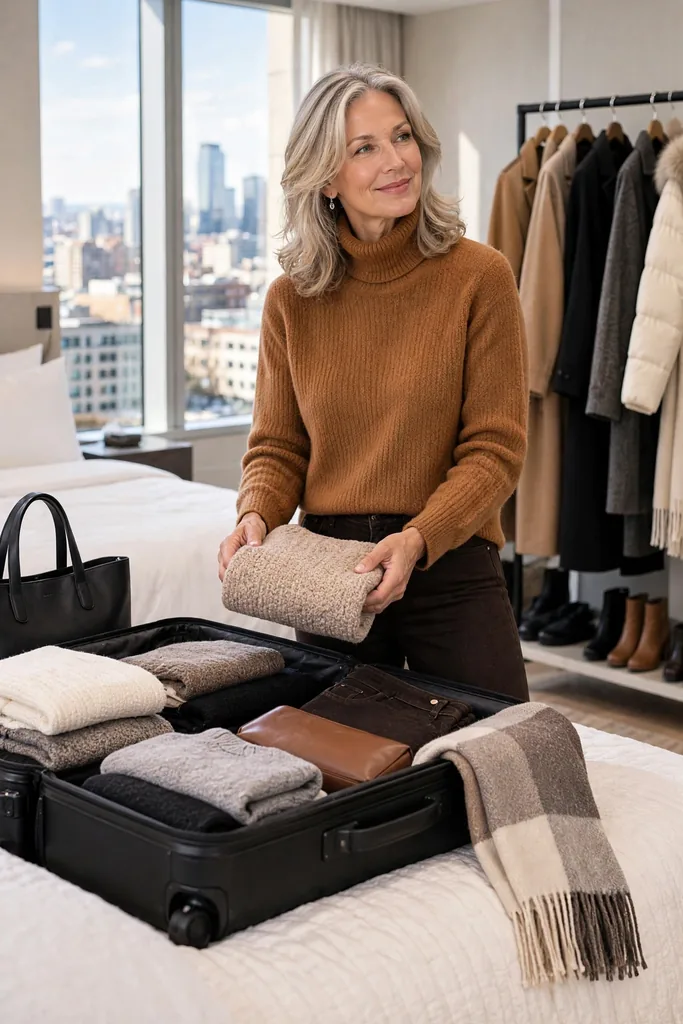
Forget the magic number: a workable capsule wardrobe over 50 is not defined by how many garments it holds, but by whether it covers the situations you repeat week after week.
Map your real winter week first. Yours might be built from errand runs, long lunches with friends, work-from-home days, appointments, travel, and the occasional casual dinner out.
Start the capsule there — with those days, not with a shopping list.
Picture the foundation: dark jeans and comfortable trousers below; two or three fine knits plus a cardigan above; a coat, ankle boots, and one comfortable everyday shoe to finish.
Personality comes last, through scarves, earrings, color, texture — or a single bolder jacket that feels unmistakably you.
The table below proves the point: a small group of pieces, rearranged, can dress nearly every part of your week.
| Where You Are Headed | Wear This | Why It Works |
|---|---|---|
| Errands | Straight jeans, a fine knit, a cropped jacket, sneakers | Warm enough, never overdressed |
| Lunch with friends | Trousers, a V-neck sweater, ankle boots, a wool coat | Clean proportions read elegant without trying |
| Travel day | Ponte trousers, a soft knit, a cardigan, supportive sneakers | Layers that flex as the temperature changes |
| A casual evening | Dark jeans, a mock neck, a structured coat, boots | Contrast and structure polish the simplest pieces |
Distill it further and you get a personal uniform worth repeating:
Formula: straight trousers or jeans + a fine knit + a structured outer layer + comfortable shoes
Why it works: the bottom half stays clean and quiet, the knit controls the bulk, and the outer layer supplies all the shape.
Rotate the knit color, trade the jeans for trousers, swap the sneakers for boots — one idea, most of winter covered.
Spend Less by Repairing the Weakest Link in Your Winter Wardrobe
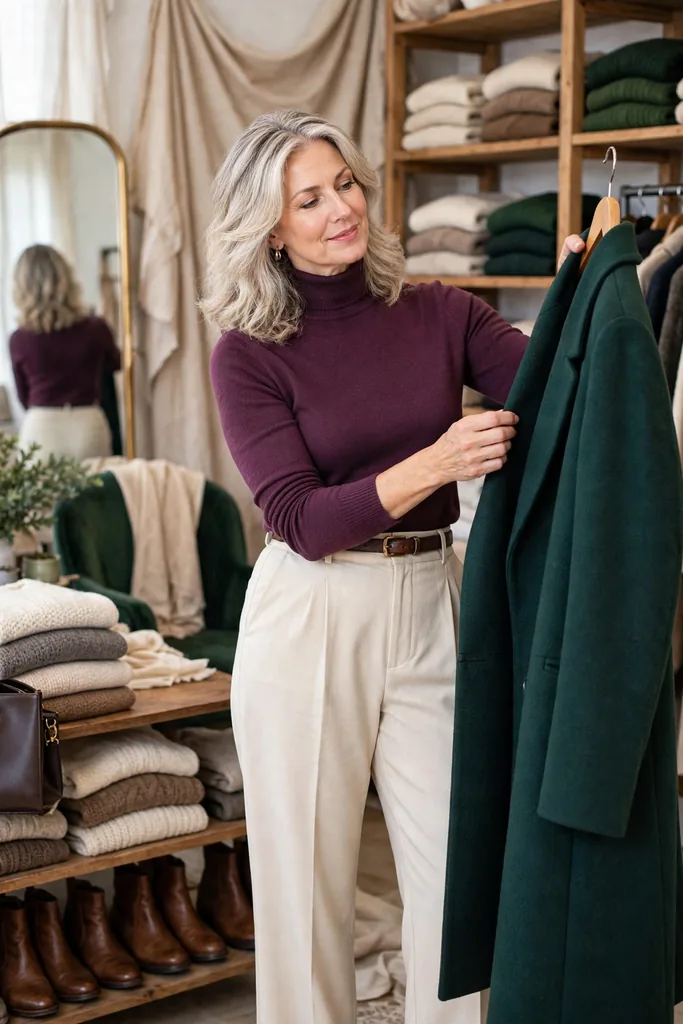
Here is the best news: most of what you need is probably already hanging in your closet.
Before you spend anything, lay out the pieces you wear on repeat and pinpoint the exact moment getting dressed turns difficult.
The pattern is usually specific: the trousers are fine, but no sweater sits right under the coat. Or everything fits, yet the only winter shoes you own feel too formal for daily life.
That gap — and only that gap — is what deserves your money first.
Think in cost per wear, not closet size. Run the numbers — a four-days-a-week coat against a twice-all-winter party top — and the winner for your attention and budget is obvious.
Your boots, trousers, knitwear, and base layers deserve that same cost-per-wear calculation.
And do not overlook the tailor. Shortened sleeves, adjusted hems, fresh buttons, or a coat gently reshaped can drag clothes you already own straight back into the present. A good cobbler can resole worn boots or stretch a tight pair for a fraction of what replacements cost.
The whole game gets easier after 50 when your closet works around your routine — instead of asking you to invent a new outfit every single morning.