
Winter Layers After 50: A Warm, Streamlined Way to Dress Without the Bulk

Getting dressed on a frosty morning turns into a small daily puzzle the moment staying warm demands one more heavy layer. A soft sweater, a sturdy coat, a wrapped scarf, and tall boots stack up until the mirror shows something broader, weightier, and far less polished than you pictured.
Past fifty, layered dressing rarely fails because layering itself is wrong. More often the stumble comes from dense fabrics, clashing hemlines, and loose silhouettes arriving all at once.
Here is the reassuring part: stylish outfits for women over 50 can stay honestly warm straight through January. The real skill lies in choosing where the warmth lives, where the structure sits, and where fabric should drift nearer the body.
No full closet overhaul is needed. A few thoughtful tweaks to fabric, proportion, and stacking order make your wardrobe work twice as hard.
Before you open the closet, hold a three-step order in mind: what warms the skin, what warms the outfit, and what shapes it. Filling those three slots beats debating pieces every morning.
Table of Contents
- Why Winter Outfits Begin to Feel Heavy So Fast
- Begin With Slim Layers That Hug the Body
- Let Your Middle Layer Add Warmth Without the Width
- Use Coat Length and Proportion for a Clean Silhouette
- Make Scarves, Sweaters, and Shoes Suit Your Silhouette
- Break the Layering Habits That Add Extra Bulk
- A Repeatable Winter Outfit Formula for the Whole Season
- FAQs
Why Winter Outfits Begin to Feel Heavy So Fast
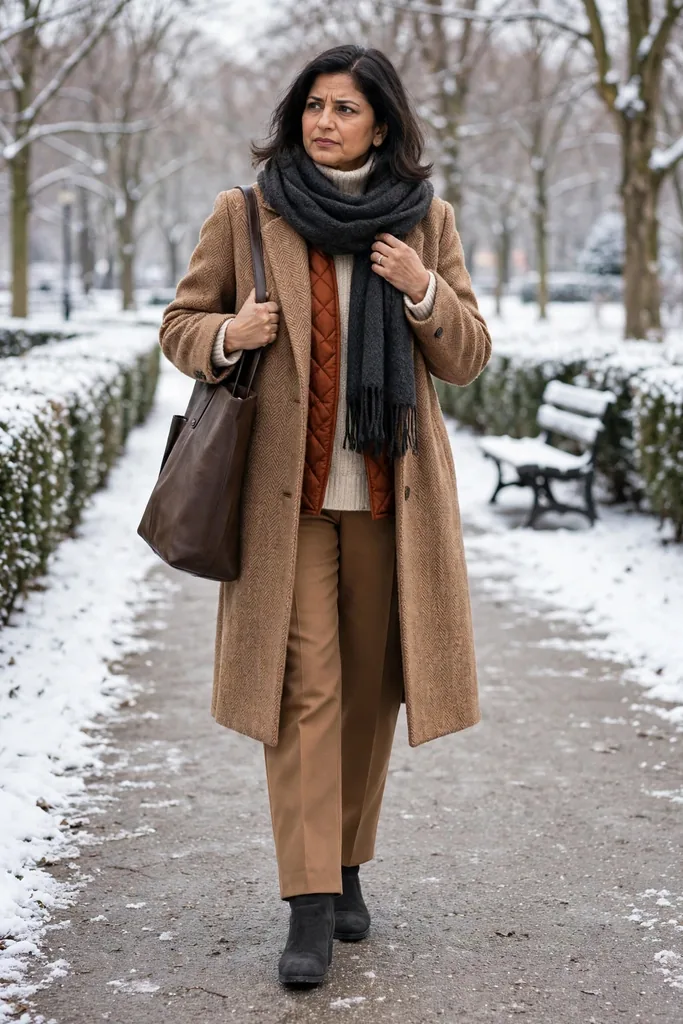
Most outfits that read as bulky are not guilty of stacking too many garments — the real trouble is thick pieces in the same place. A rich camel coat over a soft cream knit looks crisp, while that same knit trapped beneath a deep rust quilted vest and a deep charcoal scarf buries the neckline. The piece count never changed — only the concentration of padding.
A heavy knit wedged inside a padded jacket loads shoulders, bust, sleeves, and waist with fullness in one go. A generous scarf thrown over the top erases the upper half’s remaining definition.
A slouchy knit looks current on its own, and so does an easy coat, yet wearing both over sweeping rich camel trousers can erase nearly every crisp edge from the look.
The simplest mental model is a volume equation. When one piece runs roomy, let another section stay leaner or more close-fitting, with deep charcoal boots grounding the look in a firm finish. None of this demands tight clothing — only enough contrast to keep your figure readable beneath the layers.
Begin With Slim Layers That Hug the Body
Whatever touches your skin first has a single job: create warmth, not width.
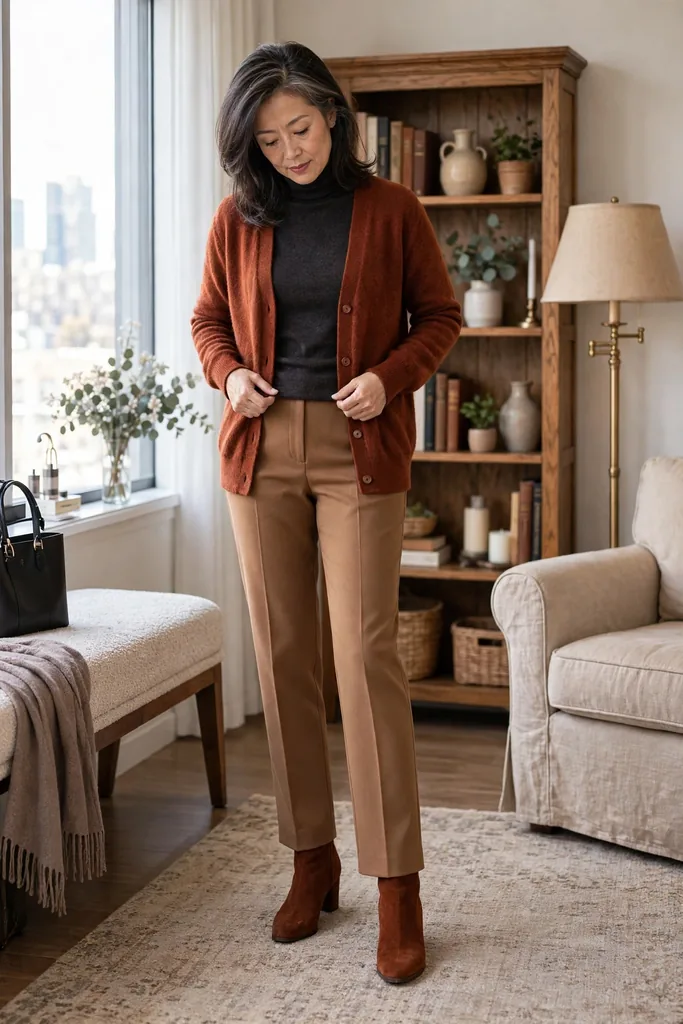
Your first layer works hardest light: a whisper-weight long-sleeve knit, superfine merino, a barely-there thermal, or a sleek jersey beats a dense cotton tee. A deep charcoal turtleneck in one of these fabrics traps air against the skin, keeping the frame slim for everything above it.
A well-chosen base traces your shape instead of squeezing it. When it rucks beneath a sweater or curls at the waistband, the layer above reads lumpier than it is.
Thickness alone never tells the whole story. Fine knits glide beneath other garments where brushed, lofty textures grab and fight you — the same reason a deep rust cardigan over rich camel trousers drapes cleanly while deep rust boots anchor the look without visual weight. The guide below maps the fabrics that cooperate best.
Test fabrics palm-to-palm in the store: merino and silk glide, while brushed fleece and heavy cable knits catch. That five-second check predicts how each base layer will behave under your sweaters all season.
| Layer or Fabric | What to Look For and Why It Works |
|---|---|
| Fine merino knit | Steady warmth through slim sleeves, no added thickness |
| Delicate thermal weave | Hides cleanly under shirting, knits, and casual outerwear |
| Sleek jersey top | Layers cleanly and pulls double duty as an indoor piece |
| Fine-gauge cardigan | Extra heat, far trimmer than a bulky knit |
| Chunky wool knit | Best as the visible top layer, not buried under more pieces |
Fit tip:
When a sweater feels perfect solo yet strained over a base layer, the cut is usually the culprit — it needs a touch more freedom through the armhole and sleeve.
That little extra room turns layering from a tug-of-war into easy comfort, and the sweater still reads tailored rather than oversized.
Let Your Middle Layer Add Warmth Without the Width
The middle tier is where most outfits quietly pick up weight they never needed. The usual suspects are the knit, cardigan, shirt-jacket, blazer, or light jacket sandwiched between your foundation and coat.
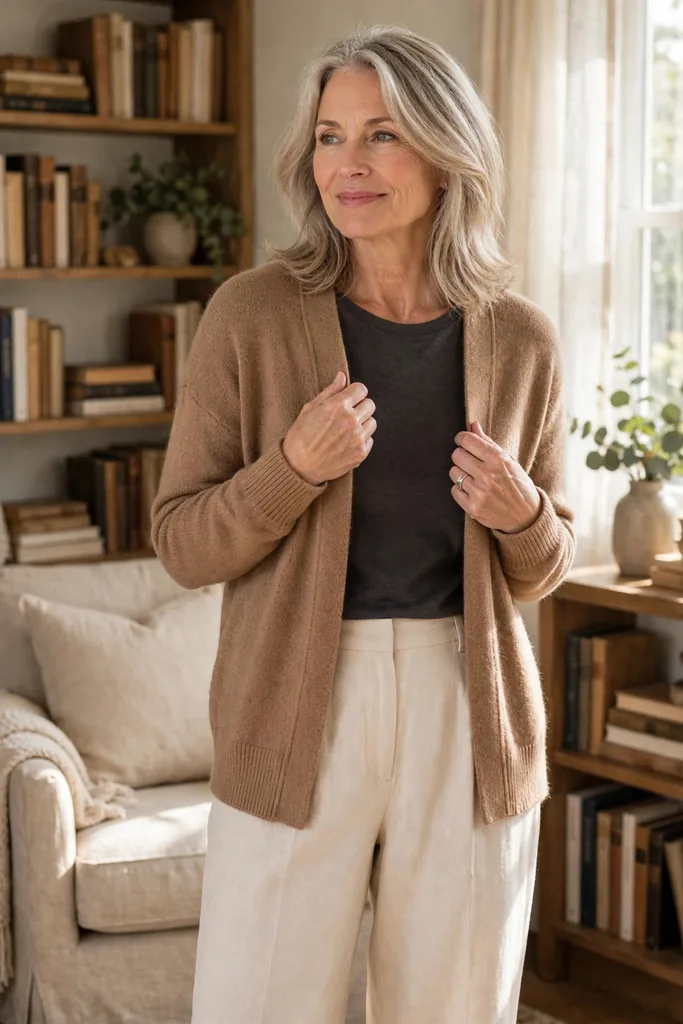
This tier rewards heat in a disciplined shape. Fine-gauge crewnecks, easy V-necks, tidy cardigans, knit jackets, and trim fleece all qualify — a rich camel cardigan over a deep charcoal tee, for instance, warms the torso with a crisp outline.
A slightly cropped sweater earns its place over straight or wider cuts — the shorter hem lets the leg line show through. Slim or narrow trousers find their counterweight in a longer cardigan or tunic-length knit.
When a substantial knit is your favorite piece, hand it the starring role. Keep everything beneath it whisper-thin and choose a coat cut generously through the sleeves — soft cream wide-leg trousers below keep the lower half flowing without competing.
Two warm pieces do not belong together simply because they are both warm. Forcing a heavy knit beneath a fitted coat is a pairing the outfit never asked for.
Comfort upgrade:
Give every winter outfit a hallway rehearsal: sit down, stretch both arms forward, and listen to what the fabric tells you. Shoulders that tug or layers that gather under the arms are asking you to drop one thick piece, not to size everything upward.
Use Coat Length and Proportion for a Clean Silhouette
The coat draws the final boundary around your whole look, making its silhouette the outfit’s most influential choice.
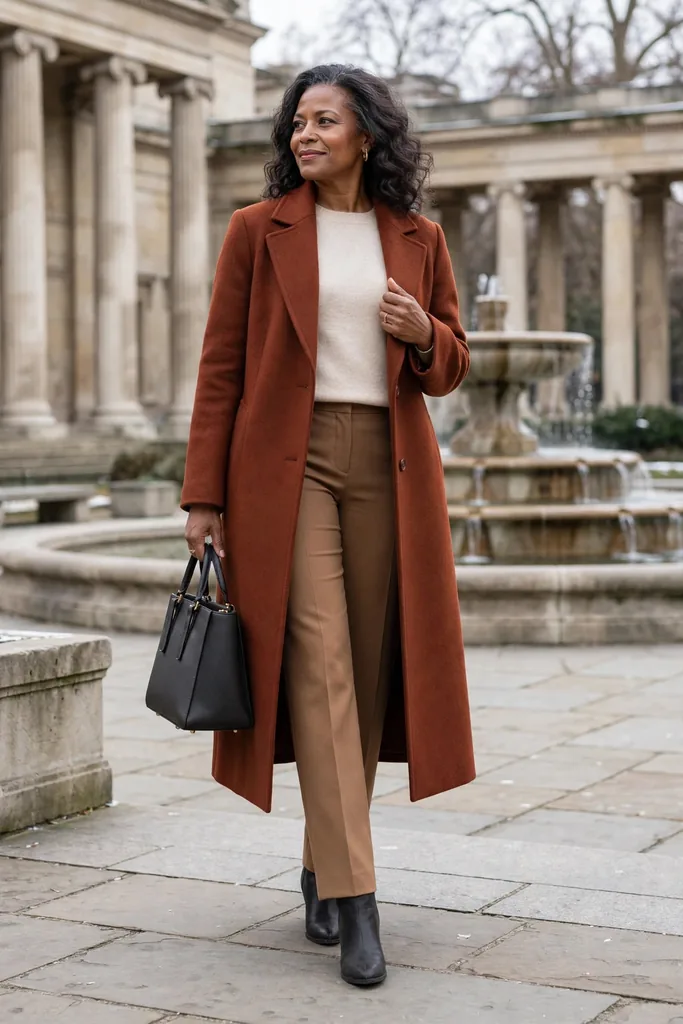
A neat single-breasted wool coat has a calming effect on a hefty knit. Worn long, a deep rust coat settles nicely over slim rich camel trousers and ankle boots, while a cropped jacket loves high-rise trousers or a sweeping skirt.
Shrinking your frame is never the objective here. The point is keeping enough architecture that every piece still reads intentional and composed.
Check the hem map: keep a two-inch gap between each visible hemline, and let no single layer end at your widest point — that is where silhouettes quietly surrender.
For example, pairing an extended coat with tunic-length knits and sweeping wide trousers pitches several vertical hems against each other. A tucked or half-tucked inner knit — a soft cream sweater is ideal — or a middle layer hemmed a touch higher brings those proportions back into line. That same thinking assembles stylish outfits for women over 50 straight from your own closet: revising a single hemline usually beats purchasing yet another sweater, and a deep charcoal bag keeps the accessories on the same disciplined page. Different days need only small tweaks to the same foundation.
| Situation | Keep the Base | Make This Swap |
|---|---|---|
| Running errands | Fine knit with straight jeans | Top with a hip-skimming puffer and sneakers |
| Lunch with friends | Fine knit with tailored trousers | Finish with a wool coat, loafers, or ankle boots |
| Very cold day | Thermal beneath a knit with trousers | Layer on a long insulated coat |
| Travel day | Soft base layer with pull-on trousers | Add a cardigan under a featherweight puffer |
| Mild winter afternoon | Long-sleeve tee with jeans | A lighter wool jacket instead of the heavy coat |
This modular approach quietly powers a capsule wardrobe over 50 — the same foundation pieces stretch across temperatures and occasions instead of multiplying.
Make Scarves, Sweaters, and Shoes Suit Your Silhouette
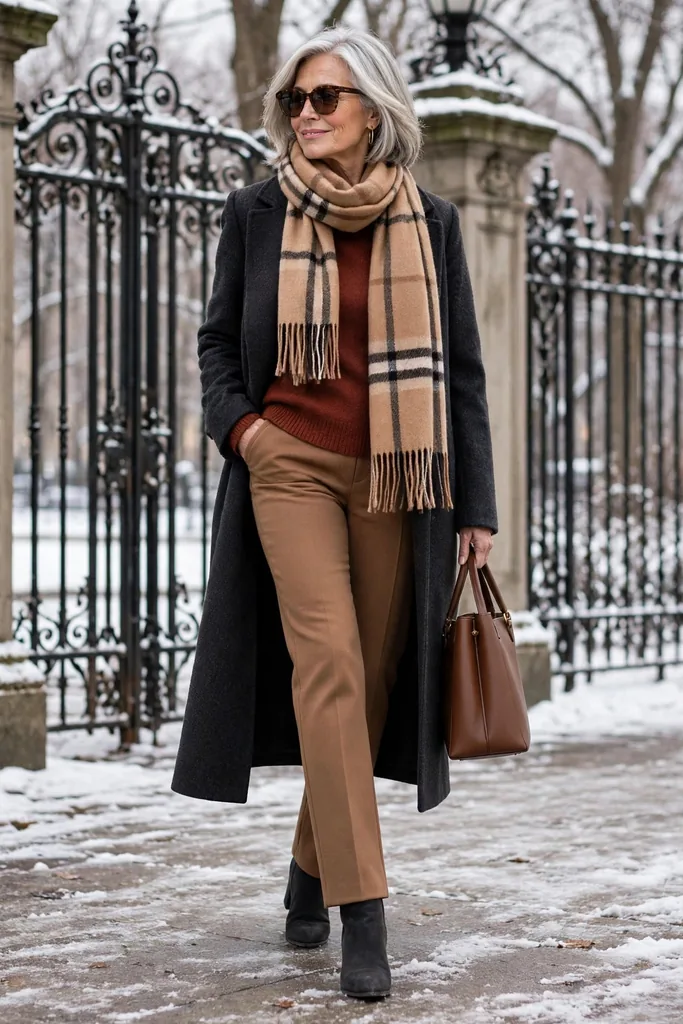
Accessories deliver warmth without another full garment — though they redraw proportions, so placement carries real weight.
Shoulders already carrying volume from a deep rust sweater and deep charcoal coat do not need a massive blanket scarf — that reads as one layer too many. Reach instead for a slimmer, gentler camel check scarf — it warms the neck while keeping the coat’s neckline on display.
A few proven pairings make these decisions nearly automatic:
- Team a substantial knit with straight-leg jeans or tidy rich camel trousers and an uncomplicated boot.
- Under a full-length puffer, keep every layer beneath streamlined.
- Generous trousers ask for a cropped knit up top, or a waistline left visible.
- Let an extended cardigan float over one clean column — top and trousers in the same tone.
- With rugged boots, keep hems crisp so fabric never pools at the ankle — deep charcoal boots handle this job especially well.
Your shoes anchor every heavy fabric above them — pick clean-reading silhouettes: a sleek ankle boot, a solid-soled loafer, a crisp sneaker, or a streamlined knee boot.
Read shoes and hems as one continuous line: cuff a jean to meet the top of the boot, or let a trouser leg break softly over a loafer’s vamp. When hem and shoe meet cleanly, the leg below the knee looks deliberate.
Footwear swap:
When the whole look turns clunky, audition sleeker footwear before altering a single garment. The troublemaker usually sits at the bottom of the look, not the top.
Break the Layering Habits That Add Extra Bulk
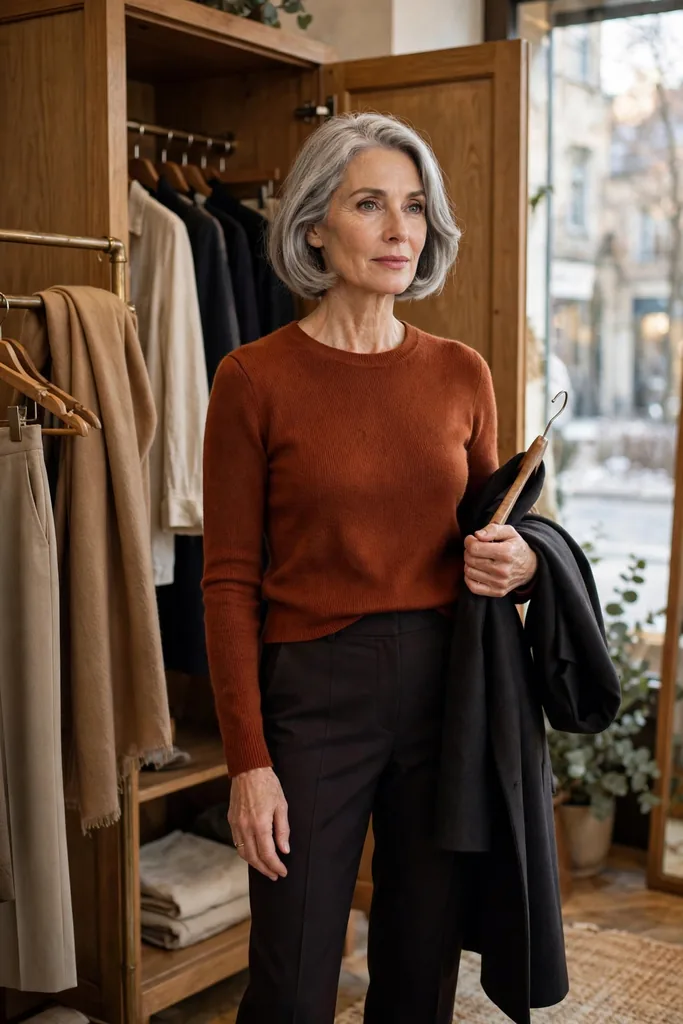
Forget rigid wardrobe rules. A sharper approach: spot pairings that leave you feeling buried or uneasy, then adjust a single element.
Some winter heroes refuse to share the stage — give them the headline slot instead of burying them mid-stack, as a deep rust sweater deserves its moment rather than vanishing under two more knits.
| Instead of This | Try This |
|---|---|
| A heavy knit crammed under a snug coat | Pair the coat with a fine knit underneath, or let the heavy knit lead under a roomier shell |
| Piling an oversized top, oversized coat, and wide trousers together | Let a single oversized piece star while the rest stays quiet |
| A stack of thick cotton layers | A single featherweight thermal replaces the whole stack |
| A bulky scarf heaped onto a high-neck knit | Go lighter on the scarf, or leave the neck open |
| Three long hems stacked: top, cardigan, coat | Give the middle layer a shorter hem for breathing room |
Still devoted to that oversized cardigan or dramatic camel scarf? Keep both in rotation. The remedy is space — let the statement piece breathe over deep charcoal trousers instead of competing with its neighbors.
That same principle explains why everyday outfits for women over 50 often turn out sharper when softness comes from one piece and structure from another.
A Repeatable Winter Outfit Formula for the Whole Season
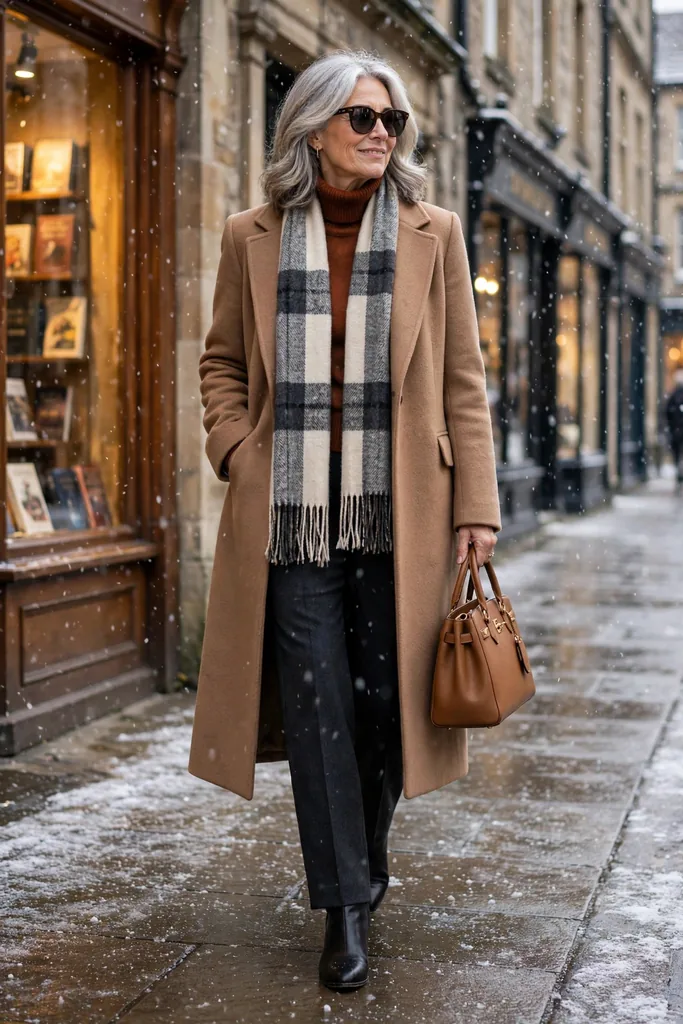
Cold mornings do not require a brand-new invention every day. One dependable uniform takes most morning indecision off your plate — ideally before the coffee cools.
The formula: fine-gauge base layer + straight-leg trousers + clean-lined coat
A fine-gauge base layer generates warmth without bulk, straight-leg trousers draw one clean line below the waist, and a crisp-lined coat supplies the architecture. Footwear closes the formula — boots, loafers, or sneakers, chosen for the day.
Color does the mood-shifting so the formula never has to: a rich camel coat over a deep rust turtleneck, a cream-and-charcoal check scarf warming deep charcoal trousers, or a rich camel bag lifting a quiet palette — small swaps, same dependable skeleton.
Bitter mornings earn a featherweight cardigan its place between base and coat. Milder afternoons need only the scarf to carry that extra warmth.
Wash base layers often and middle knits sparingly, with gentle detergent and flat drying. Kindly treated knits keep their trim shape for seasons, so your lightest pieces keep pulling their weight.
Individual pieces can rotate endlessly while the formula stays familiar — that steady familiarity gives a personal uniform its power.
FAQs
01What is the sweet spot for winter layer counts without bulk?
Three thoughtfully chosen layers generally beat a heap of thick ones — a light foundation, a warming middle, and the outer coat. Bitter weather may call for a fourth, yet featherweight fabrics keep those additions from reading as bulk. Pay less attention to the count and more to how thick each layer is and how it fits.
02What kind of knit sits happiest beneath a winter coat?
Coats glide easiest over a short list: slim merino knits, breathable wool blends, sleek cotton, and delicate cashmere. Choose narrow-running sleeves, and check that shoulder seams rest flat under your coat. A chunky knit still earns its place — it simply asks for a roomier outer layer.
03Do oversized pieces still work for layered outfits after 50?
Absolutely — oversized pieces feel current and cozy beside a leaner shape. A generously cut coat sharpens over a clean trouser line, while wide trousers regain poise under a shorter, more defined top layer.
04What keeps you warm when a thick sweater is off the table?
Distribute insulation across several light layers rather than one heavy one. One tissue-thin thermal under a medium-weight knit frequently out-warms a single bulky sweater. Warm socks, lined boots, a good scarf, and a well-insulated coat pile on heat with almost no visual penalty. And do not underestimate a fitted turtleneck as a base — it warms the neck and underarms, where body heat escapes first.
05Which palette keeps layered winter outfits easiest to pull together?
Build on neutrals — navy, camel, cream, charcoal, olive, brown, black — which move easily between layers without demanding an all-neutral closet. Anchor two or three layers in one color family, and a bright scarf, sweater, or handbag can shine while keeping the outfit calm.