
Mother of the Bride Dressing Guide: Look Spectacular Over 50
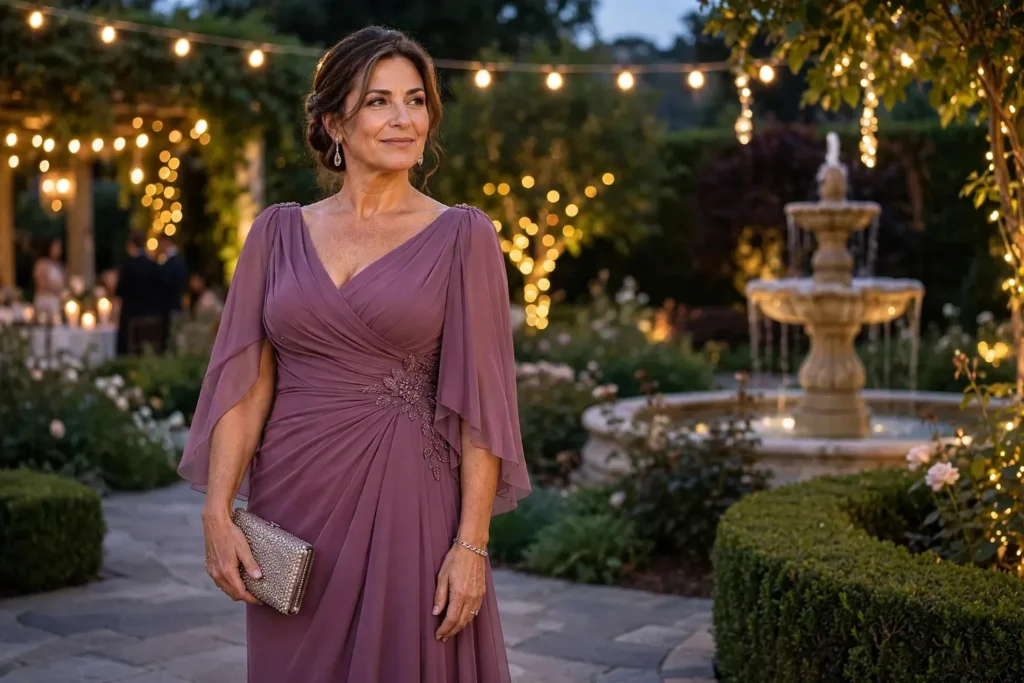
Picking your outfit for your daughter’s wedding day can turn out trickier than anyone warns you. You will want to glow in the photos, remain recognizably yourself, respect the wedding’s tone, and stay at ease across the hours of ceremony, embraces, toasts, and dancing.
Once you’re past fifty, options are seldom the problem. It is the wearying business of hunting through rack after rack of gowns that skew frumpy, bridal, or too bare — or bear no resemblance to anything in your own closet.
The secret to dressing over 50 is wearing your actual shape with confidence — and ignoring every rulebook written for a different generation. It comes down to getting four things right — formality, proportion, fabric, color — for the woman you are and the wedding in front of you.
No full closet overhaul is required. Let the celebration dictate the direction; fit and comfort do the rest of the building.
Table of Contents
- Start With the Wedding, Not the Wardrobe
- Find a Silhouette Built for a Long Wedding Day
- Let Fabric, Neckline, and Sleeves Do the Heavy Lifting
- Blend With the Wedding Party Without Becoming a Bridesmaid
- Let Accessories Play the Supporting Role
- Tiny Tailoring Tweaks That Make a Dress Look Made for You
- A Simple Mother-of-the-Bride Formula When Choosing Feels Impossible
- FAQs
- Walk In Feeling Like the Best Version of Yourself
Start With the Wedding, Not the Wardrobe
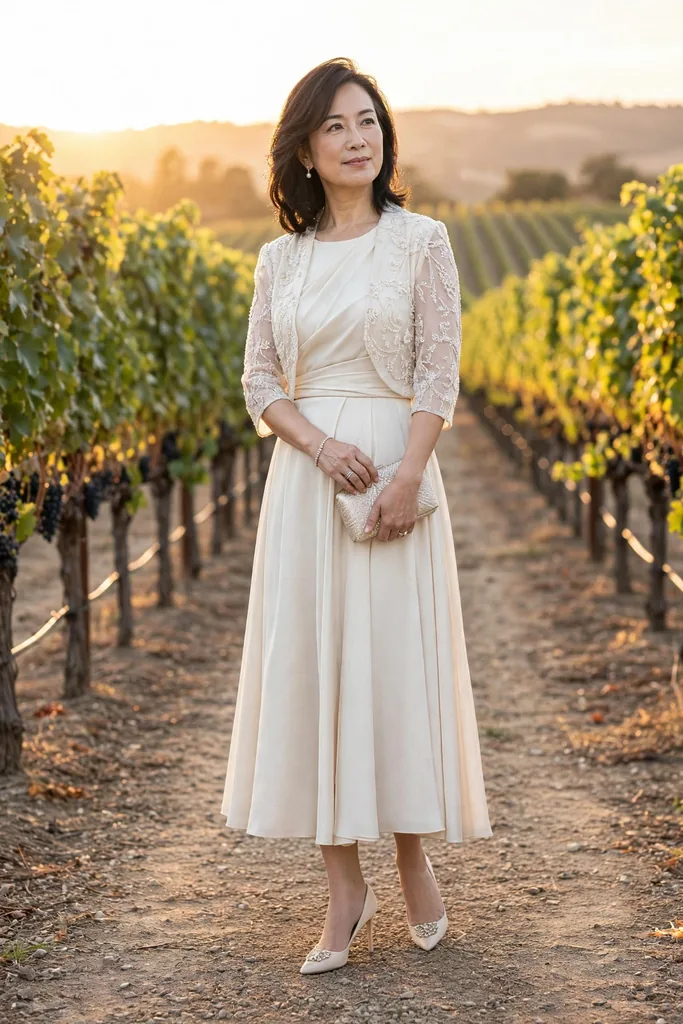
Set sleeves, necklines, and colors aside for a moment and study the event itself. A mother-of-the-bride outfit should look entirely at home in the venue hosting the wedding.
Let the invitation’s dress code lead; the venue, season, ceremony timing, and bridal-party formality fill in the rest. Today’s wedding etiquette, happily, grants far more latitude than the rulebooks of the past.
The modern mother-of-the-bride wardrobe spans gowns, midi dresses, jumpsuits, tailored suits, and polished separates — provided the choice flatters the occasion.
Match the scale: a cathedral ceremony flowing into an evening reception deserves drama — a sweeping gown or a razor-cut full-length jumpsuit. A sunlit garden afternoon invites something softer, like a flowing midi, and an intimate restaurant dinner usually favors refined separates over anything too grand.
| The Occasion | Where to Begin | What Makes It Work |
|---|---|---|
| Evening black tie | A full-length gown or an elegant formal jumpsuit | Stands confidently beside the bridal party’s formal attire |
| Grand hotel or ballroom | A long column dress, a classic A-line, or a tailored full-length silhouette | Reads polished in photographs without extra ornament |
| Outdoor garden or vineyard | A flowing midi dress, a gentle A-line, or a refined floral print | Moves easily and suits the lighter, airier mood |
| Beach or destination | A shorter hemline with room to move | Stays occasion-appropriate without weighing you down |
| Small restaurant celebration | A midi dress, a sharp trouser suit, or dressy separates | Feels festive while fitting the intimate scale |
A cocktail dress code means leaving the sweeping sequined gown at home; a black-tie one means even the prettiest daytime floral will read as underdressed.
The honored-guest test: Picture yourself at this wedding simply as a cherished guest of honor rather than the mother of the bride — would the outfit still feel right? A yes usually means you have found your level.
Find a Silhouette Built for a Long Wedding Day
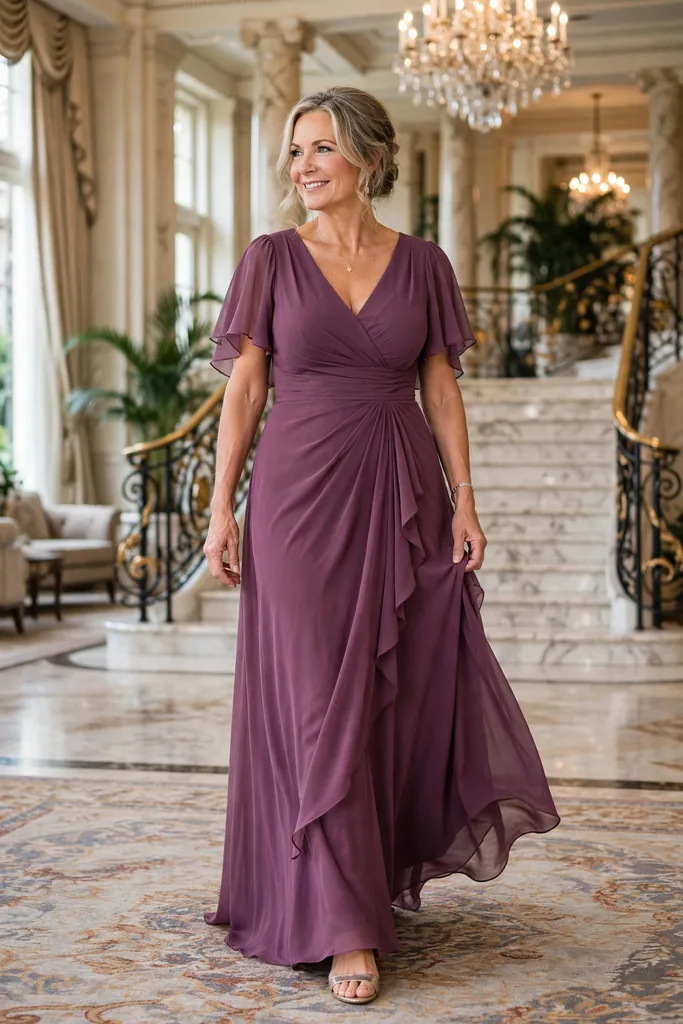
Standing still under a fitting room’s flattering light tells you almost nothing about how a dress will behave all day.
Consider the full itinerary: an hour seated for the vows, steps up to the altar, leaning in for hugs, a receiving line that never ends, cameras catching you from all sides, and a dance floor that calls your name. Your dress must cooperate for the entire program, not just the mirror.
The A-line earns its popularity honestly: it shapes the upper body gently while the skirt swings free. A straight column, meanwhile, can look crisp and contemporary when the cloth glides over the body instead of gripping it.
A gently defined waistline adds shape without ever squeezing. Forget any chart dictating where a waistline “should” fall — the true test is where the fabric rests easily against your frame.
Draping and ruching deserve your attention: they introduce movement instead of demanding that the fabric lie perfectly flat. Draping also happens to be one of 2026’s defining occasionwear directions — a graceful way to look current without leaning on anything too trendy.
Treat the fitting room as an audition, not a photo shoot:
- Settle into a chair for a solid few minutes and watch how the bodice, waistline, and neck opening treat you once you are properly seated — ease here predicts ease all day.
- Lift both arms high and confirm the sleeves and armholes never tug or bind.
- Stride briskly around the room and watch what the hem does at speed.
- Lean forward a touch to verify the neckline keeps you covered.
- Snap phone photos from the front, the side, and behind — the camera catches what mirrors miss.
A dress that demands constant tugging, smoothing, or readjusting in the shop will only grow more tiresome as the wedding day wears on.
Let Fabric, Neckline, and Sleeves Do the Heavy Lifting
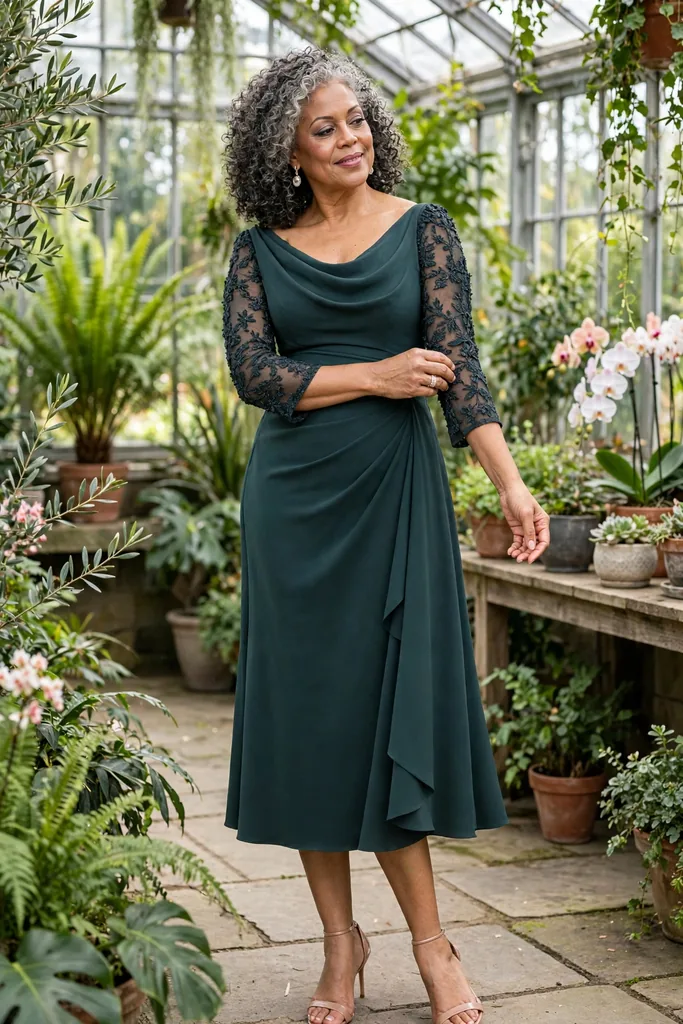
Give me a clean-lined dress in a beautiful cloth over a complicated design in unforgiving fabric any day — the first will photograph better, wrinkle less, and never fight your body.
At a formal wedding, the shortlist of reliable cloths runs from crepe, satin, and chiffon to georgette, lace, jacquard, and structured jersey. The right pick comes down to the garment’s cut and the time of year.
Crepe’s substance sketches a crisp outline; chiffon floats. Satin drinks in the light, but it also broadcasts every crease — buy it only when the sewing is flawless.
Well-made structured jersey is a quiet hero for marathon days — choose a weighty knit with real recovery and it will skim, never cling.
Keep this little fabric crib sheet beside you while you shop.
| Cloth or Feature | The Smart Way to Shop It |
|---|---|
| Crepe | Pick a medium weight with enough body to glide over the figure, never cave |
| Chiffon | Choose a lined cut with tamed volume — not layers flying everywhere |
| Satin | Demand easy drape with seams lying perfectly flat |
| Lace | Favor fresh placement and neat lining over fussy, overdone trim |
| Stretch jersey | Choose a weighty knit with real bounce-back, so knees and elbows stay smooth |
| Beading and sequins | Check for smooth lining at the arms so sparkle never scratches skin |
Whether you favor a short sleeve, a flutter, a sheer layer, or an elbow length — or prefer to go sleeveless or one-shoulder — every one of those choices can look thoroughly polished.
A V-neck stretches the eye along the upper body; a bateau brings quiet polish plus extra coverage; and a soft scoop flatters almost any necklace.
Want a more of-the-moment touch? Try an asymmetric neckline or a soft off-the-shoulder line — either one brings intrigue while letting embellishment sit this one out.
Blend With the Wedding Party Without Becoming a Bridesmaid
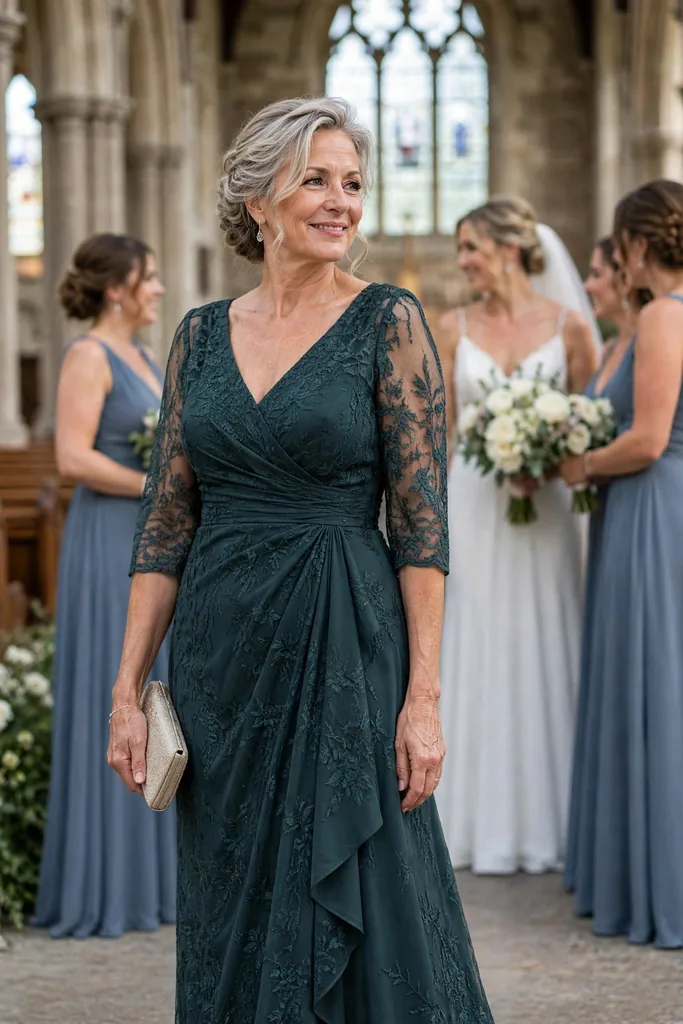
Nobody expects the mother of the bride to clone the bridesmaids’ look. Choose harmony over uniformity and the family photographs feel relaxed instead of arranged.
Take sage-green bridesmaids: strong partners include navy, dusty blue, plum, champagne pink, a deeper green, or anything else that keeps their palette company.
Check with the couple before treating any color as compulsory. One bride may hand you an exact brief; another may only care that you feel wonderful in what you choose.
Anything in the white-to-ivory family, or close enough to read as bridal, deserves a quick check with the couple beforehand. Black, meanwhile, can be stunning — especially after dark — and modern etiquette no longer files it under inappropriate.
Keep the photographs in mind, not only the room.
The flowers and bridesmaids don’t need a color echo from you. It just has to rest easily alongside them instead of fighting for the spotlight.
Framed this way, the palette decision gets simpler:
| When the Wedding Colors Run To | Shades Worth Trying |
|---|---|
| Sage, eucalyptus, and soft greens | Navy, deep teal, powdery blue, or plum |
| Blush, rose, and champagne | Mauve, berry, navy, or gentle metallics |
| Burgundy, rust, and autumnal tones | Forest green, navy, aubergine, or bronze |
| Bridesmaids in blue | Plum, silver grey, navy, or soft rose |
| A mostly neutral scheme | Jewel tones, quiet metallics, deep blue or green |
Pale is not mandatory: Belonging to the wedding party does not oblige you to pick the palest shade on the rail. A deep, saturated shade can look just as refined — and jewel tones have a habit of photographing gorgeously.
Let Accessories Play the Supporting Role
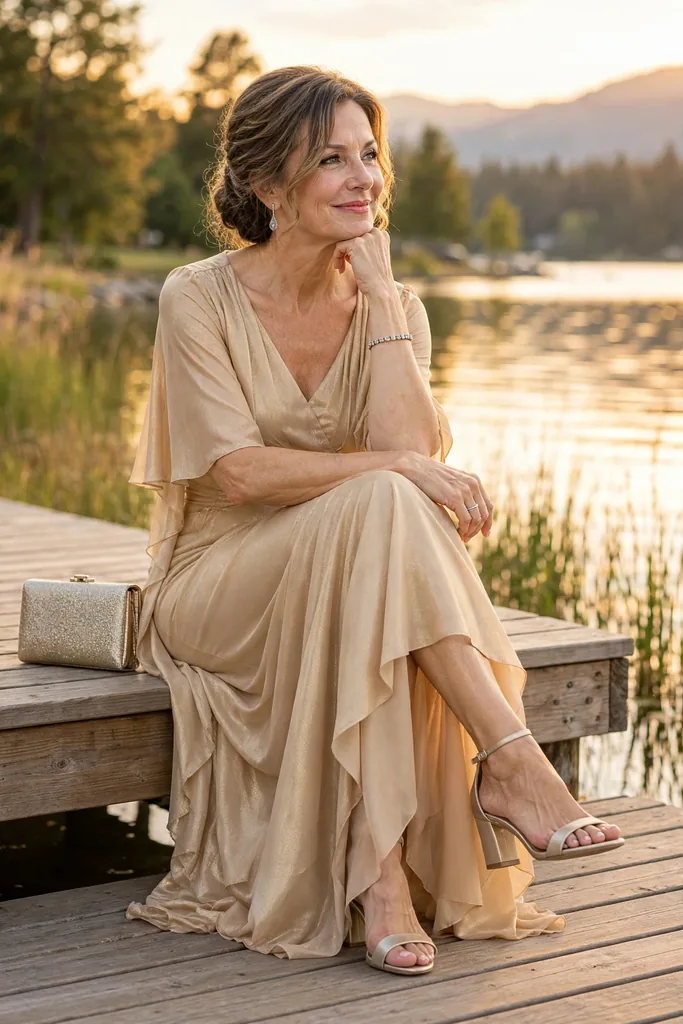
When the dress already carries presence, the accessories can afford to whisper.
When the gown itself brings beading, draping, lace, or a striking neckline, a pair of simple earrings is often plenty. A pared-back column, by contrast, invites one stronger jewel — an earring, a bracelet, or a clutch with personality.
Nominate a single area to carry the detail instead of scattering sparkle from head to toe.
Give shoes more thought than feels reasonable — the day is long. Your feet deserve as much planning as the dress: a lower, broader heel, a slingback, an elegant flat, or a kitten heel keeps you graceful from the first photo to the last dance — no hobbling required.
If you crave height but dread narrow heels, rethink the heel’s architecture instead of abandoning lift altogether. Opt for a broader heel and you will stand steadier on lawns, gravel, and stone — and survive the long reception floor.
The wear-test rule: Walk the shoes in for days beforehand, then rehearse at the finished outfit’s exact hem.
Pick a petite structured clutch or a tidy shoulder bag: room for phone, lipstick, and tissues, yet small enough to disappear from the photographs.
Tiny Tailoring Tweaks That Make a Dress Look Made for You
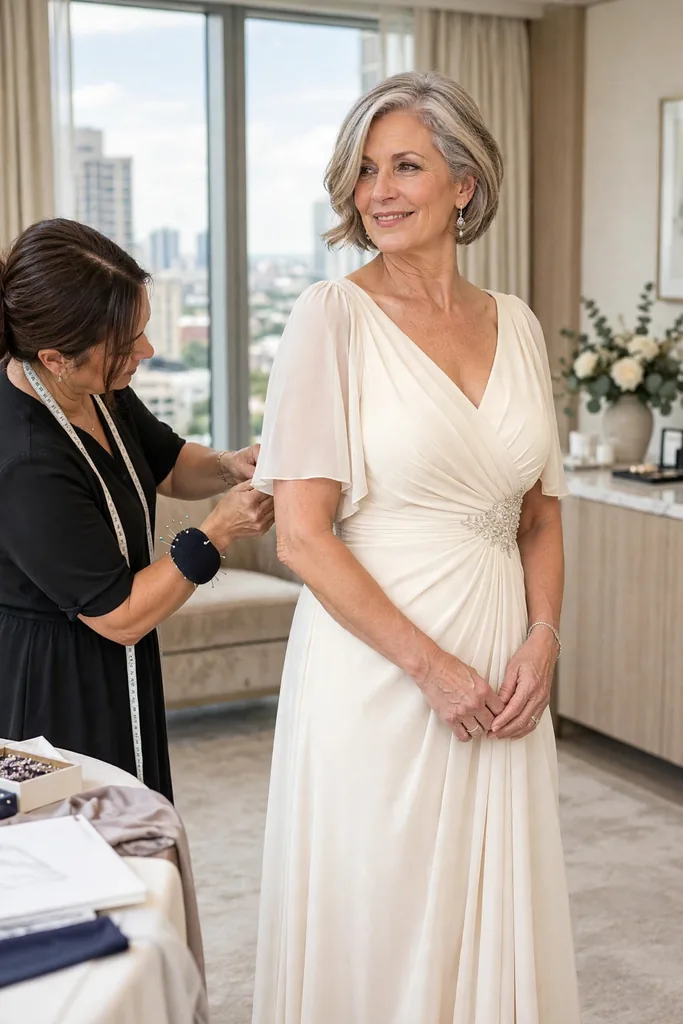
Forget the price tag — what reads as expensive is always the fit.
On the hanger a dress may look perfect; on your body it can still feel off — shoulders a fraction too wide, a waistline landing low, a hem breaking at an awkward point on the leg.
Blame the construction, never your figure — these are jobs for a tailor, not verdicts on your body.
Hemlines deserve particular care. Bring the exact wedding-day shoes to the pinning appointment for any full-length gown. With a midi, resist cutting until you have tried two or three lengths — a couple of inches can completely re-balance the silhouette.
Apply the same thinking to sleeves. A bracelet-grazing sleeve reads as a decision; a sleeve that halts mid-forearm reads as an accident.
When a dress is nearly right, these tailor’s swaps usually beat starting over:
| The Fitting-Room Problem | The Tailor’s Fix |
|---|---|
| A waistband you keep tugging at | Tailoring that skims the waist, or some fluid draping |
| A rigid boxy jacket over evening attire | Trade it for a fluid cropped jacket or a graceful wrap |
| Embellishment from neck to hem | One embellished zone, everything else calm |
| A sweeping gown at an outdoor garden wedding | A midi or airier maxi that moves freely |
| A stiletto you practically never reach for | A block heel, slingback, kitten heel, or dressy flat |
Schedule that last fitting early, while there is still time to adjust things serenely. For that appointment, bring everything: the gown, underpinnings, any shapewear, shoes, jewels, and your jacket or wrap.
How the complete ensemble works together tells you far more than any single piece judged alone.
A Simple Mother-of-the-Bride Formula When Choosing Feels Impossible
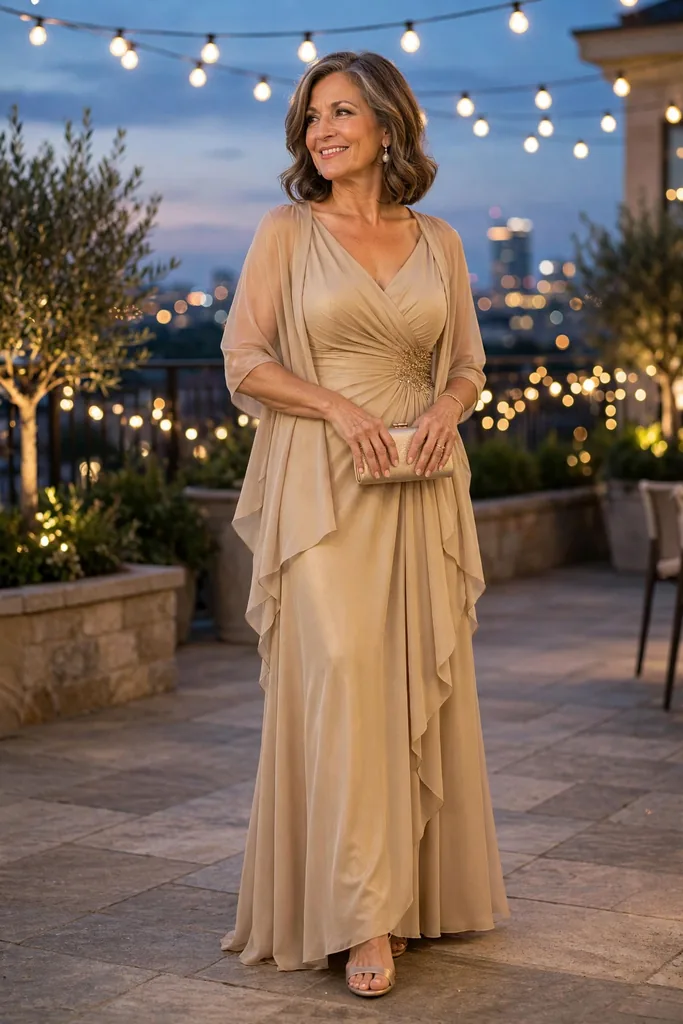
The search transforms the instant you quit chasing one mythical perfect gown and commit to a repeatable formula.
Your short formula: Start with a midi or full-length dress that fits like it was cut for you, add a single polished accessory, and finish with a dress shoe you can actually stand in.
In this formula, the dress sets the structure, the accessory brings the character, and the shoe choice keeps you comfortable from morning to midnight.
Picture it at a black-tie evening: a navy draped gown, sculptural earrings, a low metallic heel.
Picture the garden wedding: a breezy floral midi, understated gold earrings, and a steady block-heel slingback.
A dressy jumpsuit obeys it too. Look for flowing trousers, a sharply cut bodice, a single bold accessory, and heel height that leaves the trouser hem kissing the floor — never pooling.
Keep the formula in your pocket after the wedding — it steers you true whenever you shop for elegant outfits for women over 50. What makes those pieces feel special is tailoring and finish — never obedience to a narrow “mother-of-the-bride” dress code.
FAQs
Must I wear a floor-length dress as the mother of the bride?
No — let the wedding’s formality set the hemline, not your title alone. Save floor-sweeping gowns for black-tie nights; cocktail, garden, and semi-formal weddings tend to suit midi or tea-length hemlines better.
Which shade should the mother of the bride choose?
The color choice is entirely yours. Pick a shade that keeps the wedding palette and the bridesmaids’ dresses company without imitating them. White, ivory, champagne, or anything else that reads bridal — clear it with the couple before you commit.
Is a jumpsuit acceptable for the mother of the bride?
Absolutely. A polished jumpsuit rises to the occasion at plenty of weddings. Seek out fluid trousers, a sharply tailored bodice, fine cloth, and a length that draws one continuous line.
Must my look mirror the mother of the groom’s?
No need for matching. Swapping a few details on formality, length, and color helps both of you dodge day-of surprises. Comparing notes is genuinely useful; turning up as twins is not.
How do I look current without chasing trends?
Start from a timeless, uncluttered shape and finish with one present-day accent — draped fabric, an off-center neckline, sculptural sleeves, or of-the-moment earrings. The result stays fresh without leaning on a handful of here-today trends.
Walk In Feeling Like the Best Version of Yourself
On the morning of the wedding, the planning should be behind you. The dress is fitted, the shoes are broken in, the bag is packed, and the only job left is to be present — for the vows, the photographs, and the dance floor.
Choose the outfit that lets you do all of that without a second thought, and you will look exactly as a mother of the bride should: radiant, at ease, and entirely herself.