
70s Style After 50: A Modern Woman’s Guide
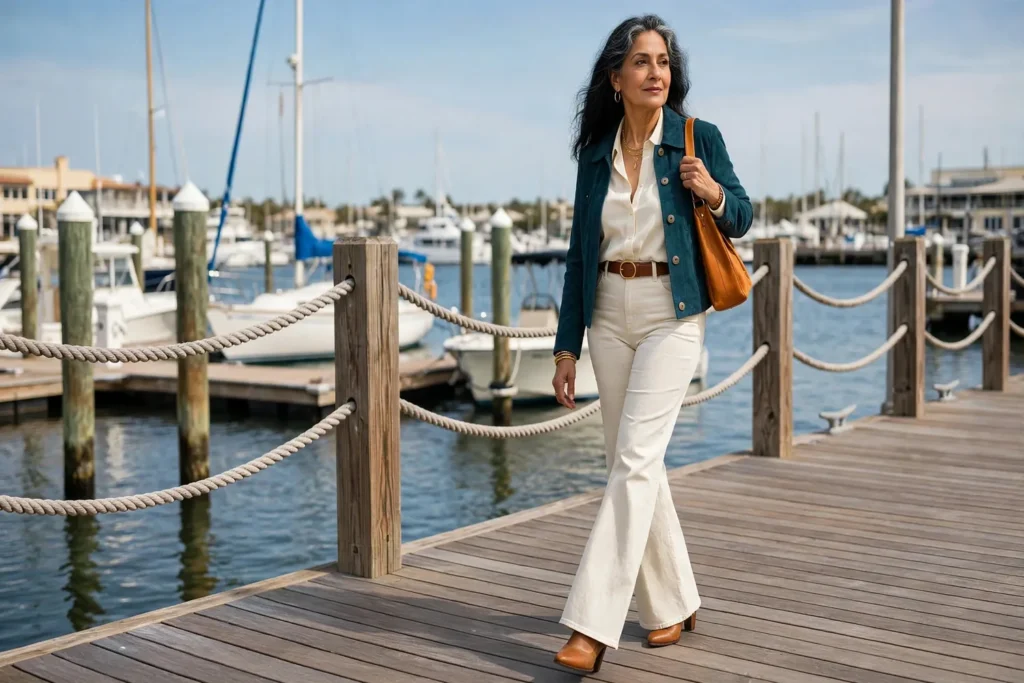
Seventies dressing can be glorious after fifty, yet few decades slip into costume territory as quickly. One flared leg, one patterned shirt, one suede layer, one platform — worn solo, each of these can look fantastic. Worn all together, though, they start telling a theme-park story instead of a personal one, and that is usually where the unease begins.
Most of us want the same thing from this decade — its personality, its color, its movement — without the feeling that we have wandered into a costume party. Here is the encouraging part: the seventies can genuinely flatter a woman past fifty, provided the silhouettes stay clean and each outfit carries only one or two strong era references.
What follows is a practical way in: the pieces that earn their place, how to balance them with the modern wardrobe you already own, and the small styling tweaks that keep everything firmly in the present. The seventies mood — minus the time capsule.
Table of Contents
- Wear the Seventies Mood, Skip the Full Time Capsule
- Flares and Wide Legs Love a Clean Top Half
- Suede, Denim, and Knitwear Without the Theme Park Feel
- Keep the Shape Simple and Let the Prints Talk
- Modern Shoes and Accessories Keep Retro Pieces Real
- Tiny Styling Tweaks Keep 70s Pieces Current
- A Repeatable 70s-Inspired Outfit Formula
- FAQs
Wear the Seventies Mood, Skip the Full Time Capsule
The freshest seventies outfits start by treating the decade as a suggestion, never a set of orders. Decide which part of it you genuinely love, then set it beside straightforward pieces you would happily wear on any ordinary day.
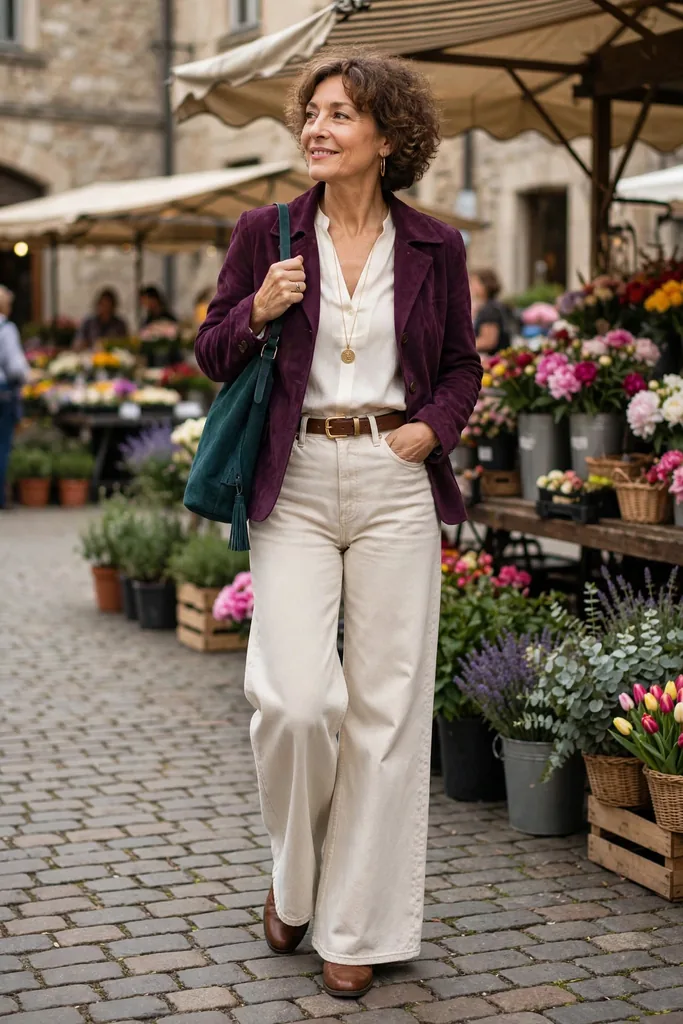
That might mean cream wide-leg jeans with a deep mulberry suede blazer — a combination that nods to the era without quoting it. It could be a marigold knit under a clean-lined trench, or a patterned silk shirt tucked into the trousers you already trust most.
Those calmer modern pieces matter more than they seem, because classic seventies design usually arrives with built-in drama: heavy texture, loud print, big volume, saturated color. Give the eye somewhere neutral to rest and the retro piece reads as deliberate rather than loud.
Carry this rule with you: a single piece gets to lead the outfit. A second quiet nod — a leather belt, a boot with a gentle heel — is perfectly fine, but everything else in the outfit should be speaking today’s language.
Cream flares and a mulberry suede blazer already carry the whole seventies message; that is genuinely enough. The floppy hat, the fringe bag, the platform boots, the peasant blouse, and a pair of oversized tinted sunglasses can all stay home this time — one seventies hero is plenty, and the outfit never needed the entire supporting cast along for the walk.
Quick check: before you head out, name the single piece telling the seventies story in your outfit. If several are competing for the role, simplify one or two of them — clarity is what makes the decade look chic instead of costumed.
Flares and Wide Legs Love a Clean Top Half
Few seventies shapes are easier to wear right now than a flared or wide-leg trouser, provided the proportions are handled with care. Chase the decade’s long line, not the most dramatic bell-bottom hanging in the shop.
Go for a soft bootcut or an easy, fluid flare — it traces the decade’s long line without swamping everything else you are wearing. Seek a waistband that settles exactly where it should, and a leg that widens gradually from the knee instead of flaring in one sudden sweep.
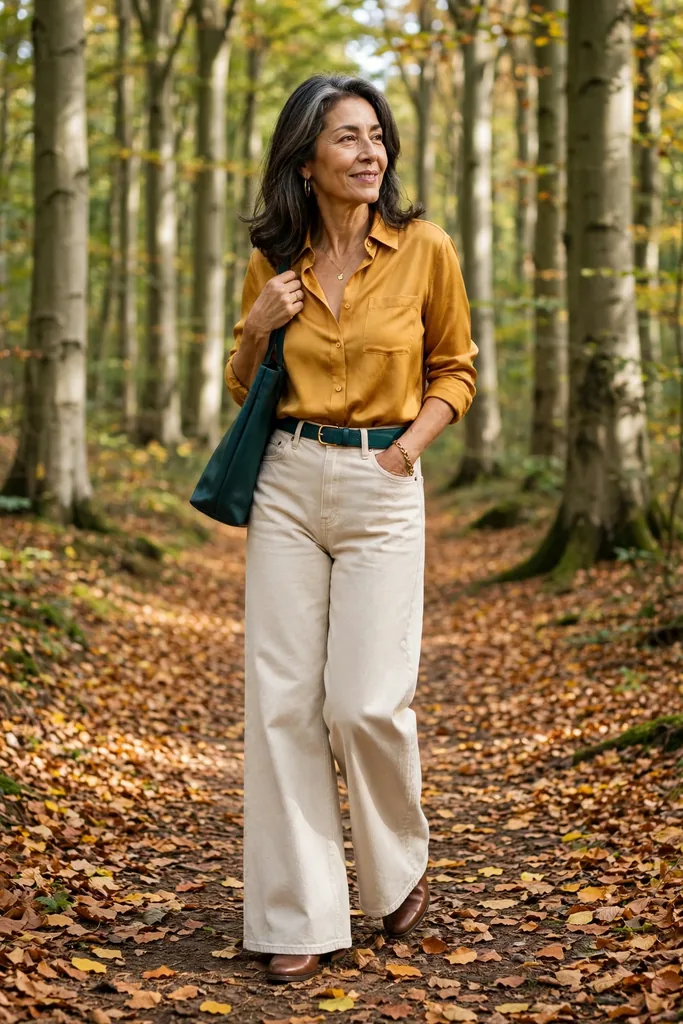
When the lower half runs generous, the upper half has to hold its shape. Tuck in the blouse, choose a knit that skims rather than swamps, or finish with a shorter jacket or a softly shaped blazer — a marigold silk blouse tucked into cream wide-legs with a slim teal belt shows this balance perfectly.
A tunic over very wide trousers can still work, but that much volume needs deliberate styling: show the wrist, define the shoulder, or pick a lighter fabric. Any of these small moves keeps the outfit from sinking into heaviness.
Use the table below as a cheat sheet — the cuts and fabrics that travel from the seventies into today’s wardrobe with the most ease.
| The Piece | What to Look For | Why It Reads Current |
|---|---|---|
| Flares, cut for today | Mid-tone or deep-wash denim, a tidy hem, and a gradual opening | Draws the leg long without tipping into theatre |
| Sweeping wide-legs | A flat front, a defined waistband, and fabric that falls rather than flares | Delivers movement with a polished finish |
| The gentle bootcut | A small kick beginning just below the knee | A whisper of the decade for ordinary days |
| A close ribbed knit | Fine or medium ribbing with a clean, neat shoulder line | Skims wider trousers without pulling tight |
| A cropped layer | Ending at the waist or the very top of the hip | Lets the long leg do the talking |
Fit tip: the hem decides everything with flares. Match the length to the shoes you will actually wear — a trouser that pools around the shoe reads careless, while one that grazes cleanly reads considered.
A low heel gives a fuller flare a beautiful drop, while flats do the job nicely once the hem is finished for them. Take the shoes you love to the fitting, not the pair you never reach for.
Suede, Denim, and Knitwear Without the Theme Park Feel
You never needed psychedelic prints to bring the seventies into an outfit. Working through texture is the subtler way in — and it blends into a present-day wardrobe with far less effort.
Suede does the heaviest lifting here. A jacket in deep teal, tobacco, chocolate, or warm mulberry brings richness and warmth without once reading retro — particularly over a base of pieces you already own and wear.
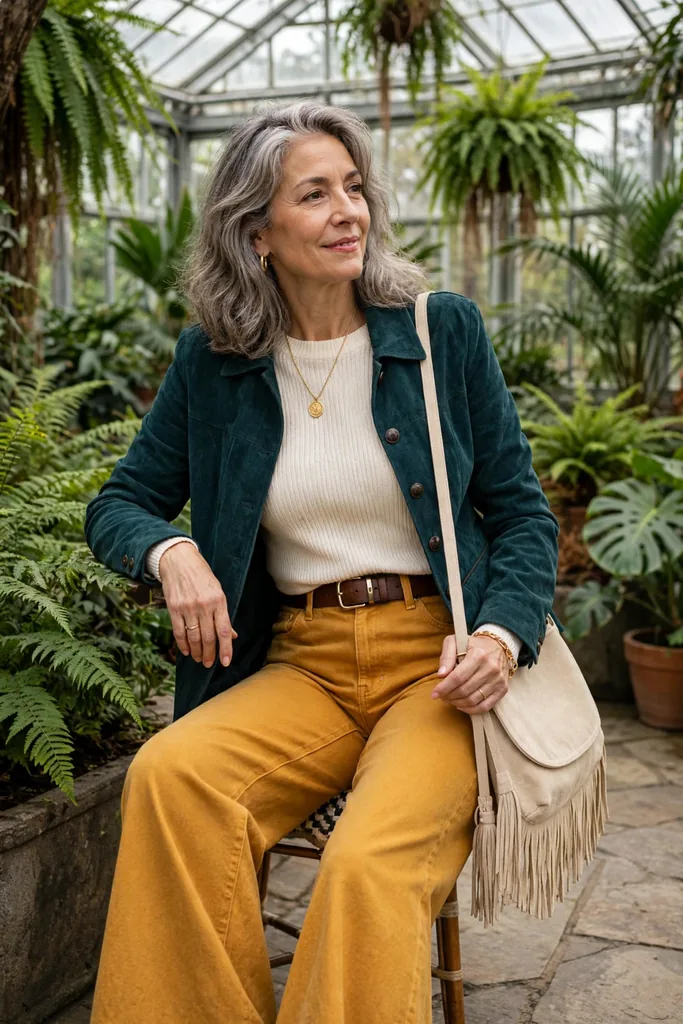
Picture a deep teal suede jacket over an ivory knit with marigold wide-leg jeans: seventies through texture and silhouette, completely current in palette. Ground the suede in something utterly plain — dark denim, a bare crew-neck, or a clean white shirt all do the job; on that quiet base, the texture comes across as considered, never nostalgic.
Double denim earns its place too, as long as the two washes sit apart. A mid-wash denim shirt worn over deeper flares, belted in leather and finished with plain ankle boots, reads classic — never costume.
Knitwear is another easy way in — ribbed polos, fine turtlenecks, striped pullovers, soft cardigans. Each one brings a whisper of seventies personality and drops straight into everyday outfits for women over 50. In warmer months, choose cotton knits over heavy synthetics — the same texture, none of the bulk.
Keep the Shape Simple and Let the Prints Talk
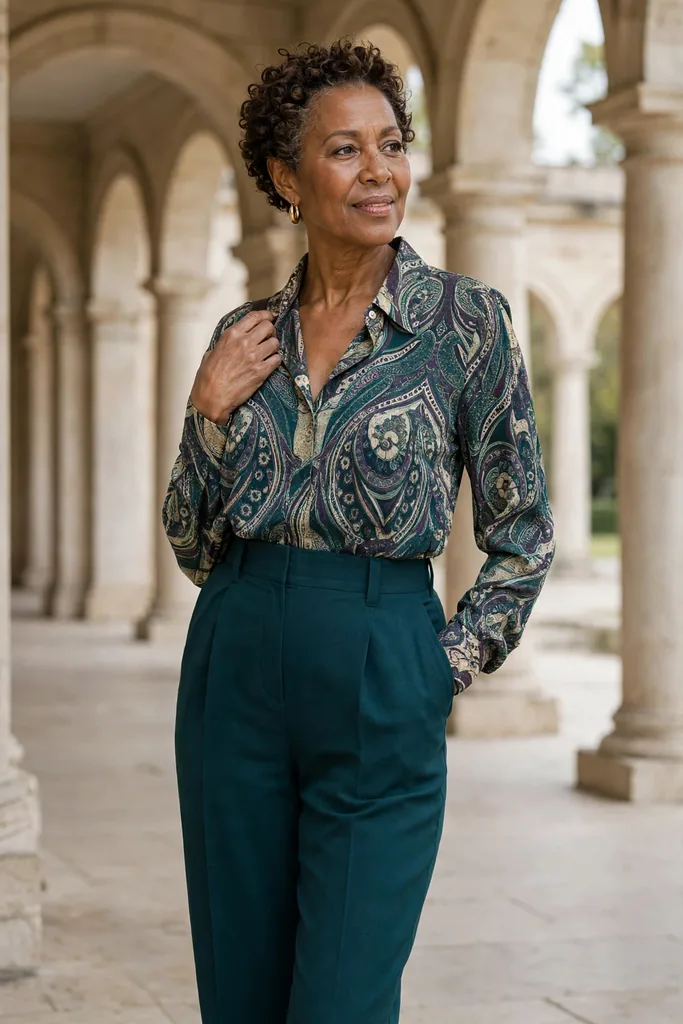
Few things in seventies dressing delight like a bold print. Paisley, bold geometry, warm florals, loose swirls, earthy striping — handled well, none of these strands you in a time-warp photograph.
The real skill is managing the visual noise around the pattern. Keep everything near it calm, and the print gets to shine instead of shouting.
A paisley shirt in deep teal, cream, and mulberry sits far more easily beside plain deep-teal wide trousers than against anything louder; team a printed midi with a plain knit and it feels fresher than pairing it with a second vintage-leaning layer.
Scale is adjustable as well. When oversized patterns feel like a lot, choose a smaller motif and let the color palette carry the era instead of the size of the print.
The seventies color vocabulary does plenty of quiet work on its own: forest green, burgundy, chocolate, teal, rust, mustard, cream, and warm navy. Keep it to a shade or two — nobody needs the whole rainbow.
Color tip: when mustard, orange, or earthy brown fights your complexion up top, move those shades down and let a kinder color live near your face. A rust skirt, a cognac belt, a suede shoe, or a printed bag worn with a top in one of your most dependable shades keeps the seventies mood while serving you rather than the other way round.
That single adjustment is often the difference between an outfit you admire in theory and one you actually reach for — the mood stays, and the colors do the flattering.
Modern Shoes and Accessories Keep Retro Pieces Real
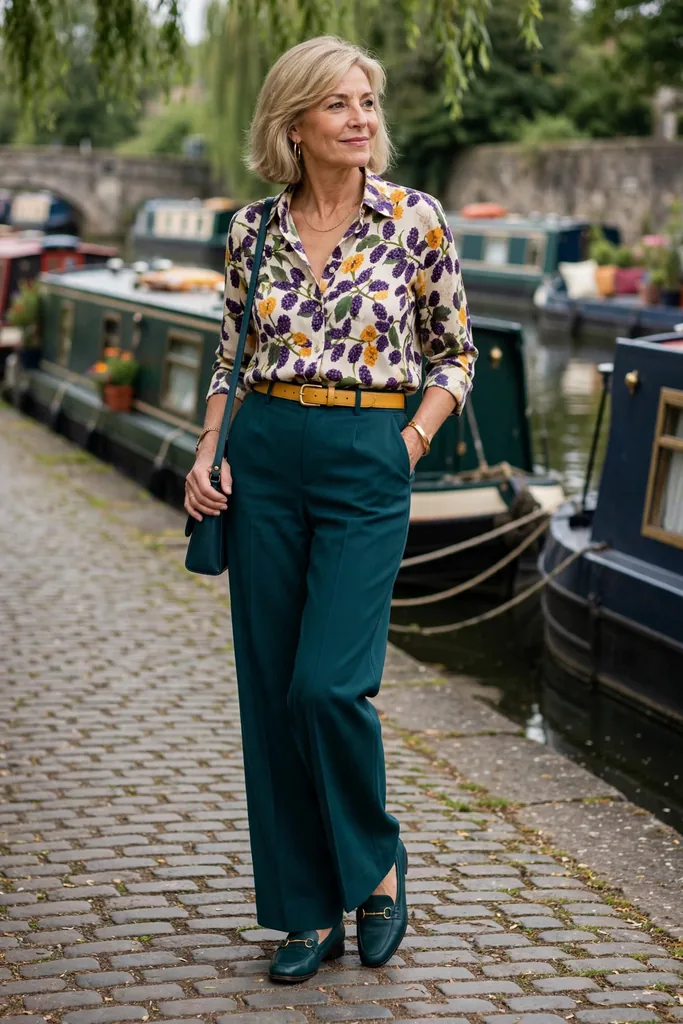
Get the accessories right and a seventies-leaning outfit reads current; get them wrong and it slides into full theatre. Style this part of the look with a light hand.
There is nothing wrong with platforms, oversized sunglasses, wide belts, silk scarves, or statement earrings. The mistake is wearing every recognizable seventies signifier in a single outing.
Steady the whole look with one contemporary shoe — the loafer, the ankle boot, the clean sneaker, the low block heel, the almond-toe flat all do this job. Picture a mulberry, cream, and marigold floral shirt with deep teal wide trousers — against a calm shoe the outfit reads modern; against a towering platform it reads themed.
Or flip the logic: let the shoe carry the decade and keep the clothes clean. A platform loafer or a chunky boot with simple trousers and an unfussy knit places the seventies hit exactly where you want it, and nowhere else.
Apply the same thinking to jewelry and you will rarely go wrong. One pair of sculptural gold earrings can supply all the retro character an outfit needs — there is no reason to layer a second story on top of it.
Give bags the same light touch: a structured leather or suede style nearly always looks more current than heavy fringe. If fringe is the piece you truly love, calm everything else down and let the bag be the playful center of the outfit.
Comfort note: skip the towering platform if it is not your thing. A modest block heel or a platform sole offers nearly the same lengthening balance, and you will actually enjoy the lunch, the errands, and the evening out in them.
Tiny Styling Tweaks Keep 70s Pieces Current
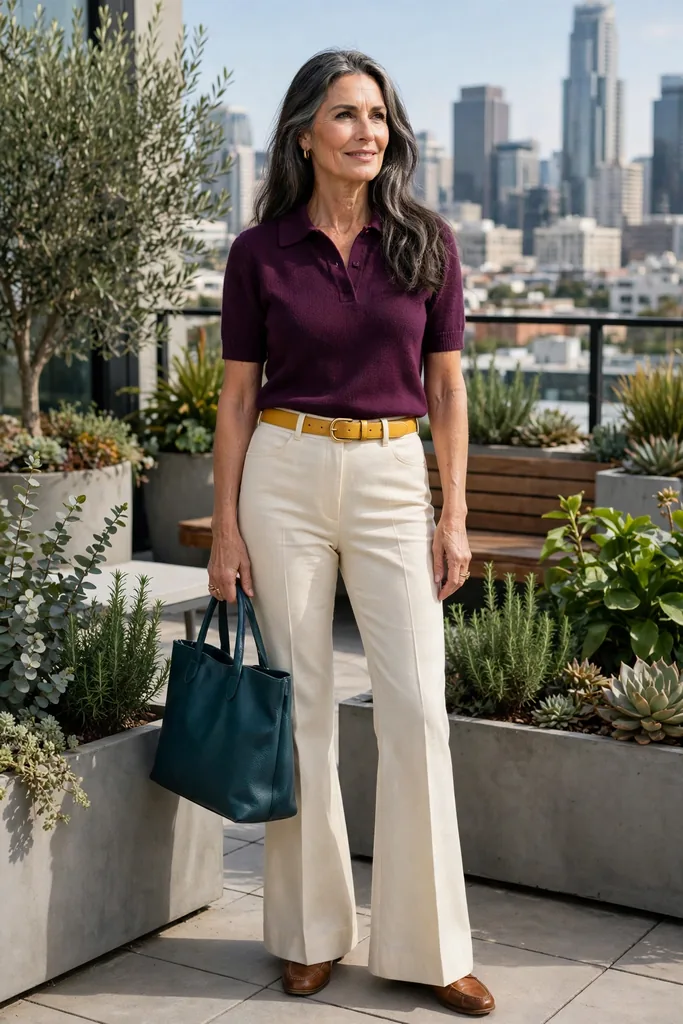
Sometimes the garment is innocent and the combination is the problem. The outfit does not need to lose its personality — it usually needs a single small correction.
Tweak the shape, the shoe, or how many retro details appear, and the entire look shifts. A mulberry knit polo with cream flares, a marigold belt, and a teal tote is proof: change the tuck or the shoe and it stays firmly in the present. That is the entire trick — adjust the balance, not the identity.
A few dependable reframes for the moments an outfit feels stuck in 1974:
| Fixes When It Feels Dated | Do This Instead |
|---|---|
| Bell-bottoms at full drama with a loud blouse | Soften the flare, or trade the blouse for a simple fitted knit |
| A long, flowing peasant blouse paired with wide trousers | Go for a half-tuck, or pick a shorter blouse that reveals your shape |
| Everything at once — suede jacket, fringe bag, platforms, tinted glasses, and a floppy hat in a single outfit | Hold on to the suede jacket and quiet down the accessories |
| Pattern overload, from neckline to hem | Let a single print take the lead, with denim, cream, navy, or chocolate doing the supporting work |
| Towering platforms paired with each retro look | Take turns instead — loafers one day, ankle boots the next, then sneakers or block heels |
A few smaller signals are worth a glance in the mirror as well:
- If the whole outfit is reading too brown: rescue it with cream, denim blue, burgundy, or soft white — any shade you already know flatters you works here.
- When a blouse leans too bohemian: the fix is simple: tuck it into structured trousers and finish the outfit with a plain, fuss-free leather flat.
- If wide-leg jeans feel bulky: rethink the waistband first — a tidier finish there, plus a knit that reveals more of your natural waistline, slims the whole line considerably.
- If the look feels over-polished: bring back denim, suede, or an easy knit to restore the decade’s relaxed spirit.
None of this is law. Think of them as levers to pull when an outfit promised more on the hanger than it delivers worn.
A Repeatable 70s-Inspired Outfit Formula
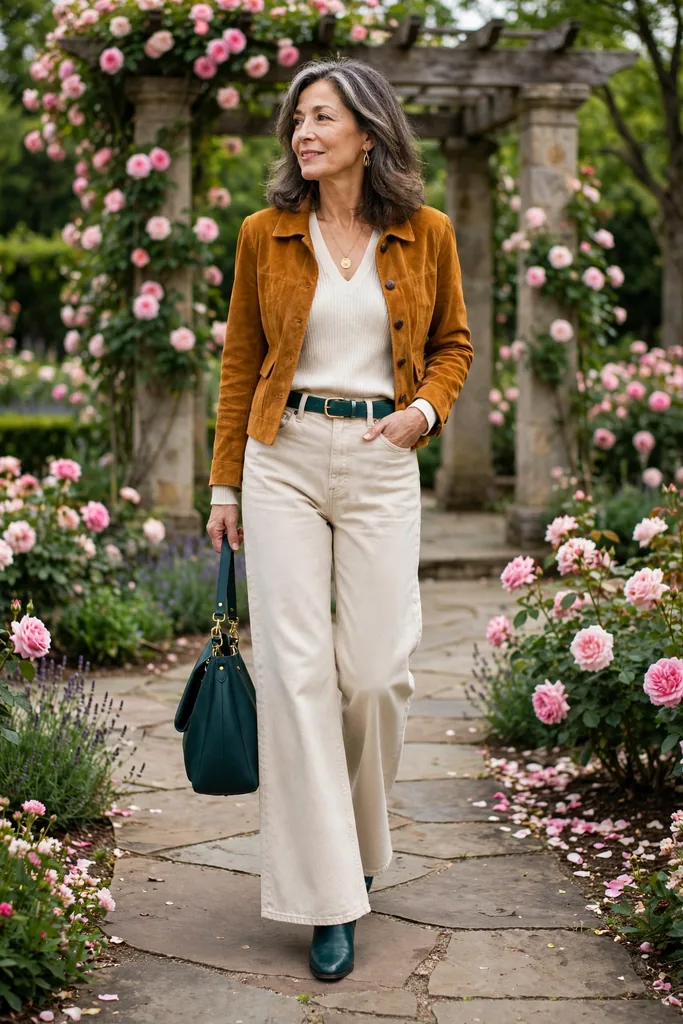
Retro dressing becomes genuinely useful when it turns into a uniform: a set of proportions you know work for your body and your routine, repeated in different colors and textures.
Your repeatable formula: wide-leg or flared trousers with a neat fitted top, a shorter textured layer, and easy shoes.
Let the trousers deliver the seventies line while a plain top reins in the volume; finish with suede, denim, a cardigan, or a cropped blazer for personality that never swallows the line.
A marigold suede jacket over cream flares with a slim teal belt is the formula in action. From there, a single swapped piece is all it takes to suit where you are going:
| The Day Ahead | The Effortless Formula | Why It Lands |
|---|---|---|
| Daily errands | Bootcut jeans with a striped sweater and clean sneakers | A seventies line in thoroughly practical pieces |
| Lunch dates | Cream flares plus ivory blouse, finished with a marigold suede jacket and ankle boots | Polished, never overdressed |
| Dinner, smart-casual | For a smart casual dinner: wide-leg trousers, a fitted knit, gold earrings, and block heels on your feet | Proportion and jewelry do the talking — no costume |
| Travel days | Soft wide-leg jeans with a plain tee, a cardigan, and loafers | Comfortable pieces that still draw a clean line |
| Weekend plans | Try a denim skirt, tuck in the knit, add a leather belt and boots | The decade referenced, flares entirely optional |
This approach is also a smart route to stylish outfits for women over 50 — trends come and go, but no separate wardrobe is required for any of them.
Once your four anchors are set — trusted trousers, a good top, a great layer, comfortable shoes — play with the belt, print, jewelry, and fabric to shift the mood.
FAQs
Do flare jeans still work after 50?
Yes, without question. With flare jeans it is proportion that matters, never age. Choose a gradual flare rather than an extreme one, and style it the modern way: fitted knits, tucked shirts, blazers, or shorter jackets on top. The detail that makes or breaks them is hem length — the jeans should fall cleanly over the shoes you actually plan to wear, not pool around them.
How can I style 70s pieces without looking costumed?
Hold the obvious retro references to a minimum — a single hero piece per outfit. Let flares, a suede jacket, or a printed blouse lead, and support it with simple contemporary basics: clean denim, plain knits, modern shoes. That push-and-pull between the retro piece and the quiet modern ones is precisely what keeps everything current rather than themed.
After 50, which 70s pieces make the easiest entry point?
Begin with pieces that may already live in your closet: a suede jacket, ribbed knits, bootcut or flare jeans, a printed blouse, wide-leg trousers, a good leather belt, and simple gold jewelry — each one earns its place. Each one mixes naturally with the wardrobe basics you already own, so you can fold the look in gradually — there is no need to rebuild your closet around the decade.
My style is simple — can 70s prints still work for me?
Yes. Give the print a single piece to live on, and keep the rest of the outfit quiet. Try a paisley blouse over dark straight denim, or a geometric skirt beneath a plain cream sweater — the decade’s personality comes through while your simplicity stays intact.
Which shoes keep a 70s-inspired outfit looking modern?
You have plenty of good options — ankle boots, loafers, block heels, simple sneakers, almond-toe flats, or a moderate platform all earn their place here. Let the outfit’s balance choose the shoe — more trouser volume and more retro detail elsewhere call for a calmer shoe.