
Funeral Outfits for Women Over 50: Tasteful, Modest, and True to You
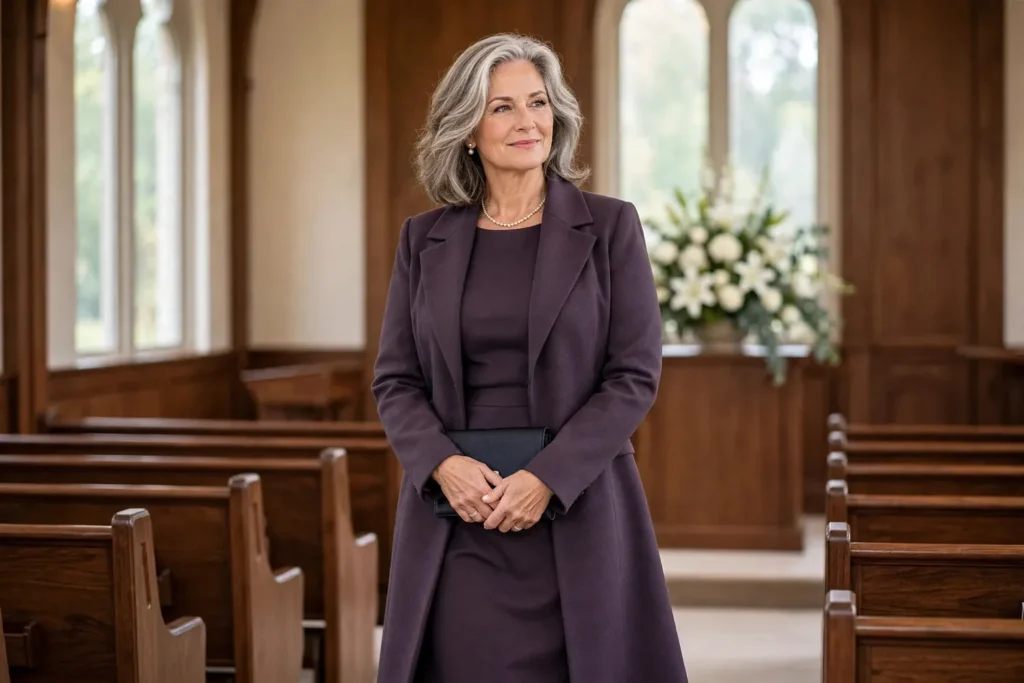
Few mornings are as strangely hard to dress for as the day of a funeral. Respect is the aim, yet the open wardrobe raises questions: how somber must the palette go, how formal the tailoring be, how covered-up the silhouette?
Past fifty, honoring the day does not demand disappearing into a shapeless black uniform. The question of what to wear to a funeral over 50 gets settled less by old rulebooks than by three quiet anchors: restraint, a flattering fit, and deliberate choices.
The whole aim fits in one line: appear polished without pulling focus. The right palette, fabric, proportions, footwear, and finishing details let you dress with respect and still recognize the woman in the mirror.
Table of Contents
- Read the Room First: Let the Service Guide What You Wear
- Black Works, but It Is Not Your Only Option
- Simple, Clean Lines Look More Considered Than Extra Formality
- Quiet Fabrics Are What Make a Simple Outfit Look Polished
- Skip the Dress If You Want: Trousers Can Be Every Bit as Appropriate
- Choose Shoes You Can Stand In From Start to Finish
- Finish With Jewelry, a Bag, a Scarf, and Makeup That Stay Quiet
- Plan for the Weather Without Losing the Quiet, Respectful Mood
- Still Look Like Yourself, Just Turned Down a Notch
- Steer Clear of the Choices That Leave You Fidgeting All Service
- Have One Go-To Funeral Formula Waiting in Your Wardrobe
- FAQs
- Dress So the Day Can Hold Your Attention
Read the Room First: Let the Service Guide What You Wear
Set aside age and wardrobe for a moment — the nature of the service matters most. Save your most conservative clothes for the traditional church funeral — an informal celebration of life will not ask that of you. Outdoor graveside gatherings add weather and footing to the equation; a family get-together at home usually feels gentler and less formal.
When the family communicates a dress request, honoring it matters more than any personal preference. A beloved color, or a floral print, might be what is requested. Team colors are possible too, as is anything that ties back to the person being honored. Faith and cultural customs call for the same sensitivity.
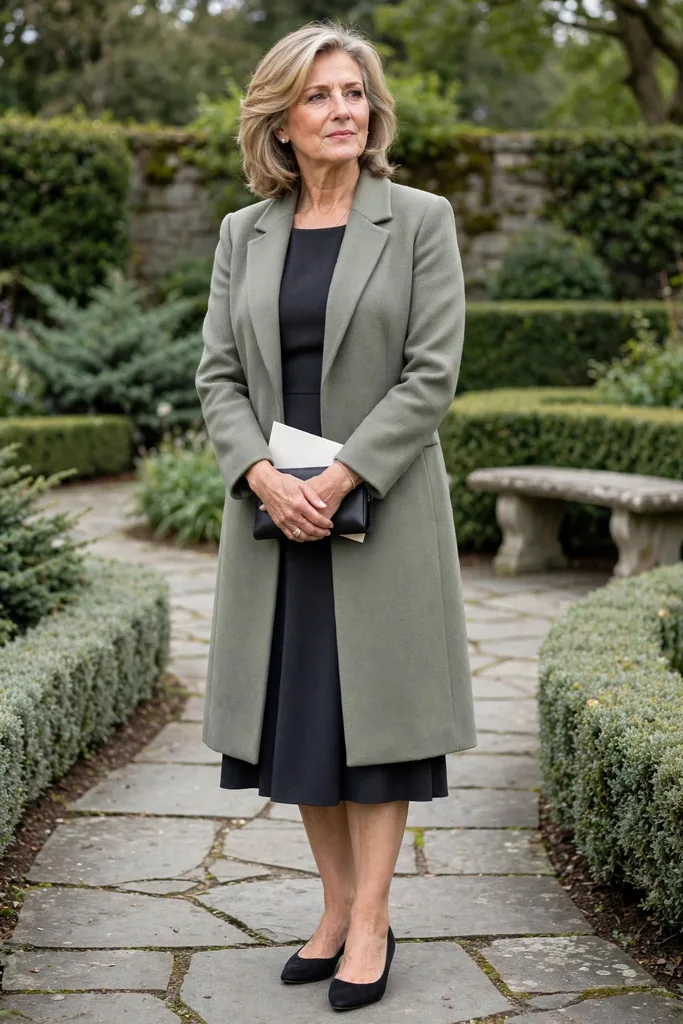
Uncertain what is expected? When expectations feel unclear, a quick call to the funeral home — or to someone close to the family — reads as considerate, never awkward. Where no dress code is given, take what you would wear to an important daytime event and quiet it down one notch: a plain dress, tailored trousers, a skirt beside a polished blouse, or calm separates under a blazer or cardigan. Picture a sage-grey tailored coat over a charcoal midi dress, the white program resting in both hands — nothing there asks to be noticed, and that is precisely the point.
Black Works, but It Is Not Your Only Option
Few colors are as effortless as black: somber, formal, and easy to coordinate. Still, no law says the entire outfit must be black — least of all when all-black washes you out or looks severe. Charcoal and navy are the obvious stand-ins. Deeper options like burgundy and forest green, or softer ones like brown and gray, bring richness without noise, and all of them carry the day beautifully.
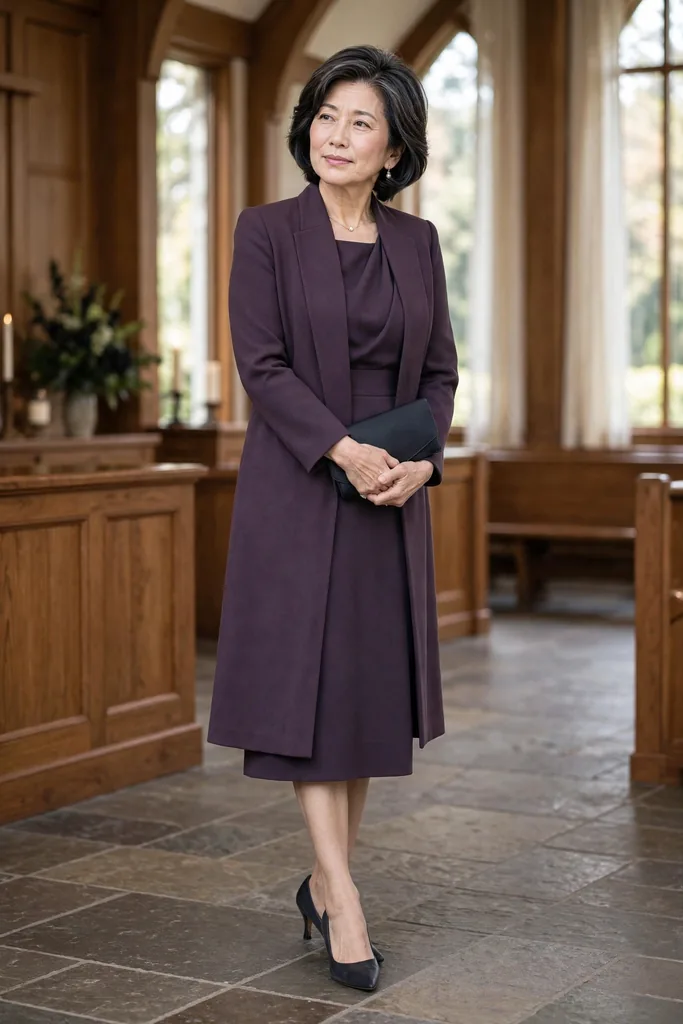
A hushed palette still gives the occasion the calm visual effect it asks for. When dark tones at the throat feel harsh, let a softer blouse, scarf, or neckline show beneath the jacket — restraint stays intact while your complexion brightens. A muted plum coat and dress paired with deep charcoal shoes shows one alternative carrying the same quiet weight as black.
Very bright colors and loud prints steal more focus than the day can spare, barring a family request. Faint prints, hairline stripes, low-key weaves, or softened florals can still pass. Instead of asking whether a piece is permitted, ask whether it might compete with the reason everyone is gathered.
Use this quick color chart when you are staring into the closet second-guessing everything.
| Shade | Wear It As |
|---|---|
| Black | A safe home in dresses, trousers, skirts, coats, or blazers. |
| Navy | The formality of black, minus the harshness. |
| Charcoal gray | At its best in trousers, knits, and outerwear. |
| Deep brown | Deep and understated; loves fall and winter. |
| Burgundy, forest green | Let them star — keep everything else plain. |
| Soft beige or ivory | Best peeking out as a blouse or layer under darker pieces. |
Simple, Clean Lines Look More Considered Than Extra Formality
Looking right at a funeral asks for no complicated styling. Plain pieces often look more deliberate precisely because nothing visual is competing. A straight or softly shaped midi dress is among the easiest paths — pick cloth with enough weight to drape smoothly instead of gripping the body.
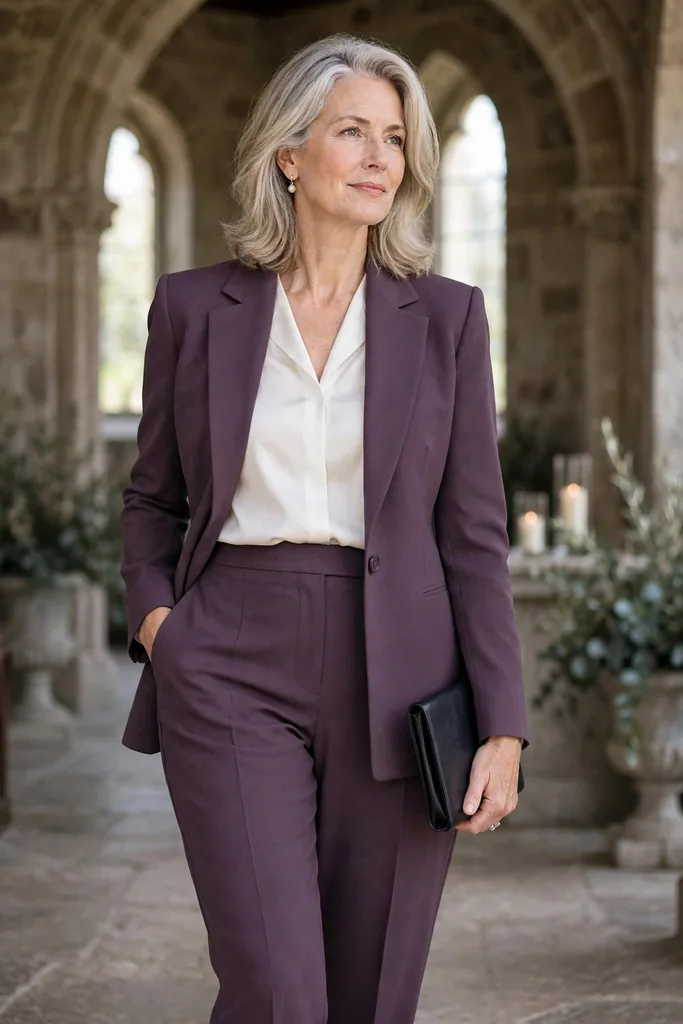
Tailored trousers suit a great many services just as well. Over them, layer a blouse, a soft knit, or a tailored jacket — the venue and the weather decide which. Skirts in knee or midi length pair just as nicely with a plain blouse or sweater. Hiding your shape is unnecessary; cloth that skims instead of grips simply feels more at home on a solemn day. A muted plum blazer and trousers over a warm ivory blouse shows how little a clean-lined outfit needs to say.
Fit tip: test-drive the outfit in a chair before the day. Expect far more sitting than standing, and far more walking and waiting, than you planned for — a skirt that creeps up or trousers that pinch will hijack your thoughts within the hour. In this setting, comfort is not sloppiness; it is what keeps your thoughts with the people around you. This principle serves women over fifty far beyond funerals: a piece that sits easy at the shoulders, waist, and hips nearly always looks more polished than a restrictive one chosen just because it seemed dressier.
Quiet Fabrics Are What Make a Simple Outfit Look Polished
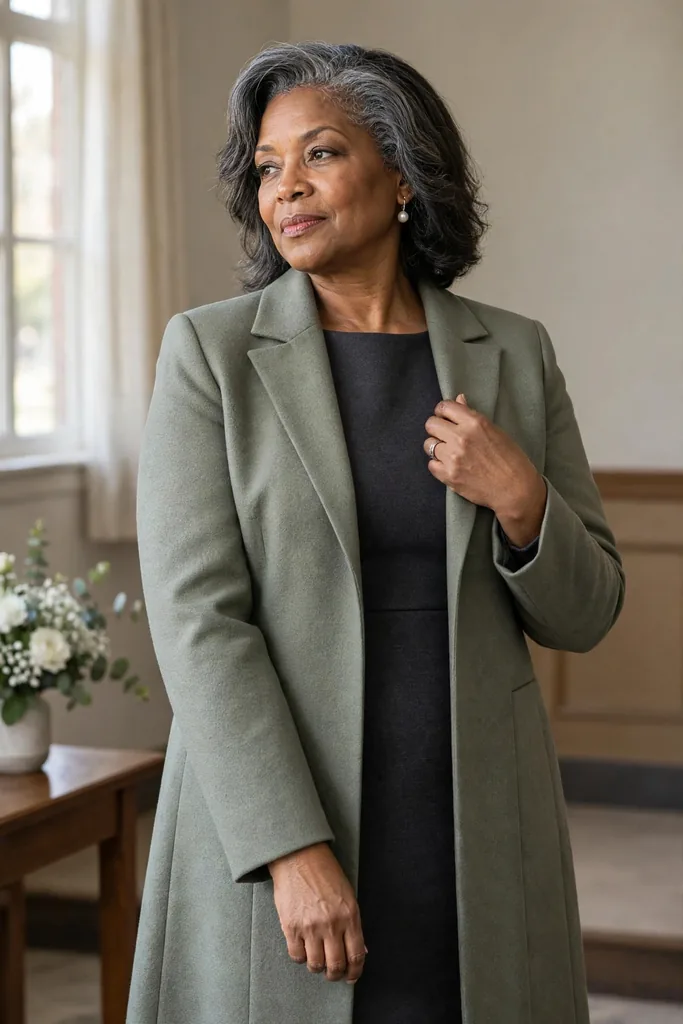
Strip an outfit of color and pattern and the fabric starts speaking louder. No surprise, then, that two plain dark outfits can leave entirely different impressions. Matte cloth is the most reliable funeral territory: fine wool, crepe, ponte, cotton blends, soft knits, and weighty jersey all sketch clean lines with no flash at all.
High-shine satin, heavy sequins, metallic weaves, and dramatic sheers draw the eye — the wrong direction for the day. A little texture is welcome; keep it hushed. Pleats pressed into a blouse, or gentle draping on a dress, lend interest without disturbing the respectful tone. A sage-grey wool blazer over a charcoal sheath dress shows how the cloth itself can carry the look once shine is off the table.
Fabric tip: creases matter more than cost. An affordable blouse that sits smooth beats a pricey one that arrives rumpled from the car ride. Take one last look at the whole outfit in daylight before you leave — lint, pet hair, creases, and a missing button all shout on dark cloth.
Run this quick wardrobe check before you head out.
| Instead of This | Try This |
|---|---|
| High-shine party cloth | Matte crepe or a soft woven. |
| Thin cloth that grips | A mid-weight cloth that skims. |
| A big dramatic print | A solid, or a whisper of pattern. |
| Heavy sparkle or trim | A clean neckline or hushed texture. |
| Slouchy sweatshirt fleece | Fine knit, ponte, a wool blend, structured cotton. |
Skip the Dress If You Want: Trousers Can Be Every Bit as Appropriate
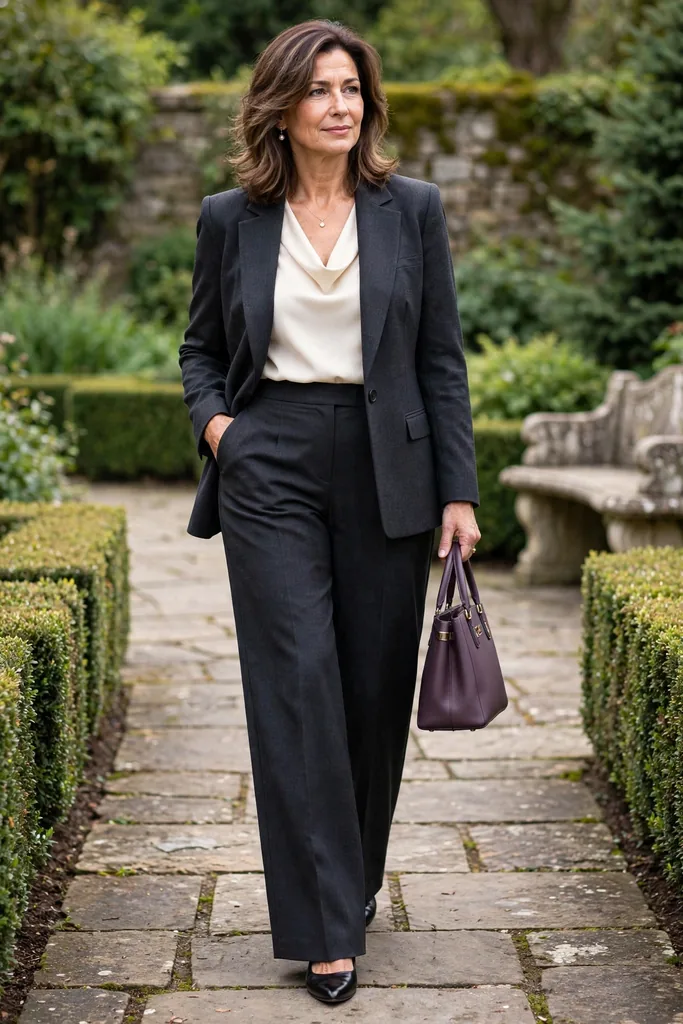
Plenty of women grab a dark dress on instinct, as if it were the one officially correct answer. If dresses are rare in your life, there is little sense forcing one on an already emotional day. Trousers with a good cut can look every bit as polished and proper.
Straight, gently wide, or softly tapered legs are the most obliging — they sit easily under any simple layer. One ready answer: dark trousers, a fluid blouse, a blazer; another is tailored trousers, a fine knit, and a low-key coat. Charcoal wide-leg trousers beside an ivory cowl blouse, with a muted plum bag on the arm, proves the point without a dress in sight. Skirt lovers have options too: straight midis, softly pleated midis, and plain A-lines all move freely without tipping casual.
They also work as dependable outfit formulas for women over 50, since they ask nothing of your body shape and chase no trend. Adjust cuts, necklines, and proportions freely until the whole pairing feels like you.
Your own closet already holds everything these respectful looks require.
| Setting | Outfit Formula | Why It Works |
|---|---|---|
| A traditional service | Dark midi dress, plain coat, closed-toe shoes. | Serene, polished, easy to wear. |
| Church service | Trousers, blouse, blazer, loafers. | Coverage that never feels stiff. |
| A graveside service | Dark trousers, fine knit, weather-ready coat, flats. | Handles walking and long standing with ease. |
| Celebration of life | Midi skirt, blouse, cardigan. | Gentler in mood, still considered. |
| A warm-weather service | Featherweight midi dress with a light layer and low shoes. | Polished silhouette, zero extra weight. |
Choose Shoes You Can Stand In From Start to Finish
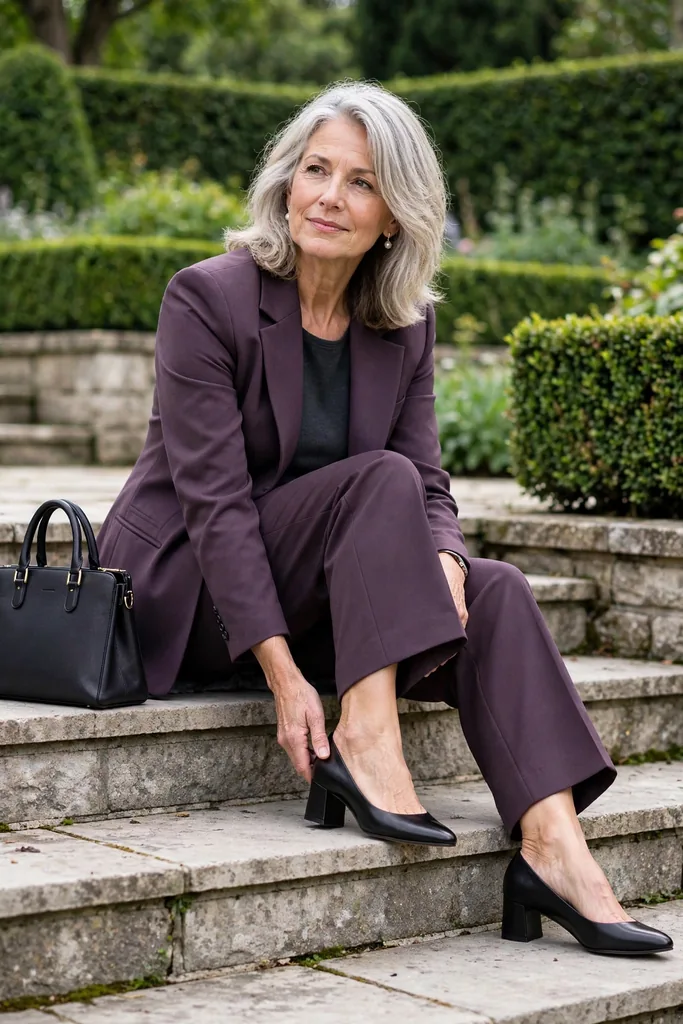
If there is one place practicality should win outright, it is footwear. Reception lines, long walks across parking lots, and uneven cemetery ground all demand shoes you trust. Low block heels, polished flats, loafers, simple pumps, and sleek ankle boots all earn their place — pick the pair that carries you confidently, not the dressiest pair in the closet.
Heel-wearers need not abandon them; fifty-plus is no mandate for flats. Sore feet, or footing that feels unsteady on grass and gravel, make a beautiful flat the wiser pick by far. Steadiness beats height every time, and black block-heel pumps can stay in the picture: a plum suit with a charcoal top and the right black shoes reads entirely appropriate.
Ahead of an outdoor burial, check the sky before you go. Spindly heels disappear into soft ground; polished leather soles turn treacherous in the wet. Comfort idea: if the day includes both the service and the burial, leave a spare, walkable pair in the car and change outside — the indoor outfit stays exactly as planned.
Finish With Jewelry, a Bag, a Scarf, and Makeup That Stay Quiet
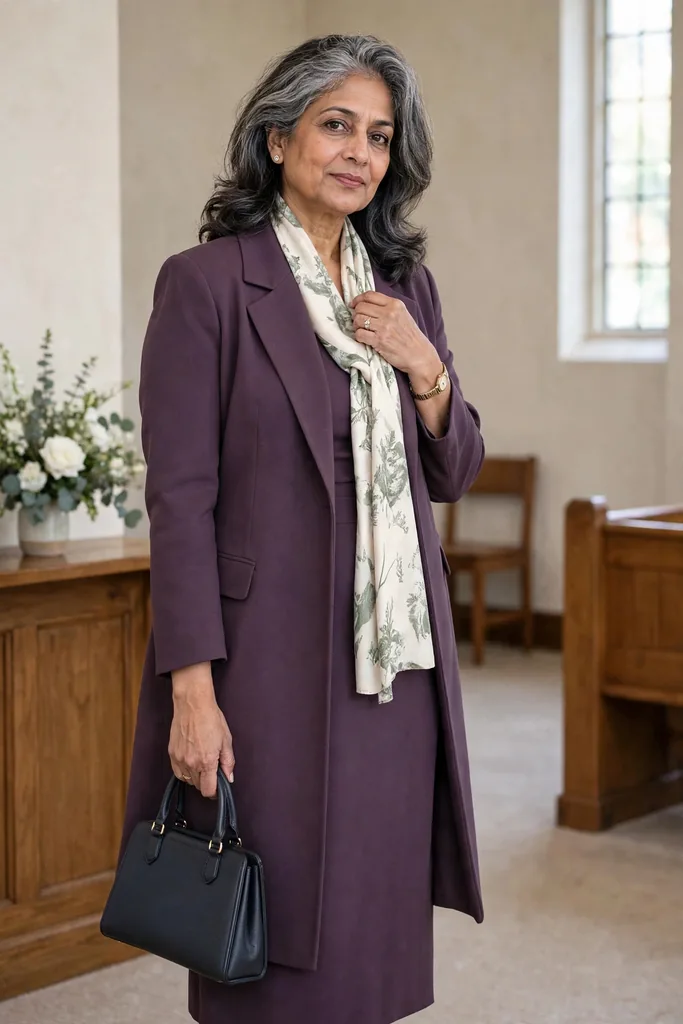
Accessories need not vanish. They do their best work supporting the outfit instead of becoming the headline. Lean on the classics: a fine chain, pearls, petite earrings, a watch, or one quiet bracelet — every one a safe choice. When bold jewelry is your signature, wear a single piece rather than a stacked collection of statements.
A mid-size or small structured bag suits the day far better than a beach tote or a heavily beaded evening clutch. Any of the usual suspects will cooperate — black, navy, tan, gray, burgundy, or deep brown. A scarf is a gift when you want a whisper of color near your face — keep it to a softened print or solid shade, draped loosely rather than arranged elaborately. An ivory scarf printed in soft sage-grey, beside a deep charcoal bag, keeps every finishing touch exactly where it belongs: hushed.
Makeup answers to the same rule. Wear what makes you feel composed and like yourself — just not the day to trial a dramatic new look. The day asks nothing of your hair color or lipstick: hiding gray, switching shades, or looking different from your usual polished self is entirely optional. Dressing respectfully still leaves space for who you are.
Plan for the Weather Without Losing the Quiet, Respectful Mood
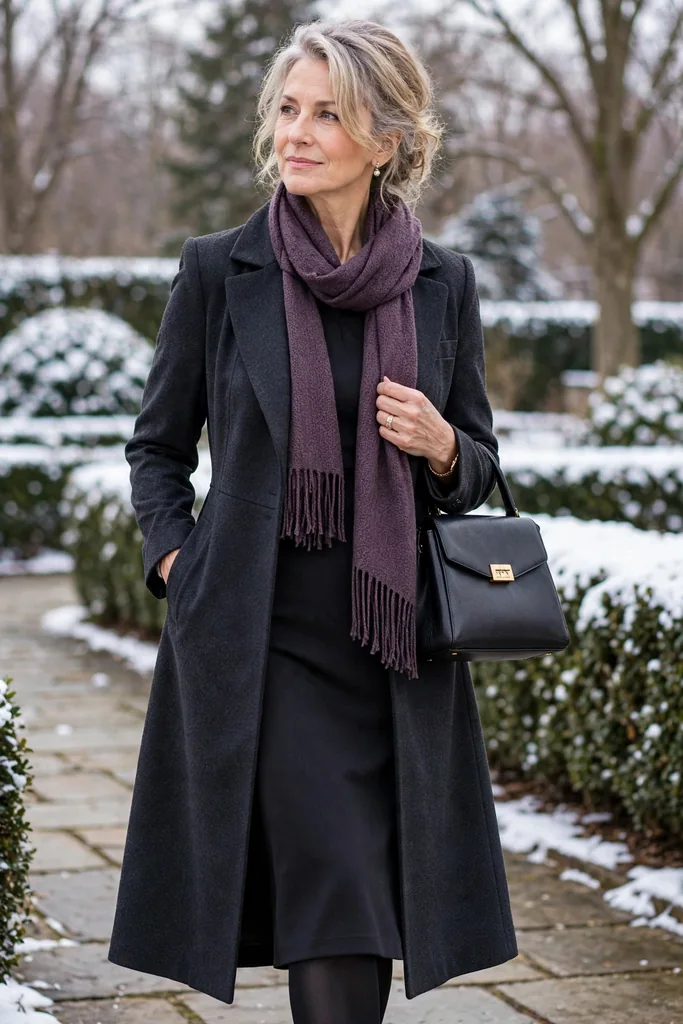
The prettiest outfit fails the moment an outdoor service leaves you shivering — or wilting in the heat. Factor the season into your planning right from the start — comfort first. When heat is the issue, reach for breathable weaves — cotton blends, linen blends, featherweight crepe — anything that moves. Short sleeves pass muster, though a light cardigan or jacket keeps your options open indoors.
At cold-weather services, a simple wool coat often becomes the most-seen piece you own that day. No special occasion coat is needed — the clean dark neutral already in your closet usually does it. A charcoal wool coat with a muted plum fringed knit scarf takes on winter without disturbing the quiet mood.
If rain threatens, a plain umbrella and shoes that tolerate damp ground are non-negotiable. Arriving prepared always looks more polished than struggling in clothes picked for looks alone.
A single base outfit can travel across several seasons with small tweaks.
| Base Outfit | Warm-Weather Swap | Cold-Weather Swap |
|---|---|---|
| Dark midi dress | Featherweight cloth, low flats. | Tights, wool coat, ankle boots. |
| Trousers and blouse. | Swap in a breathable blouse and a light blazer. | Trade up to a fine knit under a structured coat. |
| Midi skirt, top. | Short sleeves and flats. | Sweater, tights, closed shoes. |
| Dark separates. | A featherweight cardigan. | Warm scarf, gloves, longer coat. |
Still Look Like Yourself, Just Turned Down a Notch
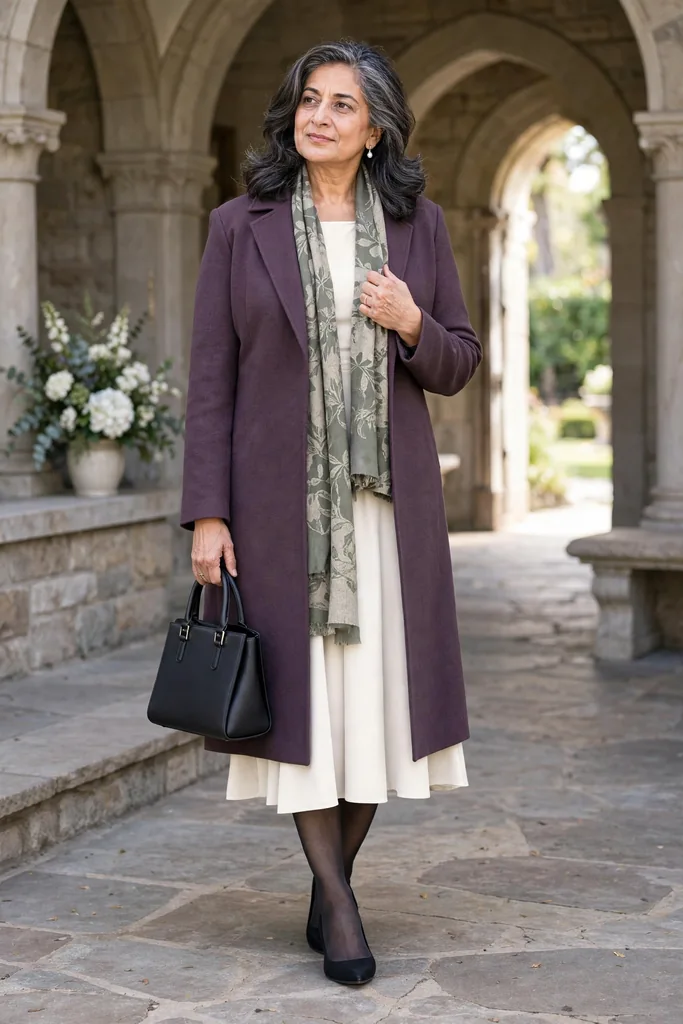
Honoring the day does not mean shelving your personal style. Turn the volume down instead of changing the person. Color lovers: reach for the deep version of your usual shade. Scarf devotees: pick a quieter pattern. If tailoring is your hallmark, a structured blazer will feel like home. If softness is your language, a fluid midi dress plus a cardigan speaks respect just as fluently.
That explains why elegant outfits for women over 50 need no tangled web of restrictions at all. Style rings truest once you know which elements are genuinely yours — and at a funeral, you keep those elements and edit them lightly. A muted plum coat over a warm ivory dress, finished with a sage-grey scarf, puts the whole formula on display.
The result reads composed, never costumed — plus your everyday lipstick applied a shade softer instead of skipped. Once the service starts, the clothes should fade from your mind entirely.
You might try:
- That deep burgundy blouse you love, rather than its bright-red cousin.
- Plain gold studs in place of the oversized statement pair.
- A dark floral scarf rather than the big colorful one.
- A beautifully cut trouser instead of stiff formalwear that never felt like you.
Steer Clear of the Choices That Leave You Fidgeting All Service
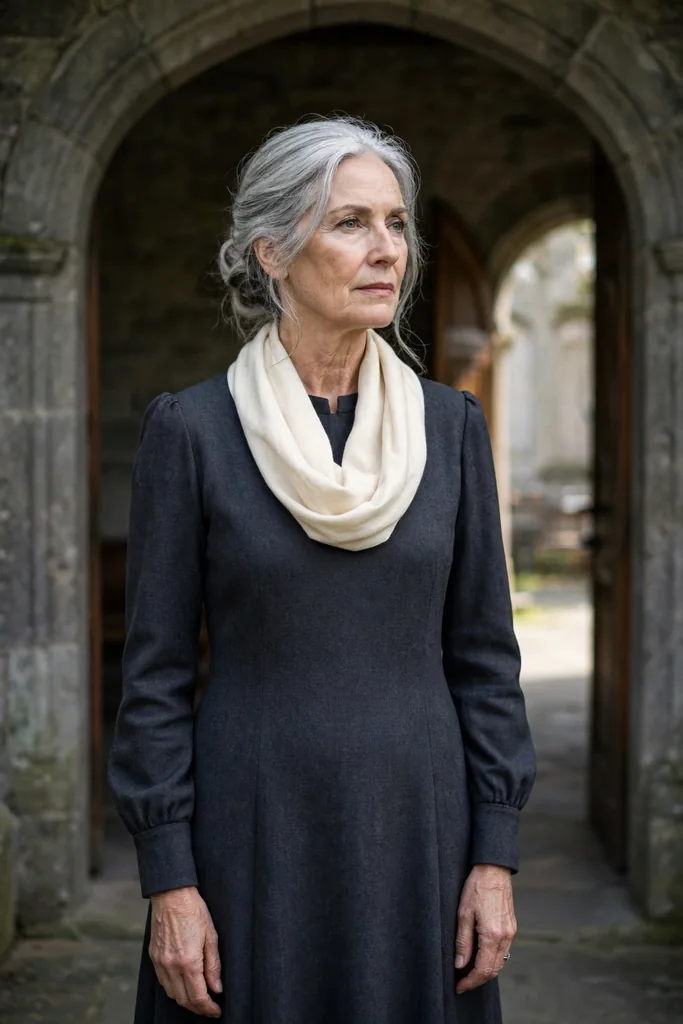
Most wardrobe missteps at a funeral are not etiquette violations. They happen when clothes itch, gape, slouch, or shout — leaving you thinking about fabric instead of the family.
A neckline that needs constant tugging wants a camisole — or a different top. A hem that hikes alarmingly when you sit wants more length. When an outfit feels too casual, structure rescues it: a blazer, refined cardigan, sharper shoe, or polished coat is often enough. A charcoal midi dress with an ivory scarf loosely draped is the kind of settled pairing that asks for no attention at all.
The same thinking runs in reverse. When a severe dark suit has you feeling boardroom-bound instead of family-focused, a knit shell, blouse, or plain scarf softens everything. Nobody needs the room’s most fashionable outfit — the aim is simpler: dressed right, comfortable, and settled enough to give your attention where it belongs.
Have One Go-To Funeral Formula Waiting in Your Wardrobe
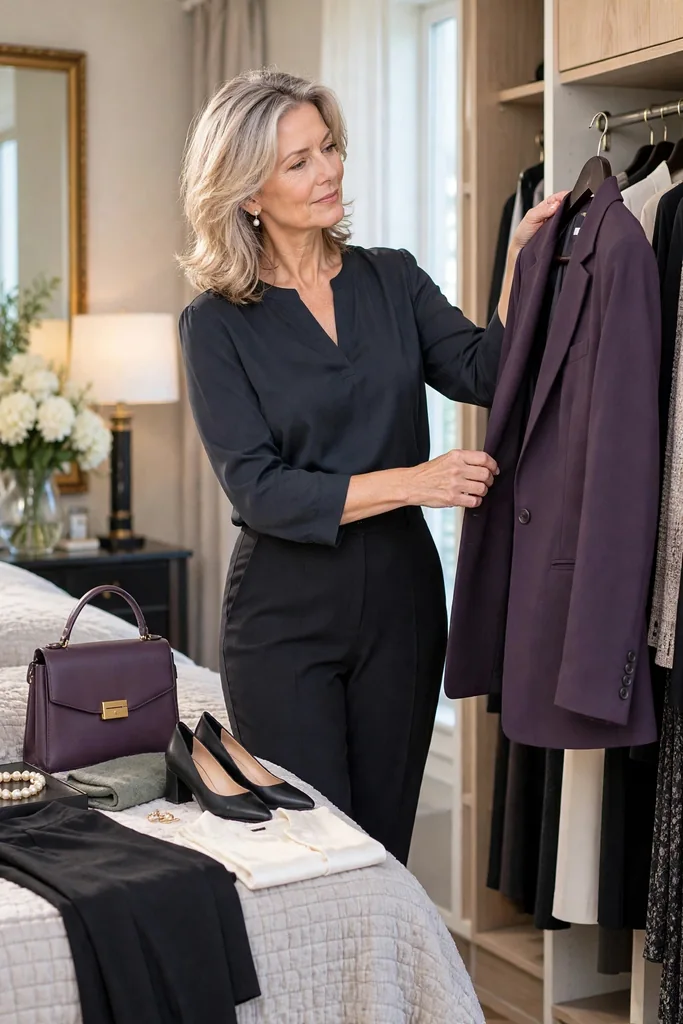
Funeral news rarely gives much notice. Emotional weeks are easier with fewer decisions — keep a dependable combination ready in the wardrobe. Keep a plum blazer on the hanger beside charcoal trousers, a sage scarf, an ivory blouse, and a pearl necklace — an answer that needs no deliberation.
Here is the standby equation I reach for first: dark trousers (or a midi skirt), a soft blouse or fine knit, one structured layer, and polished shoes you can genuinely walk in. The structured layer lends a considered air, while the softness underneath keeps sternness away. Blazer, cardigan, trench, or plain coat — whatever structured piece your wardrobe offers will do. A dress version comes together just as easily: dress formula: a simple midi dress + quiet jewelry + practical shoes + a weather-wise outer layer.
Neither calls for a wardrobe reserved for funerals. No funeral-only wardrobe is required — pieces already in rotation for everyday or smart-casual wear will do the job. That may be the most reassuring response to what to wear to a funeral over 50: pick clothes that honor the occasion, flatter the body you have today, and let you be fully present — no outfit worries allowed.
FAQs
Is wearing black actually required when you attend a funeral?
No — black is traditional and unfailingly safe, yet dark navy, charcoal, brown, burgundy, and other muted tones are every bit as fitting for the day. Once the family has named a color or theme, their wishes come before any habit of reaching for black.
Would trousers be a respectable choice for a woman at a funeral?
Absolutely — a well-cut pair of trousers belongs at many funerals and memorial services. Match them to the formality with a blouse, a knit, a blazer, a cardigan, or a polished coat, and favor a clean, well-fitting pair over anything slouchy. What the whole outfit says matters more than bowing to tradition with a skirt.
Are jeans ever okay at a funeral?
For a traditional funeral, proper dress trousers remain the safer bet; jeans read too casual unless the family asked for casual dress or the memorial's nature invites it. If jeans are genuinely your only option, pick a clean dark pair with no distressing and dress it up with a blouse, knit, blazer, or another polished layer.
What is the best approach to summer funeral dressing after 50?
Lean on featherweight fabrics with real structure. Good options include a midi dress in a featherweight weave. A skirt worn with a blouse, or tailored trousers paired with a short-sleeve top, will serve you just as well on the day. Pack a light cardigan or jacket for air-conditioned chapels, and favor comfortable flats or low heels when part of the service is outdoors.
What is the right way to dress for a celebration of life?
These can be less formal than traditional funerals, but the family's guidance comes first. Color, relaxed clothing, or a nod to the person being remembered may all be welcomed. With no specific guidance, stay with polished pieces in restrained colors and let the venue set the tone.
Dress So the Day Can Hold Your Attention
Dressing for a funeral after fifty gets easier the moment you stop hunting for one sanctioned outfit. Thoughtful choices, an honest fit, real restraint, and attentiveness to the family and the day — that is where respect comes from.
Nothing on that list is off-limits — trousers, dresses, skirts, a touch of color, walkable shoes, and the pieces that still feel like yours. The last step is the simplest: wear what leaves you composed, then forget about clothes and be fully present for the people who need you.