
One Winter Wardrobe That Carries You Through the Whole Season: A Capsule Guide Women Over 50 Will Love

Somehow a winter closet fills up faster than any other season’s. Between heavy coats, thick sweaters, tall boots, scarves, and those one-outfit-only purchases, women over 50 often end up with rails of clothing and almost nothing that combines into a real outfit.
And here is the annoying truth: owning more rarely makes cold-weather dressing any simpler. Shifting proportions, new comfort priorities, and heavier fabrics can leave an outfit looking bulkier and less refined than you planned.
The answer is a capsule wardrobe over 50: a tight lineup of pieces chosen to layer without fuss, feel easy through long days, and pull from one shared palette. The best part is that nothing has to be thrown out to start.
This guide walks through every category that matters — coats, knits, bottoms, shoes, color, and morning-ready formulas — then shows how to shop strictly for what’s missing. By February you’ll have a wardrobe that feels like yours, not a project.
Table of Contents
- Every Winter Piece Should Pull Its Weight in Several Outfits
- Begin With a Coat That Fits Your Actual Winter Life
- Slim Knits, More Outfits: Rethinking Winter Layers
- How to Balance Heavy Layers From the Waist Down
- Shoes Decide What Your Capsule Can Actually Handle
- A Simple Color Plan: Three Neutrals Plus a Few Accents
- Three Go-To Outfit Formulas for Busy Mornings
- Shop for the Missing Piece, Not a Repeat of What You Own
- Your Winter Capsule at a Glance
- FAQs
Every Winter Piece Should Pull Its Weight in Several Outfits

What makes a piece truly essential in winter goes deeper than being basic. It earns its place by fixing several morning dilemmas at once and working with enough of what you own to deserve its space.
Set a stunning sweater that matches a single skirt beside an unassuming merino knit that goes with jeans, tailored trousers, a midi skirt, and under a coat — the plainer piece delivers ten times the outfits.
Never underestimate fit alongside versatility. Heavy-weather clothes add apparent weight by themselves, so garments that glide over the body rather than pinching or drowning it will always sit better in layers.
Put each contender to one test before it enters the capsule: does it work three ways with pieces already in my closet? That question alone keeps lovely-but-lonely items from piling up.
Start with this framework:
| Item | Choose | Goes With |
|---|---|---|
| A winter coat | Flat shoulders, room for knitwear below, a knee or mid-thigh hem | Jeans, trousers, skirts, dresses |
| A fine knit | Merino, cotton-rich blends, cashmere mixes, or a soft featherweight wool | Blazers, outerwear, jeans, smart trousers |
| Dark denim | Straight, slim, or easy-relaxed legs with a tidy finish | Sweaters, shirts, boots, loafers |
| Smart trousers | Straight cuts, fuller widths, or tapered legs | Knitwear, blouses, jackets |
| A midi skirt | A drapey knit, wool mix, or gentle pleating | Delicate knits, boots, structured coats |
| Ankle boots | Comfy heel height, grippy sole, neat toe | Denim, pants, skirts, dresses |
Take stock of your closet before spending a cent. Pull every winter piece onto the bed and sort into three piles: wears constantly, wears rarely, never wears. The middle pile usually reveals the pattern — wrong color family, awkward length, or needs tailoring. Fix or release those before adding anything new, or the capsule inherits the same problems.
Begin With a Coat That Fits Your Actual Winter Life

No other garment hides as much of your outfit as a winter coat, so its cut matters far more than collecting trendy jackets that seldom make it out of the closet.
Check tidy shoulders and real ease through the arms and torso — a sweater must fit beneath. If it glides over a thin blouse but tugs across a chunky knit, you’ll resent it by week two.
Fit tip:
Test every coat over the thickest sweater you truly wear. Stretch your arms out front, sit, fasten all buttons — then judge the size.
Coats that end at mid-thigh or the knee are the hardest workers, pairing with trousers, denim, and most skirt lengths. A softly tailored wool-blend coat can even rescue the plainest everyday outfits for women over 50, lifting them into something refined.
Let one hardworking neutral do the anchoring — navy, charcoal, camel, chocolate, olive, black, or soft taupe steadies everything without demanding exact matches below. A back vent or side slits also make sitting, and car seatbelts, far easier in a knee-length coat. When buying new, heft the coat in your hands first; a lighter cloth with good structure beats a heavy one you’ll dread lifting.
Got a winner of a neutral coat in the closet already? Hold onto it. This season’s trending silhouette is no reason to pension off a winner — a new scarf, different shoes, fresh knitwear, or another trouser shape can supply the novelty.
Slim Knits, More Outfits: Rethinking Winter Layers

Chunky knits are cozy, but a wardrobe of nothing else leaves no room to layer. Fine and mid-weight sweaters are the unsung workhorses — maximum outfits, minimum bulk.
Merino, cotton blends, cashmere mixes, and sleek wool knits glide beneath coats without shoulder bulk, and a front tuck into trousers or a skirt restores definition in seconds. Turn knits inside out before washing and skip the dryer — pilling is what ages a capsule fastest.
A crew neckline sits cleanly under jackets; a soft V opens the space near your face; a mock neck offers turtleneck-like warmth without the choked feeling. If static plagues your knits, a light mist of water on the inside before wearing tames it without chemicals. Roll knits instead of folding; it prevents hard creases and saves drawer space.
Hold on to one or two richer textures if they make you happy — a cable knit, a brushed cardigan, or a slightly slouchy sweater adds welcome variety against an otherwise clean lineup.
Easiest win: team a handful of neutral knits with one or two face-flattering shades. For accents, think burgundy, deep red, rust, forest green, plum, soft blue, or cream — any of these rescues a dull cold-weather outfit.
The same foundations swing between very different days like this:
| Piece | Easy Day | Dressed-Up Day | Freezing Day |
|---|---|---|---|
| Crew-neck knit | Straight jeans plus sneakers | Wool trousers plus loafers | Thermal underneath, coat on top |
| Turtleneck | Dark jeans with ankle boots | Midi skirt, structured jacket | Top with a scarf and long coat |
| Cardigan | Tee and relaxed trousers | Blouse and tailored trousers | Worn done-up over a featherweight merino knit layer |
| Sweater dress | Flat boots | Belted with sleek ankle boots | Long coat plus opaque tights |
That’s when a winter wardrobe starts punching above its piece count: same familiar items, restyled for the weather and the day.
How to Balance Heavy Layers From the Waist Down

Cold-weather proportions are tricky — knitwear, jackets, and coats already add volume above the waist. Snug isn’t required below the waist, but the overall line must stay coherent.
Straight-leg jeans sit in the sweet spot between skinny and ultra-wide. Ankle boots, sneakers, loafers, even heavy-duty winter boots all work — no single-trend commitment.
Favor straight, easy-wide, or tapered trouser cuts. Wool-blend and heavy ponte fabrics warm you far better than thin office pants while still looking sharp.
Tempted by wide legs? Mind the length. Extra fabric puddling on shoes weighs the whole look down; a hem that just kisses the shoe sharpens every line. Cropped wide trousers that show off ankle boots can be the most flattering winter proportion of all.
Make room for skirts in the winter capsule. A flowing midi with a lightweight sweater and boots reads effortlessly elegant — no strict tailoring required.
Rise matters more than the number on the tag. A mid-to-high rise keeps knitwear tucked and your back covered when you sit; low rises fight every tucked layer all day long. Always sit down in the fitting room — if the waistband gaps or digs, the cut is wrong no matter how good it looks standing.
Don’t overlook what goes underneath. Thermal leggings beneath trousers add serious warmth without changing the outfit’s look, and fleece-lined tights turn a midi skirt into genuine winter wear. Keep one pair of each in black; they are the invisible foundation the whole capsule stands on.
Comfort hint:
If stiff waistbands nag you all day, hunt for back-waist elastic, stretch-woven cloth, or hidden side elastic — keep the trousers.
Shoes Decide What Your Capsule Can Actually Handle

Even a flawless rail of clothes falls apart on the wrong shoes. Frozen sidewalks, marathon errands, travel days, rain, and long hours upright all change the brief.
The simplest starting point? A sleek ankle boot. Go for a stacked low heel, flat sole, or easy platform — trousers and dresses both take them, and you gain coverage open shoes can’t offer.
Add one comfort-first daily shoe — sneakers, supportive flats, or loafers in leather — where the climate cooperates. You’re covering real-life scenarios, not collecting categories. A weatherproofing spray and a cushioned insole can rescue boots you already own, often for less than a new pair costs. Keep a small brush by the door for salt marks — they ruin leather faster than snow does.
Coordinate your hemlines with your shoe shapes. Fuller cuts call for a shoe with real presence; slimmer straight legs pair best with a sleek boot or loafer.
Shoe strategy:
If heels elevate an outfit but wreck your feet, switch to a flat boot with a pointed or almond toe — the lengthening line stays, the heel doesn’t have to.
Now hand the personality job to accessories. Scarves, bags, earrings, and gloves do the heavy lifting — a patterned scarf, a textured tote, bold earrings, or jewel-toned gloves can transform plain winter basics fast. Rotate two bags — a structured tote for day and a small crossbody for evenings — instead of buying more shoes.
Traction is a safety feature, not a style compromise. Seek lugged or textured rubber soles if your winters bring ice; smooth leather soles look handsome and grip nothing. Love a boot with a slick sole? A cobbler can add a thin rubber layer for a fraction of the boot’s price — a trick worth knowing before February arrives.
Think in shaft heights when pairing boots with hems. Ankle boots vanish under wide trousers and show nicely with cropped or straight legs; knee-high boots need a skirt with enough hem to meet them, or straight jeans tucked inside. One ankle boot plus one taller boot covers nearly every winter hemline you will wear.
A Simple Color Plan: Three Neutrals Plus a Few Accents
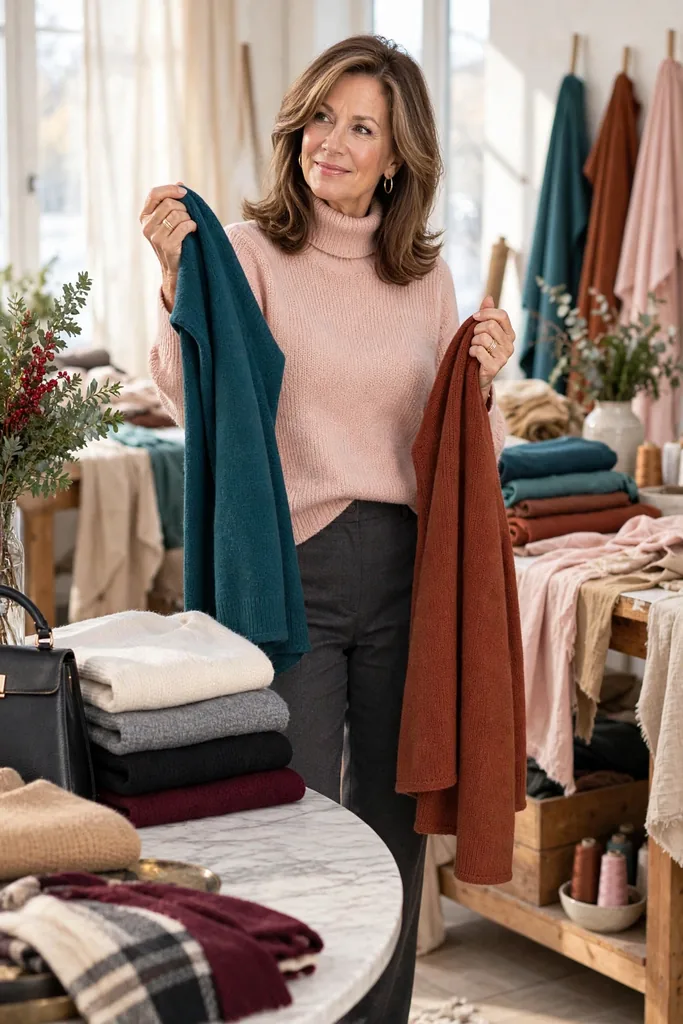
Forget the idea that capsules mean beige-black-white uniforms. You just need enough shared color for most pieces to get along.
Start from the two or three neutrals already dominating your rails — denim, black, olive, chocolate, camel, cream, charcoal, or navy all make steady ground.
Then fold in a color or two you genuinely love. Let knitwear, scarves, shirts, bags, and even socks carry your color — the pricey pieces stay neutral. Unsure which accents suit you? Hold the fabric to your face in daylight: the right shade brightens your eyes instead of washing you out. Test new accents at home in daylight before removing tags, not under store lighting.
Pair neighbors instead of matching exactly — black with charcoal, cream with camel, denim with navy, burgundy with chocolate — and watch how much richer the result looks than one flat shade. When in doubt, echo your hair color in one of the neutrals; it almost always harmonizes.
That’s the real simplification of dressing over 50: no more one-off outfits, just mix-and-match combinations.
Three Go-To Outfit Formulas for Busy Mornings
Forget the capsule wardrobe over 50 that photographs beautifully on the rail — the one that counts gets you out the door at 7:30 without a second thought.
Build a small rotation of go-to outfits from pieces that already flatter you. Then rotate the fabric, color, shoes, or accessories instead of starting from zero each day.
These four combinations handle most ordinary winter days.
| Moment | Outfit | The Payoff |
|---|---|---|
| Market runs and casual lunches | Easy denim, a soft sweater, short boots, your coat | Relaxed pieces keep bulk in check |
| Office days and meetings | Pressed trousers, a neat blouse or sweater, a sharp coat | Crisp lines read polished, never stiff |
| Dinners and gatherings | A swishy midi, a close-fitting sweater, boots, statement jewelry | A neat top steadies the skirt’s movement |
| Long travel days | A soft wool sweater, stretchy pants, an open cardigan, comfortable flats | Soft layers roll with temperature swings |
Formula:
Dark-rinse denim + fine-gauge knit + ankle boots + a longline wool coat.
Every piece in that lineup has a job, which is why it works daily. Trade the knit for a cardigan, put wool trousers where denim was, add a scarf — the look turns fresh, no new purchases needed. Photograph each formula once it clicks; a phone album of proven outfits ends morning guesswork for good. Lay tomorrow’s formula out the night before — decision fatigue drops to zero.
Adapt the formulas to your week’s dress code instead of inventing new ones. The errand formula goes office-ready when sneakers become loafers and a structured bag appears; the dinner formula relaxes with flat boots in place of heeled ones. Same bones, different finish — that is the capsule working.
Keep one rescue outfit fully assembled for the mornings when nothing works. It should be the combination you trust on your worst days: the trousers that always fit, the knit that never itches, the boots that never hurt. Knowing it exists lowers the stakes of every other morning.
Shop for the Missing Piece, Not a Repeat of What You Own
Before spending, diagnose what’s really blocking your wardrobe. The culprit is usually smaller than you think.
Perhaps the sweaters are fine but nothing sits comfortably under them — or the jeans, trousers, and tops all cooperate while every coat refuses to close over a knit.
Quick wardrobe sort
Try organizing your closet by function instead of category:
- Keep the heroes: everything that fits well and mixes freely.
- Park the fussy ones: pieces needing constant adjustment or special underpinnings.
- Name the gaps: the comfortable dark trouser or featherweight knit you keep missing.
- Buy the multipliers first: pieces that instantly create new combinations.
Capsules reward cost-per-wear, not novelty. A coat that fits beautifully and earns wear four days a week justifies a bigger budget slice than a showpiece sweater seen twice a season. When you find that missing link, buy the best quality your budget allows — everything else will lean on it. Keep receipts and tags on for a week; living with a piece at home reveals fit issues the fitting room hides. A three-week trial run with no new purchases shows you the real gaps.
Treat tailoring as the cheapest upgrade in the capsule. Hemming trousers to meet your most-worn boots, shaping a coat waist, or shortening sleeves turns “almost right” into “made for you” for the price of a lunch. Budget one tailor visit per season; it pays back every single morning.
Your Winter Capsule at a Glance
Winter capsule checklist
Tape this list to the inside of your wardrobe door. Aim: fewer pieces, harder-working, better layering, all-day comfort.
- 1. Lead With Outerwear
Make outerwear step one: a single dependable coat that clears your bulkiest knit and flatters most bottoms. - 2. Choose Layerable Knits
Fine plus mid-weight knits: warmth without the bulk battle under coats. - 3. Steady Your Bottoms
Bottoms that keep their line under heavy top layers. - 4. Shoe for Your Reality
Footwear matched to your weather, your mileage, and your hemlines. - 5. Color From the Core
Two or three anchor neutrals, accents woven through smaller pieces. - 6. Plug Gaps, Don’t Stockpile
Buy the single missing link that fixes multiple outfits.
Your Cold-Weather Recipe: a long coat over a light knit, straight-leg denim or trousers, boots, one signature accent.