
Eyewear After 50: The Frames That Flatter Your Face

Somewhere past fifty, choosing frames can turn unexpectedly difficult. Pairs that once lit up your face can start reading as heavy, harsh, or out of rhythm with the clothes you reach for now.
This frustration hits many women in their fifties and beyond, and the usual advice only makes it worse — most frame guides still lean on stiff face-shape charts. Those diagrams ignore shifting hair color, softening features, all-day comfort, progressive lenses, and your taste has likely evolved.
Here is the encouraging part: flattering eyewear rarely comes down to one ‘correct’ shape — proportion, color, fit, and a dose of personality matter far more, and each is easier to judge than you might think.
Table of Contents
- Fit the Width and Bridge First — Face Shape Comes Second
- Choose Shape From Your Features, Not From a Chart
- Color Your Frames to Wake Up Your Face
- Factor In the Shade of Your Hair Today
- Line Up Your Frames With Your Eyes and Brows
- Steer Clear of Details That Swallow Your Features
- Match Your Frames to Your Real Wardrobe
- A Simple Try-On Formula You'll Use Every Time
- FAQs
Fit the Width and Bridge First — Face Shape Comes Second

The prettiest frames on the rack fail fast when the fit is off: pairs stretching past your face’s sides shrink your features by comparison, while overly narrow ones pinch at the temples and squeeze your face visually.
Check where each outer edge lands against your face — the sweet spot is a frame whose edges finish near your face’s sides instead of jutting well beyond them.
The bridge deserves equal attention: frames that keep sliding south usually signal a bridge too roomy — or one shaped for a different nose entirely. Adjustable nose pads solve this for many women, while a keyhole bridge adds character and comfort.
Temple length matters too: arms ending exactly where your ears begin keep everything aligned, while arms that bow outward at the hinge tell you the pair runs too small.
Bring your current prescription and pupillary distance — accurate numbers change how a frame sits more than most women expect.
Run through this quick fit check the next time you try on frames:
| Frame Zone | Check This | What It Does for You |
|---|---|---|
| Total width | The outer edges line up with the sides of your face | Holds your features in natural proportion |
| Nose bridge | Snug contact that never squeezes or slips | Keeps the glasses where they belong all day |
| Temple arms | They run straight back instead of flaring out | Avoids pinching and a squeezed look |
| Top edge | The upper rim traces or dips just under your brows | Leaves your expressions open and readable |
| Lens height | Space for your prescription, kept in proportion to your face | Restores comfortable visual balance |
Fit tip: Face forward when you evaluate a pair — frames that look charming while tilted or nudged higher than they actually sit can feel like a different pair once they settle into position.
Choose Shape From Your Features, Not From a Chart
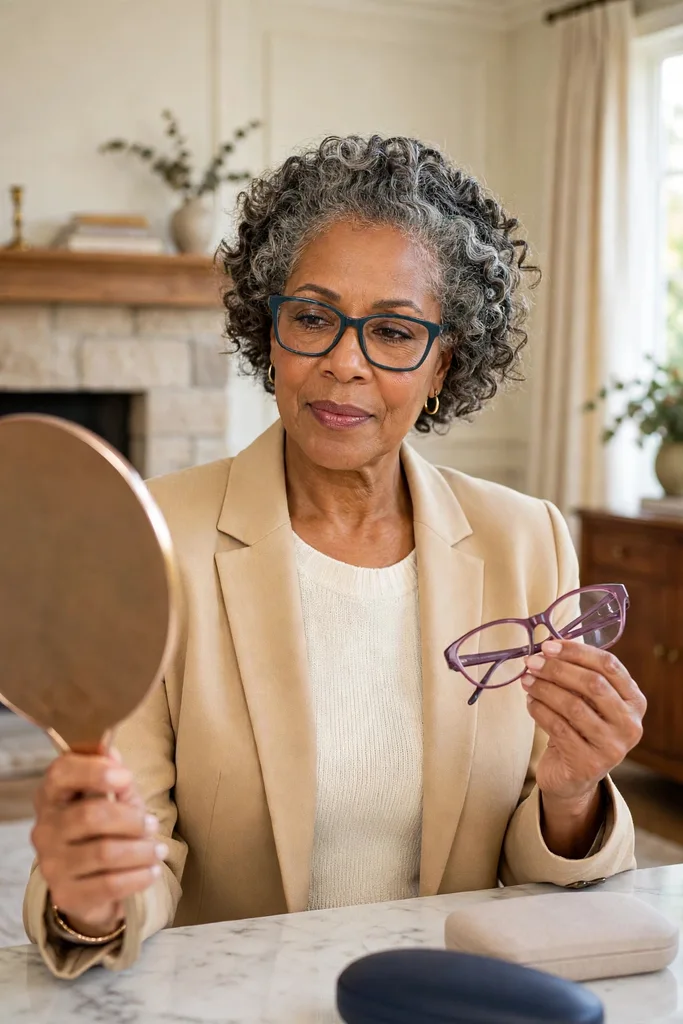
You have likely read the classic rules — square frames for round faces, round frames for square ones. Those opposites-attract rules make a decent starting point, but are far too blunt for most real faces.
Look instead at how a frame balances against your features.
When your features run soft, a touch of structure adds welcome definition — gentle rectangles, easy squares, quiet cat-eyes, and mildly angular rims all deliver that lift without turning severe.
When your bone structure runs angular, answer with curves — rounded rectangles, oval-leaning shapes, or frames with softened corners.
Aim for gentle contrast, never a cartoon of it.
A dramatic geometric pair can be wonderful on a woman whose jewelry runs bold. A daily uniform of simple earrings, soft knits, and quiet neutrals calls for a cleaner silhouette.
That attention to the person behind the frames sits at the heart of dressing over 50 — your glasses should flatter you, not follow a diagram.
Bring a friend or snap a quick selfie in natural light — a second pair of eyes catches imbalance the mirror forgives.
If you wear progressives, mention it before falling for a shape — some silhouettes simply cannot house the lens.
Color Your Frames to Wake Up Your Face

Frame color rests right beside your eyes, skin, and hair — giving it more power over your appearance than most garments you own.
Black frames remain the default, yet flatter far fewer faces than their popularity suggests. An extremely dark rim can stage more contrast than you want once your hair and coloring have softened.
Deep navy and warm amber are two of the kindest choices, defining the eyes without the hard border heavy black rims create.
Brown tortoiseshell, muted green, burgundy, soft gray, translucent taupe, and clear acetate belong in the same flattering family.
Hold a handful of colors up to your face before you commit: winners make your eyes read clearer and skin look more rested. Step near a window — store spotlights flatter nearly every color, while daylight tells the truth.
Two pairs in different colors serve different moods — a quiet tortoiseshell for workdays, a berry or teal for evenings out.
Factor In the Shade of Your Hair Today
The hair color you wore twenty years ago should not choose your frames today.
Every hair shade interacts with frame colors differently.
Silver, white, gray, highlighted, brunette, red, and blonde all deserve their own try-on session.
When gray hair carries cool undertones, it flatters — and is flattered by — confident colors like navy and berry, with charcoal, soft blue, cool tortoiseshell, or a translucent finish close behind.
If your hair runs warm, look toward honey, olive, warm brown, copper-leaning shades, or classic tortoiseshell.
An exact match is unnecessary — a whisper of contrast usually lends frames more presence. If you are growing out your color, shop for today’s hair, not the shade you are leaving behind.
The comparison below swaps rigid rules for a gentler way to think about color.
| Outdated Rule | A Better Way to Think |
|---|---|
| Black works on everyone | Hold black next to navy, tortoiseshell, gray, and translucent choices before deciding |
| Frames ought to duplicate your hair color exactly | Pick a neighboring shade or an easy contrast instead |
| Bold color belongs on younger faces | Reach for color when your closet and your character welcome it |
| A neutral pair is always the safest choice | Go quiet on color, but keep enough presence to shape your face |
| First, identify your precise color season | Hold several shades to your face in daylight and see which brightens it |
Color cue: When a frame seduces you on the display wall but your gaze keeps landing on the glasses instead of your eyes, retry the silhouette in a gentler color.
Line Up Your Frames With Your Eyes and Brows

Gorgeous frames still disappoint when their proportions clash with eyes and brows.
Aim for pupils landing somewhere near the middle of each lens. Perfect centering is not required, but a frame pushing your eyes very high, very low, or hard toward the inner corners will read as unbalanced.
The frame’s top edge need not mirror your brows exactly — it should work with them, not slice awkwardly across.
When the top rim sits exactly on your brow line, it can look heavy — a hair above or below usually reads better.
Slightly lifted outer corners bring welcome energy to many faces — one reason the soft cat-eye keeps its place.
A gentle upward sweep reads current without tipping into costume territory.
If you wear progressives, very shallow frames can starve the lens of the vertical room its viewing zones require. An optician can confirm in seconds whether a frame offers enough depth for your prescription.
That is no reason to jump to oversized glasses — a medium-depth lens supplies room while keeping your features on show.
Before settling on a shape, have the optician confirm it can carry your exact prescription instead of assuming it will.
Comfort counts as style. Glasses you keep pushing up, slipping off, or fidgeting with will never look polished.
Steer Clear of Details That Swallow Your Features

Bold glasses are not the enemy — a strong frame can become a signature.
A pair looks busy when it combines too many loud features in one frame.
A thick rim, an inky color, a roomy lens, weighty temples, and flashy decoration piled into one pair carry far more visual weight than a single statement feature would.
When frames feel slightly off, a whole new style may be overkill — changing a single element often solves the problem.
Small tweaks that often fix the problem:
- When heavy black rims feel severe: soften the color, not the shape — tortoiseshell, navy, clear brown, or translucent gray keep the silhouette while easing the contrast.
- When big frames swallow your features: hold the shape, just size the lens down a notch.
- When tiny frames read as dated: step up to a medium scale that keeps similar lines.
- When a bold cat-eye feels like a costume: choose a gentle upswept corner instead.
- When metal frames fade into nothing: go a touch thicker on the rim or pick a warmer metal.
This quick comparison makes common choices easier to weigh:
| What Feels Wrong | A Better Swap |
|---|---|
| A chunky dark rectangle | Swap it for a gentler square rendered in tortoiseshell or navy for instant relief |
| Undersized lenses | Step up to a medium lens carrying extra depth |
| An oversized frame that swamps you | Keep the shape but bring the size in line with your face |
| Busy, decorative temple arms | Plainer arms that keep the interest up front |
| A rimless pair that seems to vanish | A slim metal rim — or translucent acetate — adds just enough presence to anchor the look |
The goal is never to make your glasses vanish — let them champion your face instead of competing with it. Step back from the mirror before you decide; details that dominate up close often settle quietly at conversation distance.
Photograph each contender and compare the pictures side by side; the camera is crueler — and more honest — than the mirror.
Match Your Frames to Your Real Wardrobe

Treat your glasses as wardrobe staples — they rarely leave your face between morning and night.
When navy, cream, and denim rule your closet, frames in that family earn the most wear.
Camel, gray, olive, and burgundy round out the same hardworking palette.
A pair that only suits one special outfit cannot compete.
This is exactly the thinking behind a capsule wardrobe over 50 — versatile pieces work harder and cut decision fatigue.
Owning several pairs remains perfectly fair. Keep one neutral pair for everyday; invite a livelier, more distinctive pair out when personality is the point.
The same simple outfit takes on a different mood depending on your frames.
| Everyday Outfit | Frame to Try | The Result |
|---|---|---|
| White button-down and jeans | Tortoiseshell with warm undertones | Easygoing yet polished |
| Black sweater with trousers | A slim metal frame | Crisp, quietly refined |
| Navy knit over denim | A navy or soft-blue acetate pair | Pulled together without looking matchy |
| A cream blouse with camel pants | A honey or translucent-brown pair | Understated warmth, easy elegance |
| A plain neutral dress | Let a burgundy or green pair do the talking | Instant personality, no extra accessories needed |
Smart-spending tip: Postpone the trendy multi-pair spree until one frame already covers at least three-quarters of your daily wardrobe. Apply the same cost-per-wear thinking to glasses that you apply to shoes or coats.
Weekend denim, work neutrals, and evening looks each lean toward different frames — but one versatile pair plus one personality pair covers nearly everything.
If your wardrobe runs mostly warm neutrals, keep frame metals warm too — gold and copper suit camel and olive better than silver.
A Simple Try-On Formula You’ll Use Every Time

An endless wall of options can make every frame look wrong. A simple personal formula takes the stress out of shopping.
My try-on formula: a width that matches your face + a bridge that stays put + open space around the eyes + a color that flatters + one detail that makes you smile.
That final element carries real weight — perhaps a gently upswept corner, a translucent finish, a slim gold rim, or deep tortoiseshell wins your heart.
Hold that signature detail and tune everything else around it. A new prescription does not require reinventing your style.
For daily wear, photograph your top three contenders straight-on and from a slight angle, then study the pictures — the mirror alone can mislead. Save the formula in your phone’s notes so it is there every time you wander past a frame wall.
Crown the pair that leaves your eyes the first thing anyone notices.
Revisit the formula yearly; hair, wardrobe, and prescriptions all shift, and your signature detail is allowed to evolve.
FAQs
Can the right frames take years off your face after 50?
No frame turns back the clock, and chasing youthfulness alone can steer you toward pairs that feel nothing like you. Focus instead on frames that keep your eyes visible, fit properly, and lend your face some definition — a gently lifted shape, a current scale, and a flattering color tend to produce the freshest look.
Are cat-eye frames a good bet after 50?
The answer is often a happy yes. A soft cat-eye lends the outer corners a gentle lift and loves a feminine, polished wardrobe. Skip the dramatic vintage shape — most modern versions carry only a slight upward angle.
Is oversized eyewear a smart move after 50?
Oversized pairs can look beautiful when the width suits your face and neither brows nor features get lost. Fans of the oversized look can lighten the load with a paler color, slimmer rim, or translucent material.
Do my frames need to match my hair color?
Skip the quest for a perfect match. They can echo your hair, play against it, or pull a fresh shade from your eyes and wardrobe. The better test: does the frame define your face without dulling your coloring?
Which frame colors suit gray hair best?
Cool gray hair has four devoted fans to try first: navy, berry, charcoal, and soft blue. Tortoiseshell, translucent brown, and plenty of metal tones deserve a try-on too. The ideal pick depends on your skin tone, wardrobe, and appetite for contrast — compare several shades in daylight whenever you can.