
Silver Hair, Beautiful Colors: The Grey-Hair Color Guide for Women Past 50

Most silver-haired women remember the strange morning a favorite sweater suddenly sat flat against their cheeks — while some shade they had never bothered with lifted their whole face.
That doesn’t mean replacing the whole wardrobe or memorizing some rigid new color chart — grey hair simply resets the contrast around your face, and a few shades need retuning.
Here is the friendlier truth behind The Best Colors to Wear With Grey Hair After 50: every grey shade answers to depth, warmth and placement — and once that clicks, dressing over 50 gets a whole lot simpler.
Table of Contents
- Why Grey Hair Changes How Every Color Behaves on You
- Jewel Tones: Grey Hair’s Most Reliable Friends
- Neutrals With Real Depth (Not the Ones You Wore at 40)
- Let Blues, Greens and Purples Do the Heavy Lifting for Your Face
- Berry, Rose and Warm Reds Without Any Fussiness
- Giving Beige, Grey and Faint Pastels a Little Extra Thought
- A Simple Shade Formula for Everyday Mornings
- FAQs
- Keep the Color Story That Still Feels Like Yours
Why Grey Hair Changes How Every Color Behaves on You
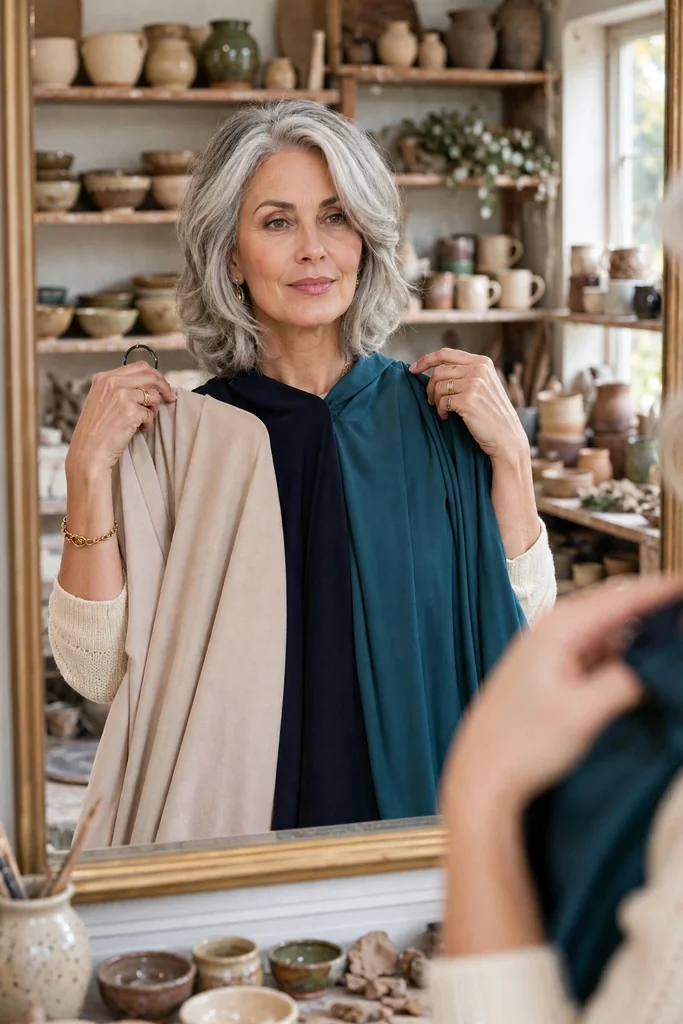
As pigment leaves the hair, the quiet balance between your hair, skin, eyes and clothes tends to shift. A beige sweater you always reached for, or a pale grey blouse that used to behave, can suddenly sit oddly — through no fault of the garment itself.
Silver is not one thing: bright silver, soft pewter, icy white, deep charcoal, or a blend of several at once. Your eyes and skin carry equal weight in the decision, which is why no universal palette exists for every woman with grey hair. A woman with bright white hair and fair skin faces a different puzzle than a woman with dark salt-and-pepper and olive skin — same silver story, different contrast math.
What counts most is contrast — enough of it, and grey hair reads as a choice, luminous and deliberate; too little, and hair, skin and clothing melt into one soft blur.
Use this as your starting point for choosing what belongs close to your face.
| When a Shade Acts Like This | What to Wear Instead |
|---|---|
| When pale beige drains your color | Deeper oatmeal, camel, warm taupe, or mushroom |
| When pale grey vanishes next to your hair | Graphite, charcoal, navy, or slate blue |
| When black lands too hard | Soft charcoal, ink navy, espresso, or deep plum |
| When pastels fall flat | Stronger, clearer takes — lavender, aqua, soft coral |
| When a bright shade is more than you want | Move it to a scarf, blouse, shoes, or bag |
Nobody is asking you to give up soft colors. The point is keeping daylight between hair, skin and clothing, so your features don’t dissolve into the outfit.
Jewel Tones: Grey Hair’s Most Reliable Friends
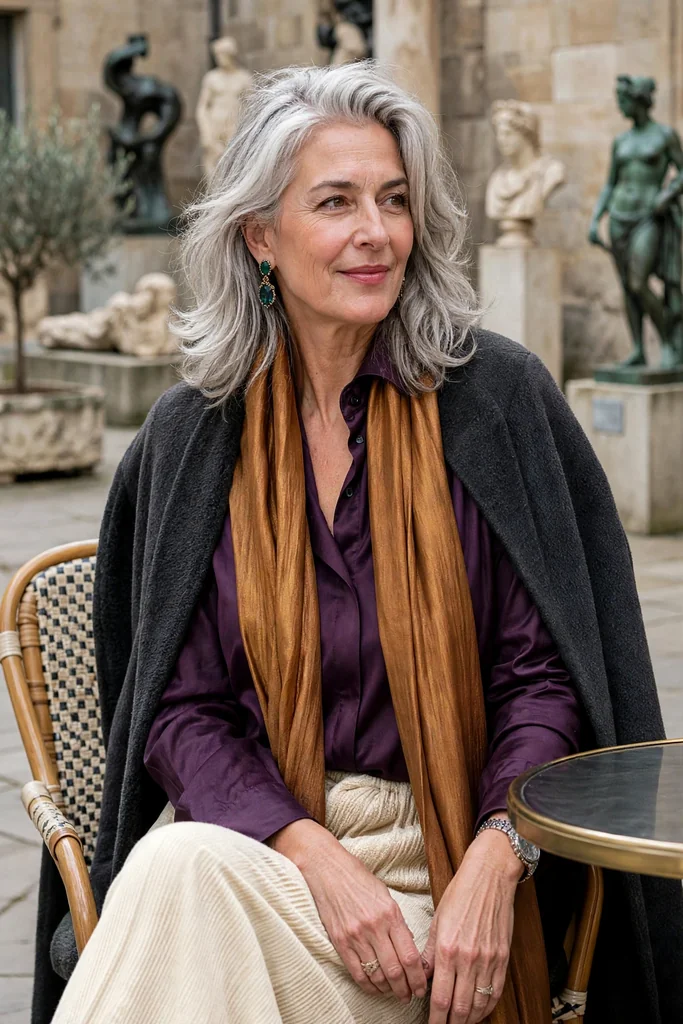
Few shades flatter silver hair as effortlessly as jewel tones do — they draw a clean line of contrast around the face and ask for almost nothing else in return.
Sapphire blue and emerald green both sit beautifully against silver hair. Raspberry, burgundy, plum, teal and deep violet belong to the same dependable family — shades with enough gravity to frame the face while staying unmistakably refined.
Picture a sapphire knit over straight-leg trousers: the outline it draws around silver hair is far crisper than anything a faded blue-grey sweater could manage.
And you don’t need a special occasion for them: a deep teal tee with jeans works as hard on a Tuesday as it does at dinner.
When you’re planning everyday outfits for women over 50, a single rich shade usually does the heavy lifting — no need to stack several strong colors.
A few pairings worth trying:
- Dark jeans and loafers under an emerald blouse.
- Charcoal trousers and simple flats with a raspberry knit.
- Cream jeans, tan accessories and a deep teal shirt.
- A plum cardigan over a white tee with navy trousers.
Color note: If jewel tones in full saturation feel like too much, softer takes still work — muted teal, petrol blue, aubergine and dusty berry all keep their contrast without raising the volume.
Neutrals With Real Depth (Not the Ones You Wore at 40)
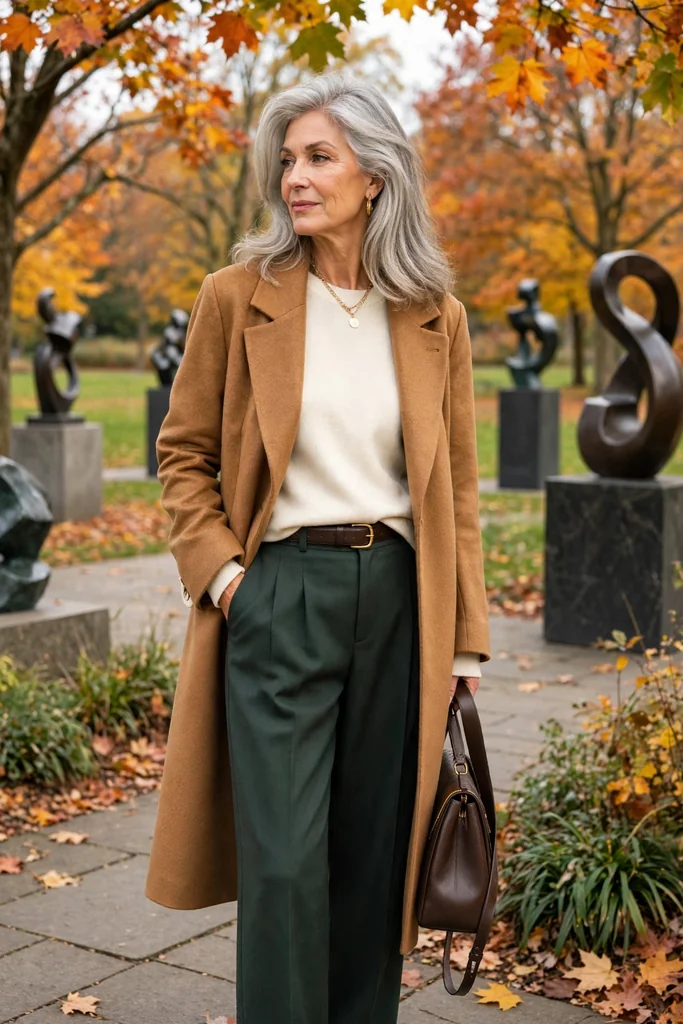
Neutrals earn their place even faster once grey enters the picture — but the neutrals that served you at forty may not be the ones serving you now.
Soft white with no yellow cast almost always looks fresher than ivory. Navy near the face reads gentler than flat black, and charcoal can be lovely precisely because it echoes the hair while still giving the outfit its edges.
Camel, chocolate, mushroom, taupe and stone all deserve a second look — the real test is whether the shade stands apart from both your hair and your skin.
Even a wardrobe built on neutrals turns out stylish outfits for women over 50 once texture and tone-on-tone shifts carry the interest.
For foundation shades, this little chart does the thinking for you.
| Neutral Shade | What to Choose | Why It Flatters |
|---|---|---|
| Navy | Saturated, true navy instead of worn-out blue | Outlines silver hair minus black’s hard edge |
| Charcoal | Graphite in medium-to-dark depths | Mirrors grey hair while holding contrast |
| Soft white | Bright cream free of strong yellow | Opens up the face |
| Camel | Full-bodied tan instead of thin beige | Lends warmth plus shape |
| Chocolate | Profound brown with genuine depth | Black’s gentler stand-in |
| Mushroom | Even blend of grey and brown | Sits happily beside denim, burgundy, navy and cream |
Try the chin test: press the garment right below your chin in natural light. If your eyes and skin look clearer before the fabric itself grabs your attention, you’ve found a helper. Run the same test on prints and patterns — a busy print in the right depth can behave like a solid.
Let Blues, Greens and Purples Do the Heavy Lifting for Your Face

Few color families serve grey hair as faithfully as blue, simply because it arrives in so many depths.
Cobalt pops against bright silver; denim blue handles casual days; navy brings structure; and a soft cornflower blue suits the moments you want to stay quiet.
When you’re shopping, hold the blue against a true white card first: the comparison exposes undertones a store mirror hides.
Green covers similar ground — forest green sits grounded, emerald reads crisp, and a blue-green teal steps in when straight green feels like too much.
Don’t skip purple either: lavender, orchid, aubergine and plum can all wake up grey hair without tipping into sugary.
The common thread is clarity — shades that look a touch cleaner and less muddy tend to sharpen the outline of the face.
Try this: Pull three similar-colored tops from your closet and line them up beside a window, judging one at a time and ignoring size or cut entirely.
See which top makes your eyes read brighter — and which one pulls the eye toward shadow or redness first. That small side-by-side test beats any seasonal color chart.
Berry, Rose and Warm Reds Without Any Fussiness

Silver hair is no sentence to an all-cool wardrobe — warmth flatters beautifully when the shade itself is right.
A berry, raspberry, rose, brick red, wine or soft coral top puts color right where the face needs it, minus any shouting.
A pure orange-red can shout on some complexions, where a deeper tomato or brick red sits far more comfortably; and where pale blush vanishes, dusty rose usually holds its ground.
Lipstick, scarves and earrings are your low-commitment laboratory — no new wardrobe required to test a shade. A berry lipstick is the cheapest experiment of all — ten minutes at the counter, and the mirror gives you the verdict.
When a berry sweater goes over the top, try the shade as a scarf against a navy coat instead. And if coral lights up your face but a full coral blouse goes too far, let the shade live in your handbag or shoes.
That’s exactly why a capsule wardrobe over 50 anchored in strong neutrals pays off: color can drift in and out without disturbing the base.
Giving Beige, Grey and Faint Pastels a Little Extra Thought
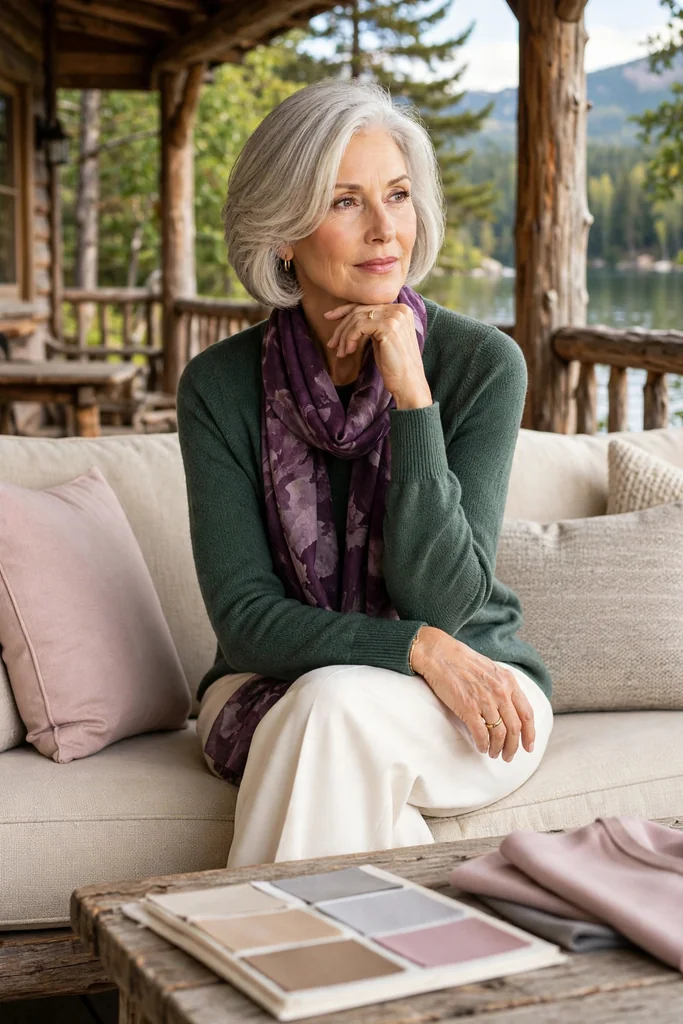
The tricky shades aren’t ‘wrong’ for grey hair — they’re tricky because they leave almost no daylight between your hair, your skin and your clothes.
An outfit whose top half lives entirely in pale beige, washed-out taupe, dusty grey or watery pastels can fall flat in a single glance.
None of that means retiring them.
Layer a beige coat over a navy turtleneck and the combination sings. Set a pale grey sweater next to a berry scarf and it comes alive — and a washed-out pastel blouse sharpens up with a stronger lip color or a deeper jacket.
A better mental model for these shades:
| The Old Thinking | The Better Move |
|---|---|
| Giving up beige entirely once hair turns grey | Keep beige but ground it — navy, berry, chocolate, or a lower neckline layer underneath |
| Treating black as the only truly flattering neutral | Line black up beside navy, charcoal, plum, and espresso and judge for yourself |
| Writing pastels off as unflattering | Pick punchier pastels, or frame the face with a deeper layer |
| Dressing only in cool tones from now on | Judge warm and cool options side by side on your own skin |
| Retiring a beloved color because it ‘stopped working’ | Give it a second chance at a deeper, clearer or softer depth |
This is the freeing part of styling grey hair: you’re tuning placement and depth, not exiling colors from your closet. Keep a ‘maybe’ pile for these shades instead of a ‘never’ pile — most of them only ever needed better company.
A Simple Shade Formula for Everyday Mornings
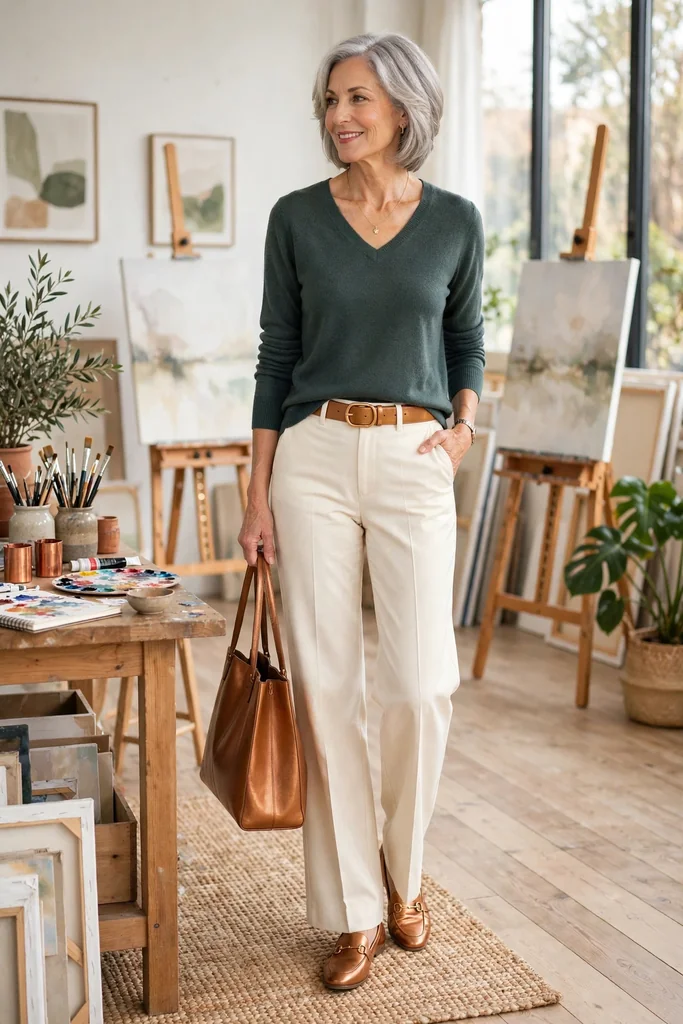
A go-to color formula takes most of the guesswork out of mornings.
Your easy formula: one dependable neutral + a face-flattering color + a quiet final touch
See it in action: navy trousers with a raspberry knit and burgundy loafers — or cream jeans with a teal blouse and camel flats.
For low-key days, try charcoal trousers, a soft white shirt and a plum cardigan — same formula, softer mood.
The trick is balance: a steadying neutral underneath, with the brighter shade up by your face giving silver hair its frame.
Snap the outfit in daylight before you head out — a phone photo catches flatness your mirror forgives.
Run the same formula for casual outfits for women over 50 — straight-leg jeans under a cobalt knit with white sneakers looks easygoing, never sloppy.
More color was never the point — it’s about putting the right amount exactly where it lands hardest.
FAQs
Which shades flatter grey hair most reliably?
Is black still an option with grey hair?
Should I stick to cool colors, or do warm ones work too?
Are there any colors I need to ban from my wardrobe?
What’s the easiest way to start wearing more color?
Keep the Color Story That Still Feels Like Yours

Grey hair doesn’t demand a whole new wardrobe — it just invites a second look at contrast, at depth, and at everything sitting near your face.
The most rewarding dressing over 50 never came from rigid color rules — it comes from noticing how your skin, eyes, hair and clothes cooperate.
Try one small experiment this week: hold three colors you already own up to daylight, and keep choosing the shade that makes you stand out before the outfit does. Your grey didn’t arrive overnight, and your palette doesn’t have to change overnight either.