
How to Wear Statement Jewelry Over 50 Without Going Overboard

A striking piece of jewelry can pull an everyday outfit together in seconds, yet it is remarkably easy to talk yourself out of wearing one. A dramatic necklace, oversized earrings, or a sculptural cuff can look perfect on its own, and then suddenly feel like too much the moment the full outfit comes together in the mirror.
For plenty of women over 50, the real difficulty is not a wish to fade into plain basics. It is landing in that comfortable sweet spot between memorable and overloaded — especially when necklines, hairstyles, glasses, prints, and a changing silhouette are all asking for attention at once.
The encouraging news is that dressing over 50 never meant shrinking your jewelry box down to timid little studs. It simply means learning how to hand your statement piece the space it needs to do its job well.
Pick One Piece to Be the Star

The simplest route to wearing bold jewelry beautifully is deciding, before you leave the house, what you want people to notice first. Every outfit benefits from a focal point, and dramatic jewelry performs at its best when it is allowed to become that focal point rather than fighting three or four others for the spotlight.
Choose a pair of grand earrings, for instance, and you probably do not need a showstopping necklace alongside them. A sculptural cuff tends to look far more powerful next to understated studs than it does crowded among stacked bracelets, cocktail rings, dangling earrings, and a chunky necklace all carrying the same visual volume.
None of this means you are limited to a single piece of jewelry per outfit. The real skill is pairing one commanding piece with quieter companions that know their place.
A bold pendant can sit very happily beside small hoops and a slim watch. Oversized earrings often love the company of a delicate chain. It is the contrast in scale that makes the whole combination look deliberate rather than accidental.
This quick reference shows how to keep the hierarchy clear.
| Your Star Piece | Soften Everything Else | Why It Works |
|---|---|---|
| Large chandelier earrings | Necklace and hair accessories | Keeps the focus around the face without crowding it |
| Chunky collar necklace | Earrings and busy necklines | Hands the necklace a clean, uncluttered stage |
| Wide sculptural cuff | Other bracelets and rings | Stops the wrist from looking visually top-heavy |
| Oversized cocktail ring | Bracelets on the same hand | Lets the ring stay the undisputed center of attention |
| Layered statement necklaces | Earrings | Avoids piling detail around the face and throat |
The goal was never minimalism for minimalism’s sake. It is visual hierarchy. Once your eye knows exactly where to land, even the boldest accessory can read as calm, confident, and completely sophisticated.
✦ The Hierarchy Cheat Sheet
One hero. Pick the single piece you want noticed — earrings, necklace, cuff, or ring.
One quiet partner. Add a second piece at half the visual volume, like small studs or a slim chain.
Everything else rests. If a third piece starts competing, it is the one to remove.
Give Your Jewelry Breathing Room

Statement jewelry needs air around it to look intentional. That matters most with necklaces, because the neckline of your top or dress becomes the frame the piece sits inside.
A generous necklace usually looks wonderful against a tidy crew neck, an open shirt collar, a simple V-neck, or a plain scoop. The quieter the neckline, the more clearly the jewelry’s shape can be appreciated — and the more expensive it tends to look.
Decorative details such as ruffles, bows, dense embroidery, lace insets, or fussy collars can end up wrestling with a large necklace for attention. If you adore both, there is no need to sacrifice either one.
You may simply discover that dramatic earrings suit the detailed blouse better, while the necklace waits for a calmer top. It is a small swap that changes everything.
Necklace placement tip: Notice where a necklace finishes. A pendant that lands inside an open neckline generally looks more woven into the outfit than one that awkwardly straddles the fabric’s edge.
Jewelry should also suit your frame rather than obey some rule about age. If delicate pieces seem to vanish on you, try a touch more scale. If very heavy designs feel tiring or overwhelming, hunt for larger shapes crafted from featherweight materials.
That sense of proportion is one of the most useful principles in dressing over 50: choose the scale that feels natural on your body, not the scale someone else insists you should wear.
Let Simple Clothes Be the Perfect Canvas

One of the loveliest things about statement jewelry is how it can make familiar basics feel brand new again.
A white button-down, a dark knit, an uncomplicated dress, a fine sweater, or a plain blazer hands bold jewelry a spotless canvas. Rather than buying a complicated outfit for every lunch, dinner, or celebration, you can shift the entire mood with accessories alone.
A black knit dress paired with gold sculptural earrings tells a completely different story than the same dress worn with a long colorful pendant. A white shirt and jeans travel effortlessly from errands to lunch once you add a cuff, loafers, and earrings with a little presence.
This is exactly where statement jewelry earns its keep inside a capsule wardrobe. It lends simple clothing endless variety without demanding dozens of extra garments.
Try these pairings when you want a reliable starting point:
- A crisp shirt + straight-leg jeans + sweeping earrings
- A fine knit + tailored trousers + a sculptural necklace
- An easy midi dress + a cuff bracelet + tiny studs
- A blazer + a plain T-shirt + a pendant necklace
- A monochrome outfit + one jewel-toned piece of jewelry
For stylish outfits for women over 50, the detail people remember is often not the clothing at all. A strong accessory can lend otherwise quiet pieces real personality.
Balance Jewelry Weight With Fabric Weight

Jewelry carries visual weight just as clothing does. A thick resin bangle reads stronger than a whisper-fine chain; a broad metal collar necklace feels heavier than a small pendant resting on a thread.
Your clothes follow the same logic. A chunky knit, a structured blazer, a leather jacket, or a dense wool coat carries far more visual weight than a fine cotton shirt or a soft, silk-like blouse.
Lining those levels up — loosely, not rigidly — is what makes an outfit feel settled.
Before you reach for jewelry, glance at the fabric and structure of what you are wearing. This guide makes the pairing almost automatic.
| Fabric | Jewelry to Try | The Logic |
|---|---|---|
| Fine knit or soft blouse | Medium pendant or earrings | Adds interest without swamping delicate fabric |
| Crisp cotton shirt | Bold earrings or sculptural necklace | Clean structure can carry a stronger accessory |
| Chunky sweater | Substantial earrings or a cuff | Tiny pieces can disappear beside heavy texture |
| Tailored blazer | Graphic brooch, cuff, or geometric earrings | Sharp lines flatter sharp lines |
| Floaty dress | Organic shapes or airy statement pieces | Keeps the outfit’s movement and softness intact |
You do not need to match everything with scientific precision. Think of it as a visual conversation: your jewelry should feel weighty enough to belong with the clothing, rather than looking lost or faintly disconnected beside it.
Use Color to Make Bold Jewelry Feel Easy

Statement jewelry does not have to mean loud color. Scale, silhouette, texture, and shine can all create drama entirely on their own.
If bold pieces make you a little nervous, begin with a shade that already lives in your wardrobe. Gold, silver, tortoiseshell brown, black, cream, deep green, or warm amber can feel striking without turning difficult to coordinate.
A single-color outfit is especially handy when you want to wear colorful jewelry. Navy beside turquoise tones, cream with warm metallics, or black with a rich red accessory gives the eye one clear point of contrast to enjoy.
When your clothing already holds several colors, try echoing one shade from the fabric in your jewelry instead of introducing yet another competing hue.
Color shortcut: Matching jewelry to your clothes exactly is rarely necessary. Repeating the general warmth or coolness often looks more relaxed and modern.
Warm browns, rust, olive, and cream tend to sit comfortably beside warmer metals, while charcoal, navy, icy blue, and black can look crisp against cooler metallic tones.
Treat these as starting points, never rules. If silver looks glorious with your warm-toned blouse, wear the silver.
Let Prints and Jewelry Share the Spotlight
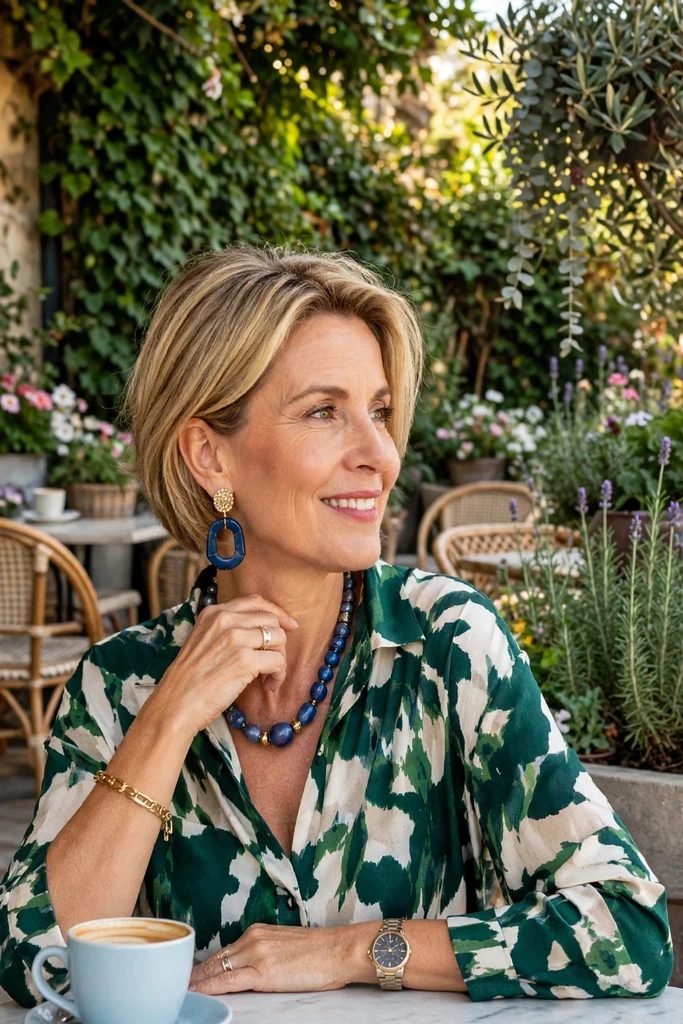
Prints do not automatically disqualify bold jewelry. The real question is always visual competition.
A large graphic print already brings plenty of movement. Adding equally intricate jewelry can leave the eye unsure what matters most. In that situation, cleaner jewelry shapes usually win over fussy, detailed pieces.
A small, evenly repeated print, on the other hand, can sometimes carry a substantial necklace or a strong pair of earrings beautifully.
When something feels slightly off in the mirror, changing just one element is usually all it takes.
This old-rule-versus-new-approach guide helps when an outfit starts feeling busy.
| The Old Rule | The Fresher Take |
|---|---|
| Never wear statement jewelry with prints | Pair busy prints with simple jewelry shapes |
| Bold earrings mean no other jewelry | Add quiet pieces that stay out of the way |
| Older women should wear delicate jewelry | Choose the scale that flatters your features |
| Metals must always match | Mix deliberately, repeating one metal elsewhere |
| Large jewelry is only for evenings | Set it against simple daytime basics for contrast |
This gentler approach leaves plenty of room for personality. Dressing over 50 gets so much easier when you stop treating style as a list of prohibitions and start thinking in terms of proportion and balance instead.
The Mistakes That Make Jewelry Feel Overdone

Most overloaded outfits do not suffer from one dramatic flaw. They simply have too many strong details all trying to lead at the same time.
A few easy adjustments usually fix everything:
- Too many oversized pieces at once: Keep your favorite statement and shrink the scale of everything else.
- An ornate neckline with a heavy necklace: Switch to earrings, a cuff, or a ring instead, so the neckline can breathe.
- Loud jewelry over loud prints: Choose a calmer jewelry shape or echo one color from the print.
- Shine from head to toe: Set gleaming jewelry against matte fabrics like denim, cotton, linen blends, or soft knits.
Comfort counts too. Heavy earrings that ache after twenty minutes, or a necklace that demands constant fiddling, will never become the pieces you instinctively reach for.
Weightless comfort tip: Look for hollow metal, resin, wood, fabric-covered beads, or other featherlight materials whenever you want generous scale without the strain.
✦ The 10-Second Mirror Check
Count the heroes. More than one dominant piece? Quiet one down.
Check the neckline. Busy collar plus bold necklace is a crowd — pick a lane.
Move your head. If anything swings, pinches, or needs adjusting, it stays home.
A Foolproof Jewelry Formula Worth Memorizing
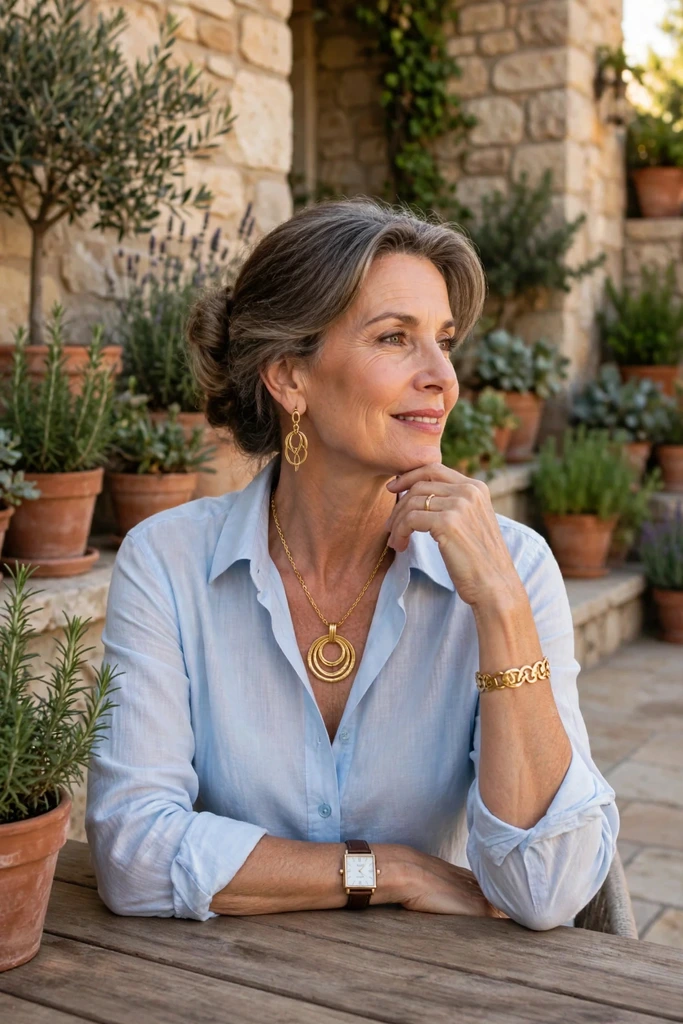
When you are standing in front of the mirror, unsure whether the outfit needs more or less, fall back on one dependable formula.
Formula: calm base + one hero jewelry piece + one quiet finisher
That could look like dark trousers, a cream knit, sculptural earrings, and a slim watch. Or straight jeans, a white shirt, a bold pendant, and small studs.
The clothing supplies calm structure, the statement piece brings personality, and the smaller accessory keeps the outfit from feeling unfinished.
The same formula adapts easily across your week, too.
A statement necklace can join a knit and trousers for dinner, while large earrings might make a T-shirt and jeans feel noticeably more pulled together for lunch. The pieces rotate; the formula never changes.