
Old Money Style After 50 — Without the Old Money Price Tag
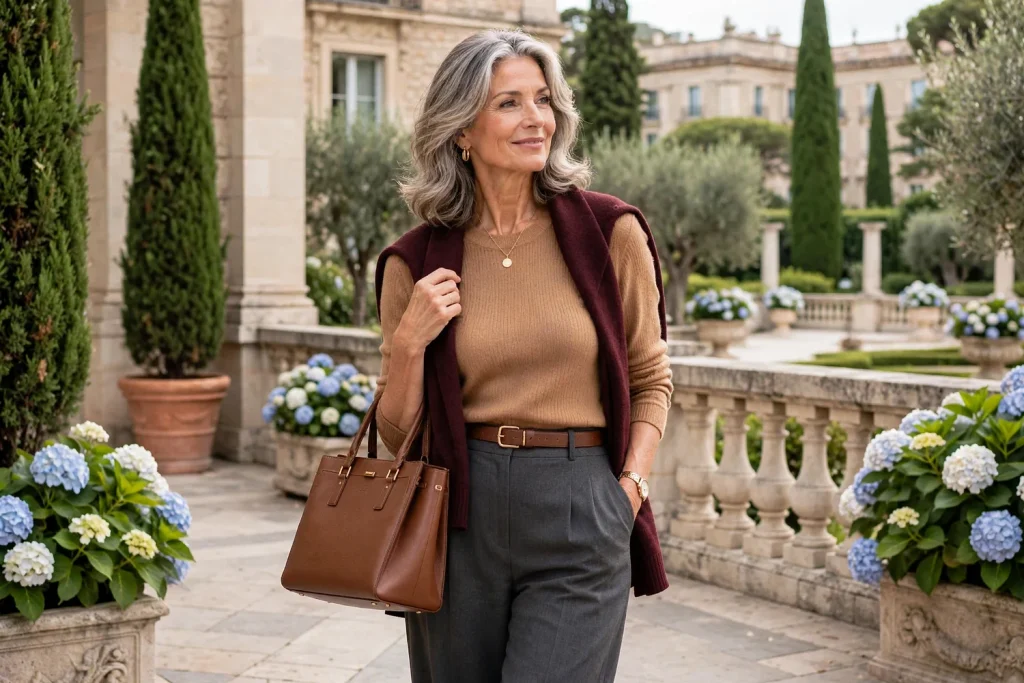
The old money look may read as expensive, but the bill is rarely what makes the outfit succeed. What actually carries it is cleaner than that: uncluttered lines, a disciplined color story, fabric with real body, and garments that fit without tugging, drooping, or looking overworked.
That distinction gets blurry on social media, where the aesthetic arrives packaged as cashmere overcoats, designer loafers, and closets that seem to run on an endless budget.
After 50, the smarter route is far more grounded. You can put together elegant outfits for women over 50 from straightforward trousers, knitwear, shirts, jackets, and accessories that may already be hanging in your wardrobe.
Looking rich is not the point. The point is clothes that read as thoughtful, serene, and beautifully finished — without spending beyond what makes sense for your life.
Old Money Dressing Is Really About Restraint, Not Labels
The words “old money” tend to summon images of country clubs, nipped-in coats, silk squares, penny loafers, and soft neutrals. But copying those items piece by piece can slide quickly into costume.
What sells the look is discipline.
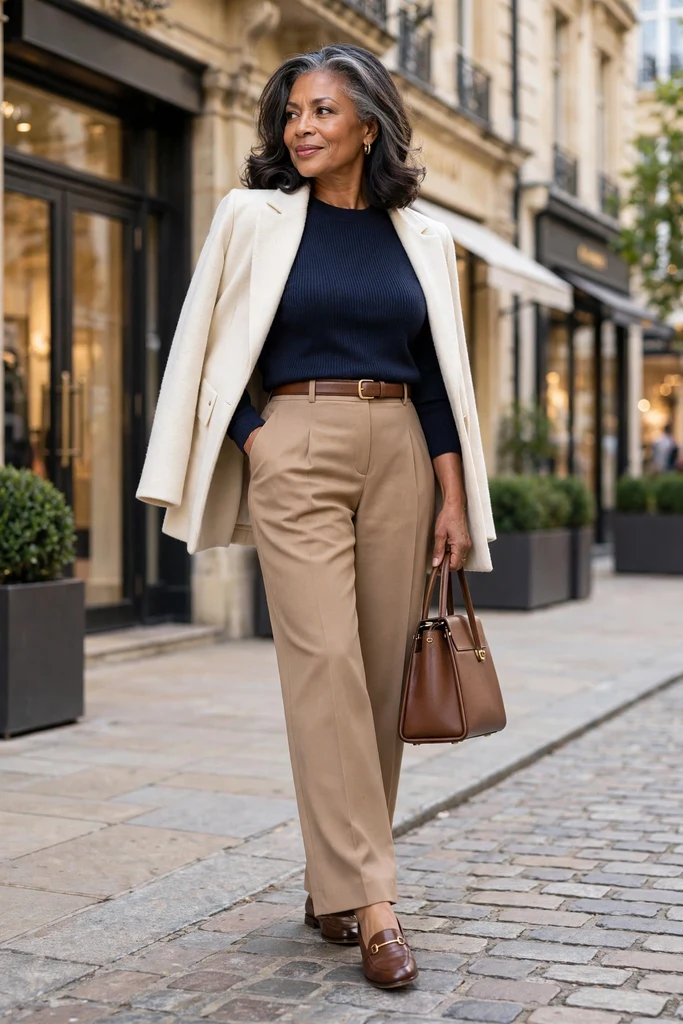
A convincing outfit usually works with a tight color palette, unfussy proportions, barely any visible branding, and one or two details that feel chosen on purpose. Nothing is shouting for the spotlight.
A cream sweater with navy trousers frequently looks more expensive than a pricey logo-covered top, because the eye registers silhouette, texture, and balance long before it registers a brand name.
That is good news on a sensible budget. Swap the question “Does this look pricey?” for “Is anything here distracting, ill-fitting, or simply unnecessary?”
That mental shift costs nothing at all.
Start With What’s Already in Your Closet
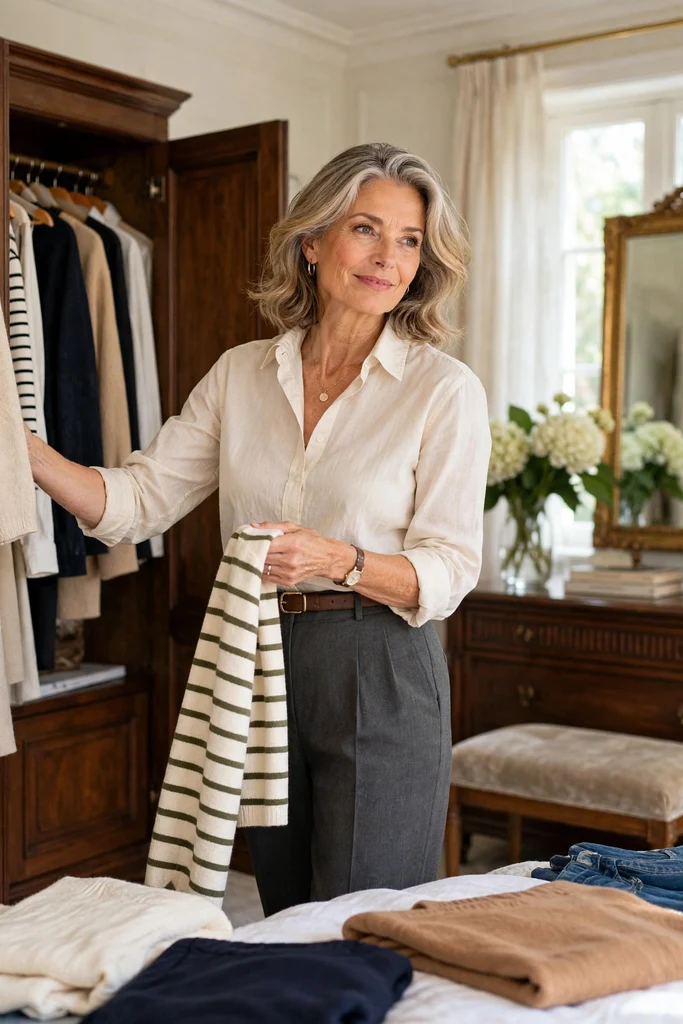
Before you buy a single thing, pull out the pieces you own that already speak this language, such as:
- straight or gently wide trousers
- dark straight-leg jeans
- crisp cotton or cotton-blend shirts
- fine-gauge sweaters
- unfussy cardigans
- blazers with a neat shoulder line
- trench coats or wool-look coats
- loafers, ballet flats, ankle boots, or clean leather sneakers
You don’t need the full traditional “old money” checklist. You need enough pieces that play well together without generating visual noise.
Fabric Matters More Than the Name on the Label
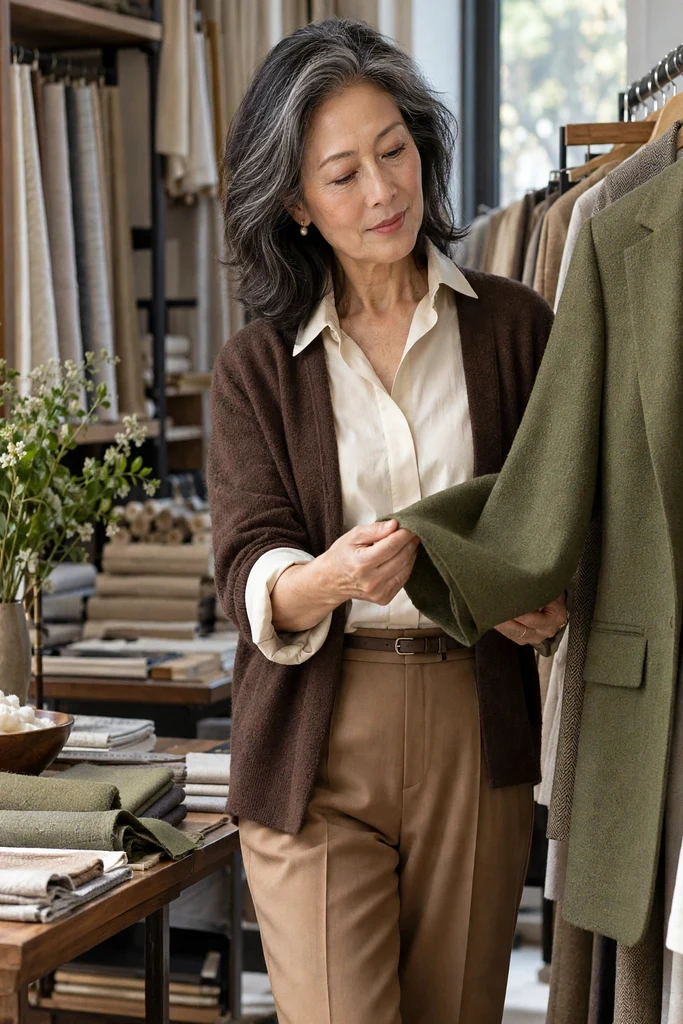
Inexpensive clothing can read as refined when the cloth hangs properly. Costly clothing can disappoint when the material creases badly, turns shiny in daylight, or grips in the wrong places.
Texture deserves your attention.
Cotton poplin, linen blends, fine knits, twill, ponte, wool blends, suede-like surfaces, and weighty denim generally suit this aesthetic because they carry enough structure to hold a clean line.
Very flimsy cloth is trickier to manage, since it can telegraph every seam beneath it. Ultra-glossy polyester can push a simple garment toward evening territory rather than quiet polish.
There is no need to ban synthetics. Plenty of practical blends wear beautifully. Judge the actual cloth in front of you instead of ruling by the fiber content on the tag.
This quick reference helps when you’re weighing two pieces against each other.
| Fabric | What to Check | Why It Flatters |
|---|---|---|
| Cotton poplin | Smooth surface with enough weight to hold its shape | Keeps shirts looking crisp instead of limp |
| Fine or medium knit | Dense weave with no obvious stretching | Lies neatly under jackets and coats |
| Ponte | Firm stretch with strong recovery | Gives trousers and dresses a smoother line |
| Linen blend | Soft texture that wrinkles less aggressively | Adds richness without looking too formal |
| Denim | Medium or heavier weight with a clean wash | Makes casual outfits feel more structured |
| Wool blend | Soft surface with enough body to drape | Helps coats, trousers, and jackets keep their shape |
Fabric Note
Check garments in daylight whenever you can. A cloth that looks matte under fitting-room lighting can appear far shinier once you step outside.
Fit Should Feel Relaxed, Never Accidental
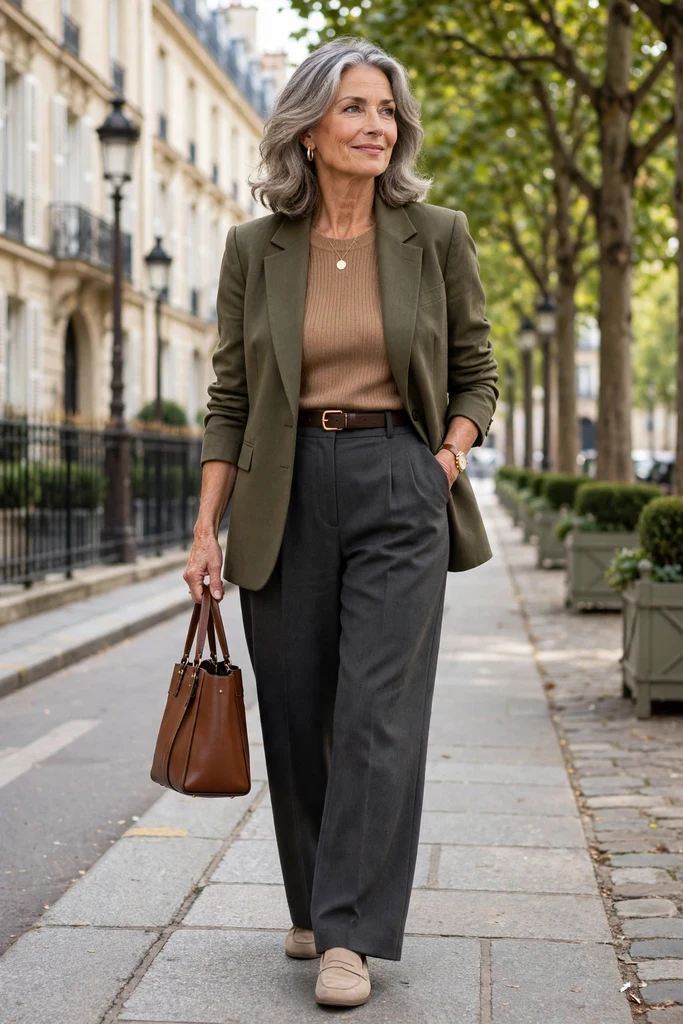
Old money dressing is rarely body-hugging, but it is never shapeless either.
The word to hold onto is controlled.
A trouser leg can be easy, yet the waistband must sit exactly where it should. A blazer can run slightly oversized, yet the shoulder should look deliberate. A knit can skim instead of cling without growing so large that your figure vanishes inside it.
This balance counts in dressing over 50, because plenty of women find that the proportions they loved years ago no longer feel quite right. That says nothing about your body needing correction.
Often a modest change in garment shape does the job.
Try a higher trouser rise if tucked tops keep looking odd. Pick a slightly shorter jacket if long blazers make your legs look shorter. Let a shirt glide over your torso rather than strain across the bust.
Tailoring can be surprisingly powerful on affordable clothes.
Shortening a sleeve, hemming trousers, or taking in a waistband can deliver more visible polish than replacing the garment entirely.
A Calm Palette: Cream, Navy, Camel, Chocolate and Black
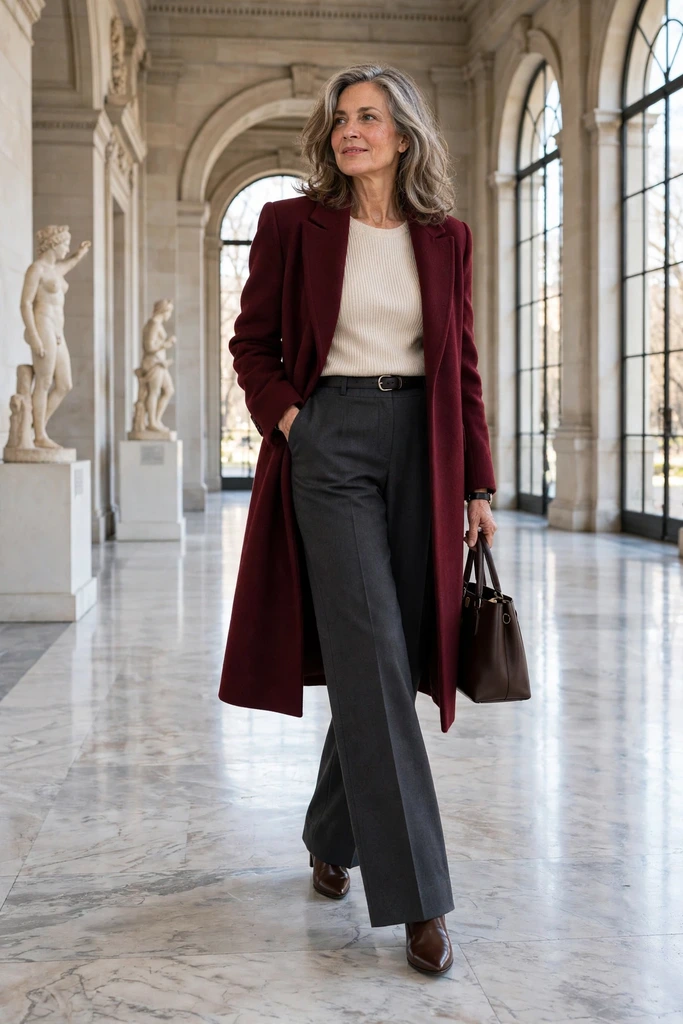
Nobody is asking you to wear beige from head to toe.
The old money look simply gets easier when most of an outfit stays inside one restrained color family.
Navy, cream, camel, chocolate, soft white, charcoal, olive, burgundy, black, pale blue, and muted grey all blend without effort. They also let cloth and proportion do the talking instead of leaning on loud ornament.
If those tones fight your complexion, shift them.
Trade cream for bright white. Swap camel for cool taupe. Take charcoal over brown. Try deep teal in place of navy.
The principle outweighs the exact swatches.
One of the simplest routes to chic outfits for women over 50 is echoing a color somewhere in the look. A chocolate belt with chocolate loafers, say, gives the eye a sense of order without tipping into matchy-matchy.
Here is how a few plain foundations can shift with the occasion.
| Foundation | Easy Day | Lunch or Appointments | Evening Out |
|---|---|---|---|
| Navy trousers | White tee plus cardigan | Blue shirt with loafers | Fine knit and simple earrings |
| Dark straight jeans | Knit with leather sneakers | Blazer over a striped top | Silk-look blouse and pointed flats |
| Cream knit | Jeans with loafers | Camel trousers and belt | Black trousers and a small clutch |
| White shirt | Jeans with a cardigan | Tailored trousers and flats | Dark skirt with delicate jewelry |
The clothes stay familiar. Only the supporting cast changes the mood.
Quiet Accessories Make Simple Outfits Look Considered
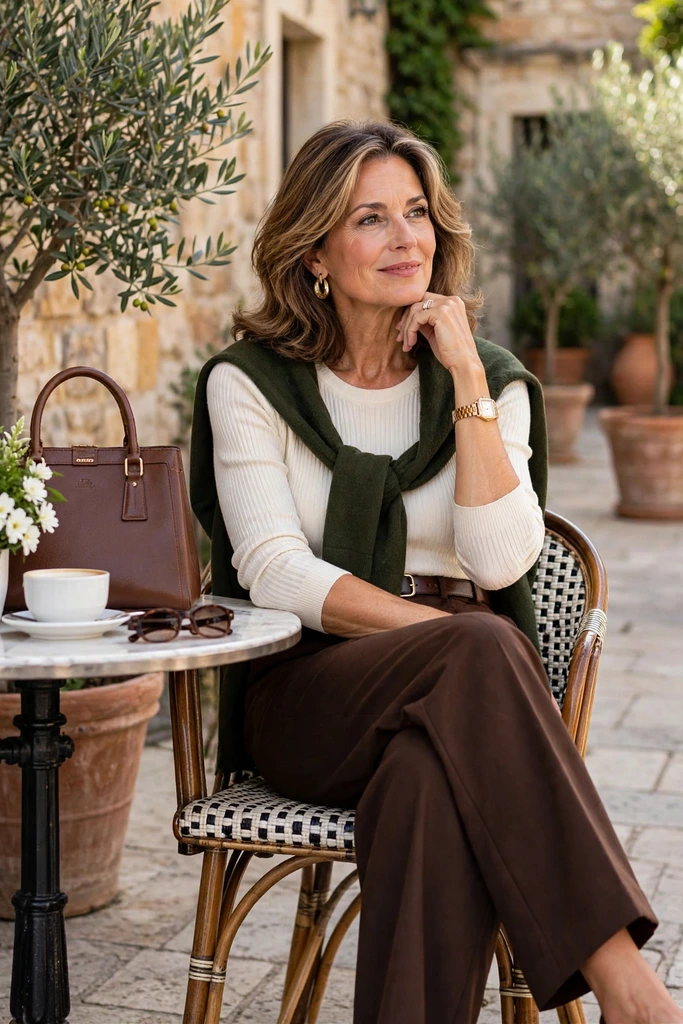
Accessories are where this look either becomes believable or starts tipping into costume.
You do not need pearls, a silk scarf, a structured handbag, gold earrings, loafers, a watch, and sunglasses all in one outing.
Pick one or two.
A neat leather belt can shape trousers and link the top half of an outfit to the shoes. Small hoops or studs can make a plain knit feel complete. A structured bag can sharpen soft clothing.
Shoes deserve extra attention, because tired footwear can drag down an otherwise polished outfit.
That doesn’t mean the shoes must be pricey.
Look for a clean shape, quiet hardware, a neat sole, and a color you can wear on repeat. Dark brown, burgundy, black, navy, or warm tan usually mix further than heavily decorated options.
Comfort Upgrade
If classic loafers feel too stiff, try soft leather, padded flats, low-profile sneakers, or supportive loafers with a thicker sole. The outfit does not become less refined because you chose shoes you can actually walk in.
Skip the Details That Turn the Look Into a Costume
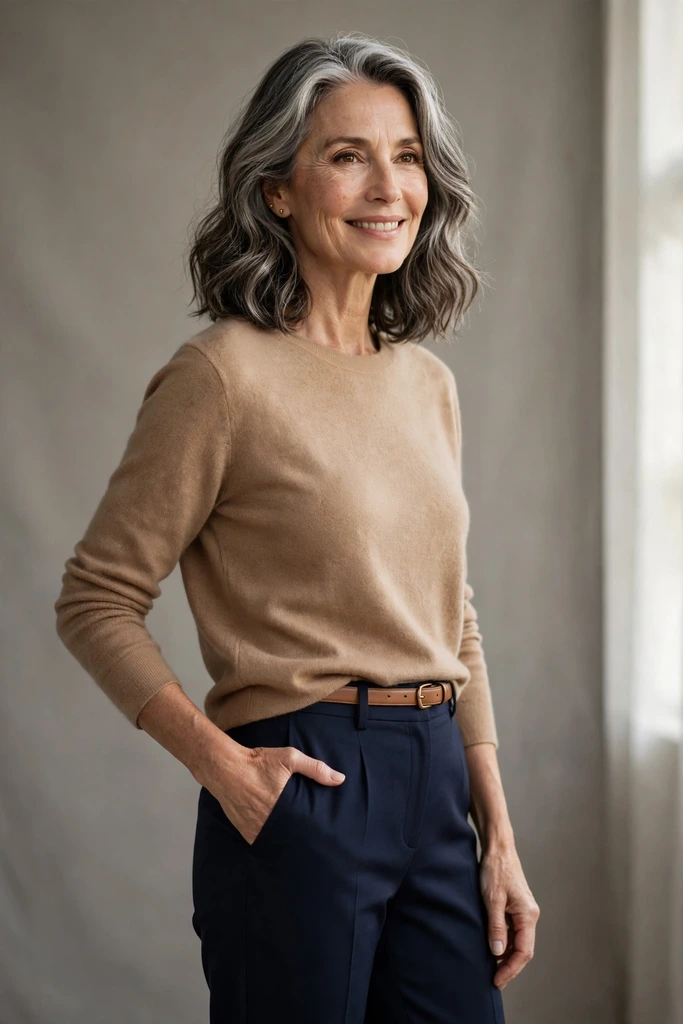
Trying too hard to broadcast “old money” usually backfires.
There is no need to copy every visual cliché. The strongest outfits borrow the tidy styling logic without turning it into a character part.
A few practical swaps:
| Instead of… | Try This |
|---|---|
| Stacking several heritage-style accessories at once | Keep one classic detail and simplify the rest |
| Buying obvious logo pieces to look costly | Put your attention on fit, fabric, and condition |
| Wearing oversized clothing head to toe | Balance one relaxed piece with something cleaner |
| Copying beige outfits that wash you out | Use neutrals that actually suit your coloring |
| Saving polished clothes only for special occasions | Wear your good trousers, knits, and loafers in normal life |
There is no requirement to make every outfit formal either.
A white tee with straight jeans, a camel cardigan, and clean loafers can carry the same restrained mood as a blazer with trousers.
That flexibility is gold for errands, travel days, coffee with friends, or easy lunches when you want to look pulled together without feeling overdressed.
Use One Repeatable Formula Instead of a Whole New Wardrobe
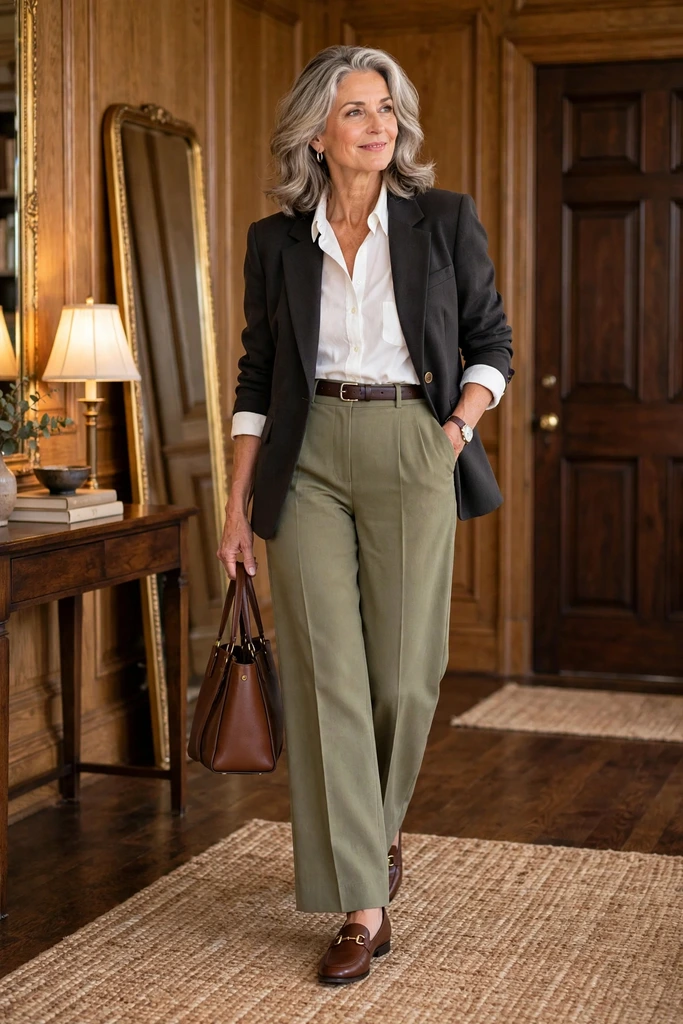
The most sustainable way into this style is to build yourself a personal uniform.
Formula: clean base + structured layer + refined shoe + one quiet accessory
In practice: straight trousers with a soft knit, a blazer or cardigan over the top, then loafers and simple earrings to finish.
The same formula relaxes with dark jeans and leather sneakers. It dresses up with tailored trousers, a fine-knit top, pointed flats, and a structured handbag.
These are the kinds of stylish outfits for women over 50 that succeed because the pieces back each other up instead of competing for attention.
You can also lean on three ready-made combinations for mornings when your brain refuses to style from scratch.
| Occasion | The Combination | Why It Works |
|---|---|---|
| Everyday errands | Dark jeans, striped knit, loafers, simple belt | A comfortable base with enough structure to feel finished |
| Lunch with friends | Tailored trousers, fine knit, cardigan, flats | Soft layers balance polish with comfort |
| Smart casual event | Dark trousers, white shirt, blazer, low heel | Crisp contrast creates a clean, confident line |
| Travel day | Straight trousers, tee, trench, leather sneakers | Practical pieces still share a controlled palette |
The formula outvalues any single item, because you can repeat it across different colors, textures, and layers.
Spend More Carefully, Not Necessarily More
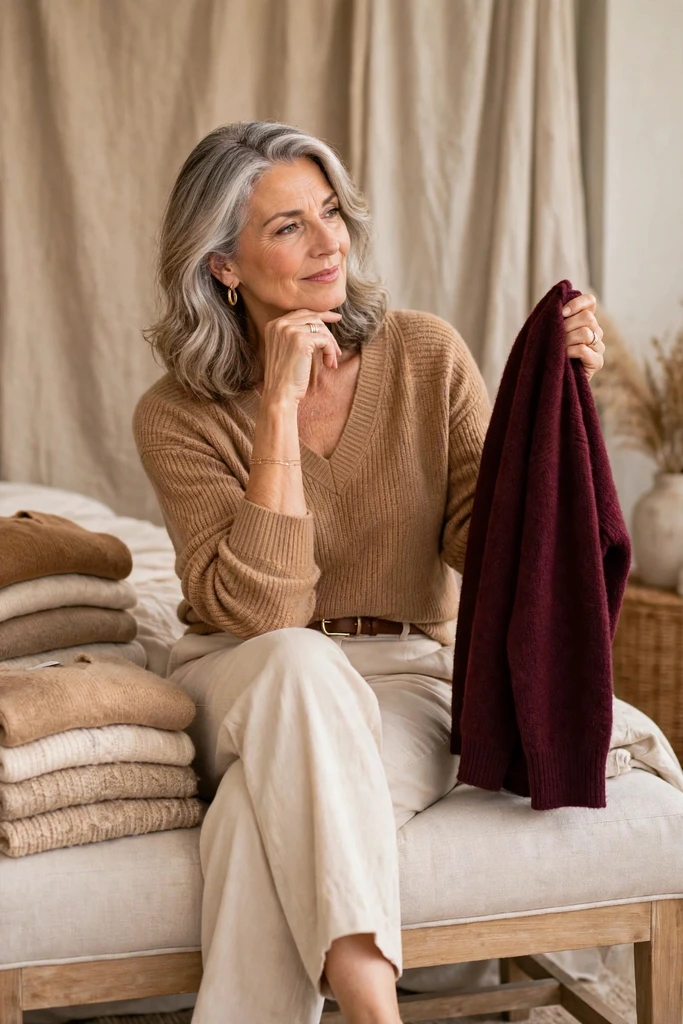
A polished wardrobe gets much easier when you stop treating each purchase as a standalone outfit.
Before buying, picture what it will team up with at home.
If a cardigan only works with one pair of trousers, it may earn little wear. If another cardigan pairs with jeans, trousers, dresses, and skirts, the second one likely delivers better cost-per-wear even at a slightly higher price.
Secondhand shops can be gold for blazers, wool coats, leather belts, silk scarves, and quality knitwear.
But condition beats the label every time.
Inspect for stretched cuffs, pilling, tired lining, worn heels, missing buttons, and set-in stains. A famous name won’t rescue a weary-looking garment.
It also helps to spend where fit is hardest for you.
If trousers are a struggle to find, put more budget there and economize on tees. If you live in outerwear for months each year, a good coat may deserve priority over another occasion dress.
That is how a wardrobe starts to feel personal instead of copied.
FAQs
Old money-inspired dressing usually centers on restrained colors, clean tailoring, good fabric, simple accessories, and classic shapes. After 50, it works best when you bend those ideas around your comfort, coloring, lifestyle, and the silhouettes you prefer — not when you copy a fixed uniform.
Yes. Begin by making your current clothes work harder together instead of replacing everything. Fit, steaming or pressing, simple color pairings, shoe condition, and considered accessories can transform an outfit’s impression without a big shopping budget.
No. Cloth needs to look and feel good, but it doesn’t have to cost a fortune. Cotton blends, ponte, substantial knits, linen blends, structured denim, and well-made synthetic blends can all look polished when the garment drapes well.
Yes. Choose a clean wash with minimal distressing and a cut that fits you well. Straight-leg, slim-straight, and gently wide-leg jeans pair especially well with shirts, fine knits, loafers, trench coats, and simple blazers.
Navy, cream, camel, brown, charcoal, olive, burgundy, white, pale blue, and black are easy starting points. You never need to wear shades that drain you — adjust the palette to your natural coloring while keeping the overall combination calm and coordinated.
Let Old Money Style Still Feel Like You
The best take on old money style after 50 is not about pretending to belong to another world. It is about borrowing the useful parts: good fit, calm color, considered fabric, neat shoes, and pieces that cooperate.
Keep what feels like you and release the rest.
Style confidence past 50 grows when getting dressed gets easier, not stricter. This week, try assembling one outfit from clothes you already own — fewer colors, a cleaner silhouette, one finishing detail.