
Why Clothes Stop Fitting Right After 50 — And How to Fix the Fit
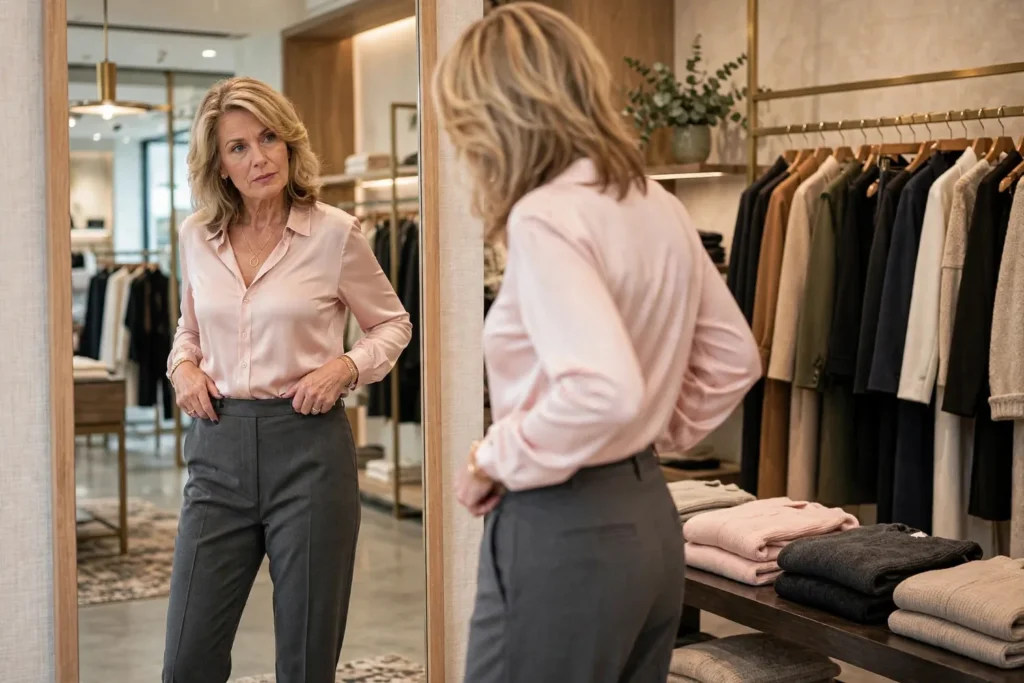
There is a special kind of fitting-room betrayal reserved for midlife: the trousers that worked last season now pinch at the waist while pooling at the thighs. Pieces that used to be your most reliable allies suddenly feel like they belong to someone else.
The instinct is to turn the blame inward — to decide your body has failed some invisible test and needs an overhaul. Mornings that once took five minutes turn into negotiations, and the dressing room starts to feel like disputed ground.
The truth is far less personal, and far easier to work with. After fifty, bodies redistribute weight and shift proportions, and almost no mass-market pattern was ever drafted with that shift in mind. The flaw is not in you — it is in the template.
Table of Contents
What Is Really Happening to Your Body After 50
Two forces are colliding behind your recent fit troubles, and neither is your fault: human biology and an industry that never updated its math. Once you move into your fifties, hormonal changes quietly relocate weight toward your middle and away from your arms and legs.
Here is the part nobody warns you about: the bathroom scale can sit perfectly still while your silhouette rearranges itself. You might weigh exactly what you did five years ago and still find your waistband tighter and your jackets pulling where they never pulled before.
At the same time, the garments on store racks are cut from “fit blocks” — the industry’s base patterns — modeled on women in their twenties, built around a sharply defined waist and an hourglass ideal. Grade that twenty-five-year-old template onto a fifty-five-year-old body and the arithmetic simply collapses. You are not the problem; the outdated template is.
Seeing it this way changes everything: you can stop hunting for a “better” body and start hunting for better construction.
It also helps to know two industry terms. A ‘fit block’ is the base pattern every size is built from, and ‘grading’ is how brands scale it up — usually by adding the same inches everywhere, as if bodies grew uniformly. They don’t. That is why the gap at your lower back and the pull at your waist arrive together: the grade assumed a shape you never had.
Fit formula: trousers — fit the hips, tailor the waist. Tops — fit the shoulders, adjust the body.
Remember: sizing up to fix one tight spot only creates two new loose ones.
Your Proportions Are Shifting Even When the Scale Isn’t
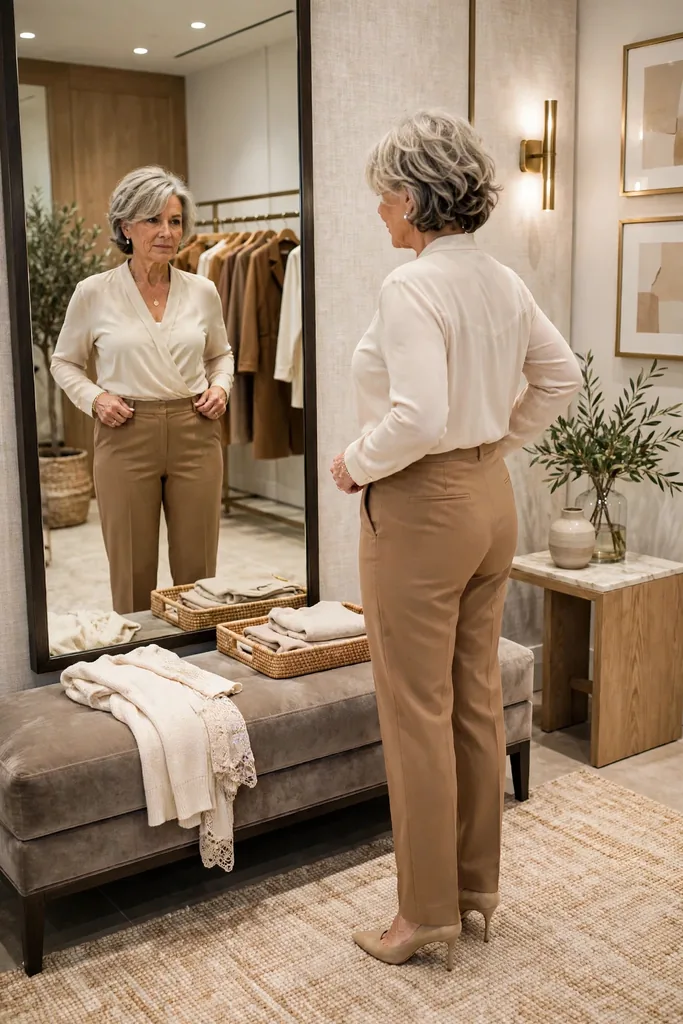
Ask a room of women over fifty and the top complaint is always trousers. Legs seem to grow slimmer while the waistline creeps outward — buy to clear your middle and the thighs and seat hang baggy; buy for the legs and the waistband digs in all day.
That changing waist-to-hip ratio is completely ordinary, but it calls for a different way of shopping. The cut that flattered you at forty was drafted for the proportions you had at forty.
A useful way to think about it: buy for the measurement that cannot be easily altered — hips and shoulders — and alter the parts that can. A waistband can be taken in for the price of a lunch; rebuilding shoulders costs more than the blazer.
So the first genuine fix is a mental one: stop dressing the body you remember and start dressing the body you live in. That single shift is what keeps you building stylish outfits for women over 50 that feel effortless instead of restrictive.
Here is how the old styling rules need to change:
Old Rules vs. What Works Now
Why Fabric and Construction Outweigh the Size Label

As your body shifts, unforgiving fabrics expose every disagreement between the garment and your shape. That crisp, heavy-cotton button-down that once skimmed your hips can start tugging at the waist or binding across the shoulders.
That does not condemn you to shapeless tunics or oversized sweats. It simply means your clothes need “give” — plus enough memory to hold a clean line from morning to evening.
Shop for textiles that flow over your frame rather than cage it. Even a whisper of stretch — one or two percent woven into a structured cloth — can transform how a garment behaves all day.
Learn to read the small print on the label. The percentage of elastane or spandex tells you how much forgiveness you are buying, and the weave tells you how it will behave — a tight twill holds, a loose plain weave drapes. And treat stretch kindly: wash cold, skip the hot dryer, and your ponte trousers will keep their shape years longer.
So when you are after pieces that genuinely flatter, rank the material above the number: pick cloth that cooperates with your body instead of fighting it.
Fabrics That Forgive: What to Buy and Why
Fabric checklist: run every candidate through three tests before it comes home.
The pinch test — stretch the fabric and let go; it should snap back, not stay stretched.
The sit test — sit down in the fitting room; the waistband must not dig when you bend.
The evening test — ask whether it will still look crisp at 6pm, not just at 9am.
What You Can Do About It Starting Today

The smartest answer to changing proportions is not a whole new wardrobe — it is a new strategy for buying and altering. You need a different method, not a different closet.
Give yourself a fitting-room system, too. Pull two sizes of anything promising, and run the sit-stand-walk test: sit down (waistband check), stand (hem and pull check), walk to the mirror (does it still look intentional from ten feet?). Anything that fails one test fails the purchase.
Three rules worth taping inside your closet door:
- Fit the fullest part first. If a blazer fits your shoulders but won’t button, buy it for the shoulders and wear it open.
- Make friends with a tailor. A simple waist or hem adjustment turns an inexpensive pair of trousers into something that looks custom-made.
- Ignore the number on the tag. Sizing is arbitrary and swings wildly between brands — snip the tags out the moment a piece comes home.
Putting together stylish outfits for women over 50 day after day comes down to honoring the body you have right now. Refuse to spend your days wrestling rigid clothes that fight back.
Keep this quick chart handy the next time something pinches, pulls, or gaps in the fitting room:
Fitting-Room Rescue: Problem, Fix, and What to Skip
Tailor talk: the three alterations worth every penny.
Waist suppression on trousers — the single most transformative cheap fix there is.
Hemming to the right break — trousers that end at the ankle bone instantly look intentional.
Taking in the back rise — erases the lower-back gap that plagues curvier fits.
Adapting Your Style to a Changing Shape

Adapting your style is not surrender — it is curation. The goal was never to dress twenty-five; it is to dress like yourself, today, on purpose.
Treat the next decade as an editing project: keep the silhouettes that still serve you, retire the rules that stopped working, and invest where fit pays the biggest dividends — trousers, blazers, and the fabrics that sit closest to your skin.
It also helps to settle on two or three repeatable ‘uniforms’ built for a shifting body: a wrap top with a straight trouser, an open blazer over a soft knit, a knit dress with a belt you can move. When the formula is decided in advance, getting dressed stops being a daily negotiation.
Style reset: three questions before anything new comes home.
Does it fit my fullest part? If yes, a tailor can handle the rest.
Does the fabric move with me? Sit, reach, bend — right there in the fitting room.
Will I wear it open or closed? Knowing the answer stops the “almost fits” pile from growing.
FAQs
Final Thoughts
Realizing your clothes no longer fit can sting, but it is not a failing on your part. Your body has carried you through decades of life — it deserves clothes that honor where it is today.
Learn how your proportions move, choose fabrics that move with you, and let a good tailor handle the rest. Dressing well after fifty is not about fighting your shape; it is about fitting it beautifully.
Start this week: pull three pieces you keep avoiding, name the exact fit problem each one has, and take the most salvageable to a tailor. Small, specific fixes beat another season of guessing.